Viggo Bjorck at 5-foot-9 topped the World Junior Championship as Sweden’s No. 1 center ahead of Anton Frondell.
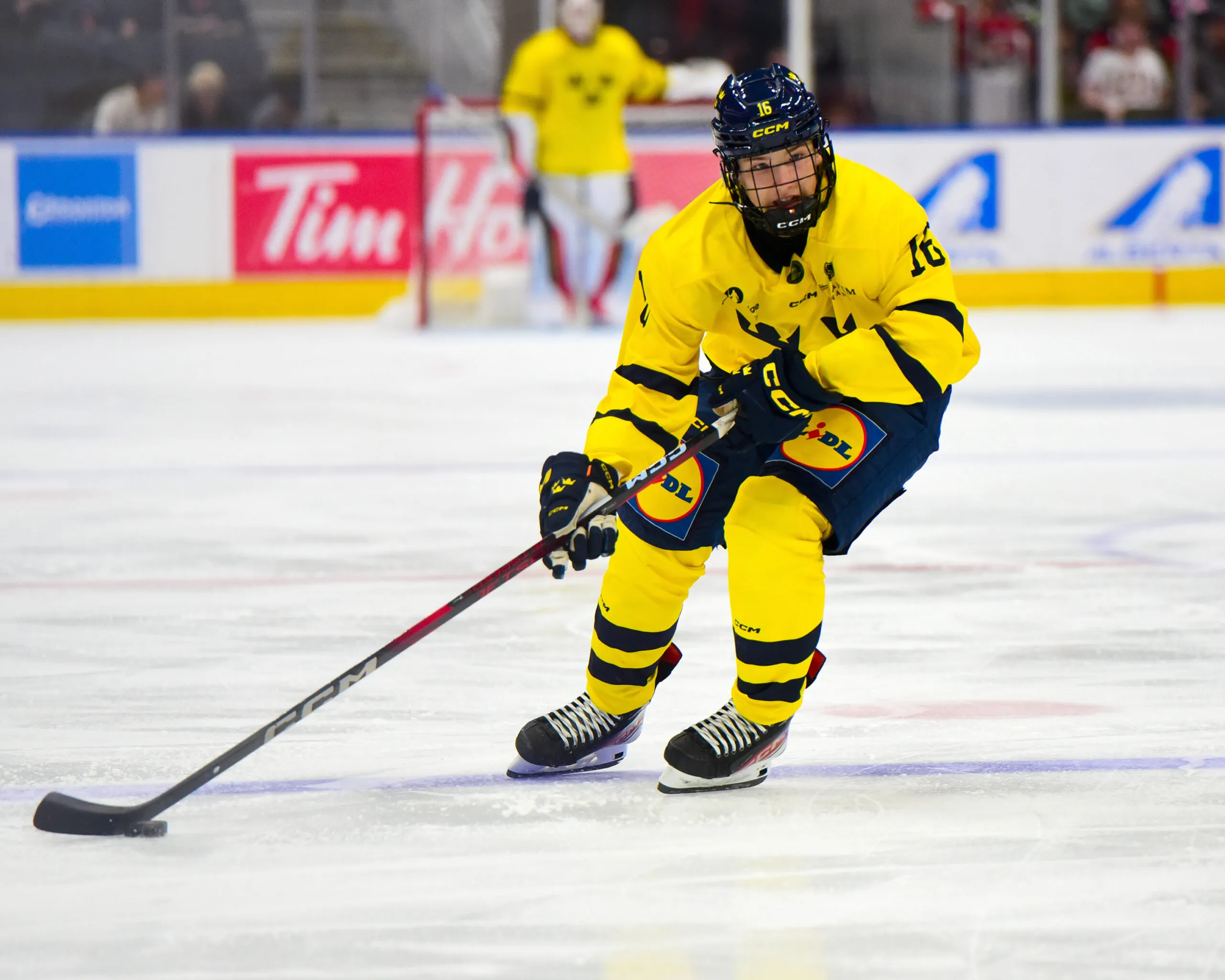
Bjorck Leads Despite Size Concerns
Bjorck earned the top center role with Djurgarden during its playoff push and excelled against men in Sweden’s top league. He set the U-20 scoring record at age 16 and performed without issue against Macklin Celebrini and Ryan O’Reilly at the World Championship. Bjorck’s two-way profile combines offensive tactics with defensive reliability developed through men’s competition. His 5-foot-9 frame remains the sole noted drawback yet has not limited his impact in any situation.
Teams scouting Bjorck contrast his complete game with historical undersized centers who succeeded at the NHL level. The prospect’s ability to win faceoffs and drive play in all zones positions him ahead of peers who lack similar balance. If Bjorck measured six feet his draft stock would rise further, but evaluators already rank him as the class leader.
Bjorck’s production includes consistent point totals in limited junior minutes while logging heavy minutes against older competition. Scouts cite his playmaking and defensive reads as NHL-ready assets. The Swedish forward’s trajectory suggests an early first-round selection that validates positional premium at center.
Malhotra and Lawrence Present Contrasting Profiles
Caleb Malhotra stands at 6-foot-2 and 185 pounds and earned recognition as one of the top two-way centers after a strong second half with the OHL’s Brantford Bulldogs. The son of former NHL player Manny Malhotra improved his mobility and net-front presence while contributing to a dominant junior squad. Malhotra’s efficient style relies on pinpoint passing rather than flash, projecting him as a reliable middle-six option.
Tynan Lawrence entered the year viewed as the potential top center but posted an unproductive second half after moving from the USHL’s Muskegon to Boston University. Lawrence captured Clark Cup MVP honors and Clark Cup title with Muskegon before struggling at the NCAA level. He rebounded with strong play at the World Men’s Under-18s for Canada, showcasing speed and puck control across all three zones.
The two prospects highlight divergent paths: Malhotra built momentum late while Lawrence’s early dominance faded. Lawrence’s dual-threat tools and habits still support a first-round grade despite the dip in production. Malhotra’s physical advantages and family hockey ties add intangible value that teams weigh against pure skill metrics.
Later Centers Offer Safe Floors With Upside
Oliver Suvanto brings a hulking frame and pro-style details from Tappara in Finland where he played most of the season at the men’s level. Suvanto flashes bursts and a heavy shot yet remains inconsistent offensively, projecting safely as a bottom-six defensive center. His cycle work and board battles already exceed typical draft-age peers.
Jack Hextall ranks as one of the smartest players available and compensates for average quickness by slowing the game and exploiting seams. The Youngstown USHL product rarely settles for low-danger chances and maintains a solid defensive game through diagnostic reads. Hextall projects as a middle-six center whose intelligence elevates every tool.
Additional names such as Ilia Morozov at Miami (Ohio) and Maddox Dagenais in the QMJHL add depth but reinforce the class drop-off after the top five. Teams may reach for centers early or bypass the position given the limited high-end options.
Bjorck’s projection as a top-line two-way center will set the benchmark for center selections through the 2026 first round on June 25.
Frequently Asked Questions
Sources

Par Mike Jonderson
Mike Jonderson is a passionate hockey analyst and expert in advanced NHL statistics. A former college player and mathematics graduate, he combines his understanding of the game with technical expertise to develop innovative predictive models and contribute to the evolution of modern hockey analytics.