






The 2026 Stanley Cup playoffs have reached the conference finals stage, setting up compelling matchups between some of the league’s top teams. With the eastern conference final featuring the Montreal Canadiens against the Carolina Hurricanes and the western conference final pitting the Vegas Golden Knights against the Colorado Avalanche, fans are in for a thrilling ride toward the Stanley Cup final.
This round promises intense competition as teams battle for a spot in the championship series. The schedules have been set with games beginning later this week, offering plenty of opportunities for dramatic moments and standout performances.
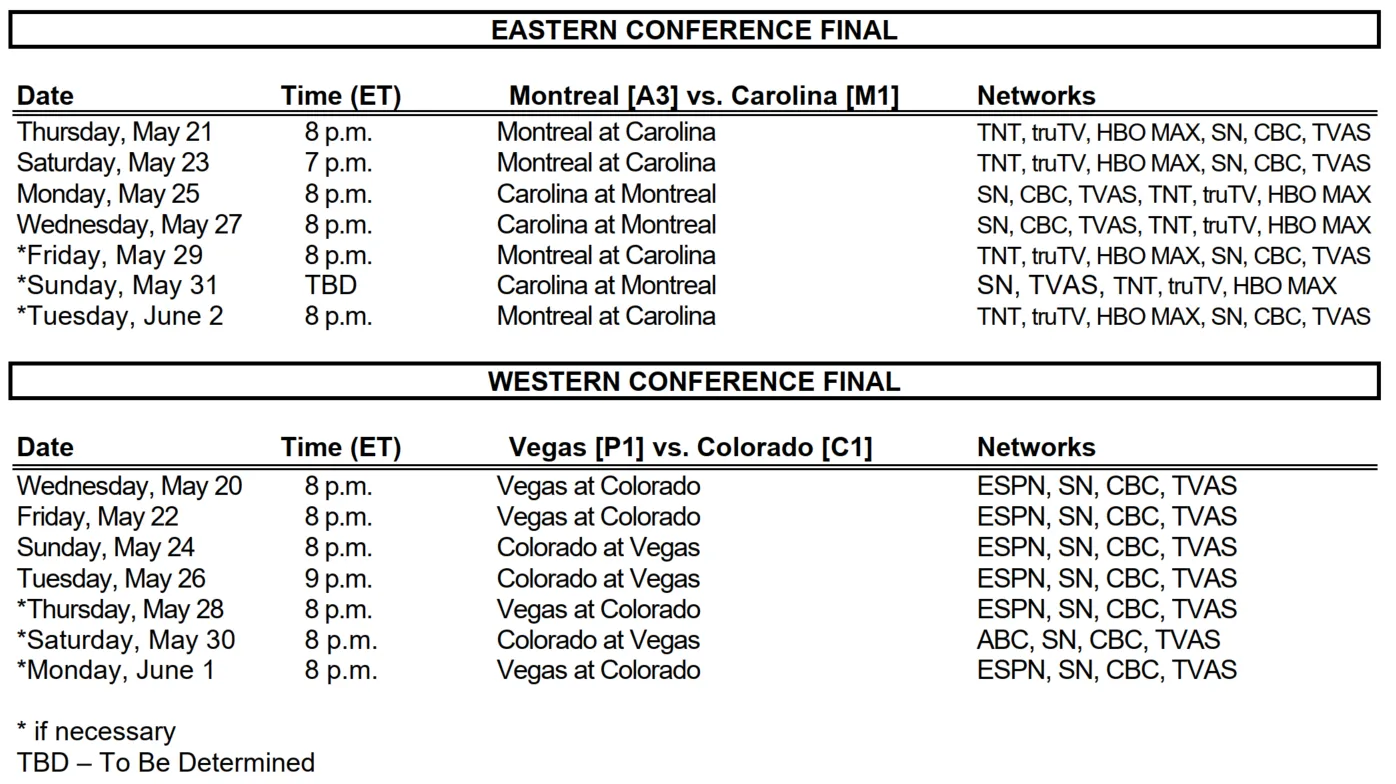
Eastern Conference Final: Montreal Canadiens vs. Carolina Hurricanes
The eastern conference final opens with the Montreal Canadiens traveling to face the Carolina Hurricanes. Both teams have shown strong form throughout the playoffs, and this series is expected to be a hard-fought battle.
- Game 1: Montreal at Carolina – 8:00 p.m. ET, Thursday, May 21
- Game 2: Montreal at Carolina – 7:00 p.m. ET, Saturday, May 23
- Game 3: Carolina at Montreal – 8:00 p.m. ET, Monday, May 25
- Game 4: Carolina at Montreal – 8:00 p.m. ET, Wednesday, May 27
- Game 5*: Montreal at Carolina – 8:00 p.m. ET, Friday, May 29
- Game 6*: Carolina at Montreal – TBD, Sunday, May 31
- Game 7*: Montreal at Carolina – 8:00 p.m. ET, Tuesday, June 2
- if necessary
The series could extend to a full seven games, with potential for high-stakes overtime thrillers. Montreal will look to leverage its speed and depth while Carolina aims to use its defensive structure and home-ice advantage early on.
Recent playoff trends suggest that home teams often hold an edge in these rounds, making the early games in Carolina particularly crucial for the Hurricanes.
Western Conference Final: Vegas Golden Knights vs. Colorado Avalanche
In the west, the Vegas Golden Knights hold a 1-0 series lead after a 4-2 victory in game 1 against the Colorado Avalanche. The Golden Knights will now host the next contest as they seek to build momentum.
- Game 2: Vegas at Colorado – 8:00 p.m. ET, Friday, May 22
- Game 3: Colorado at Vegas – 8:00 p.m. ET, Sunday, May 24
- Game 4: Colorado at Vegas – 9:00 p.m. ET, Tuesday, May 26
- Game 5*: Vegas at Colorado – 8:00 p.m. ET, Thursday, May 28
- Game 6*: Colorado at Vegas – 8:00 p.m. ET, Saturday, May 30
- Game 7*: Vegas at Colorado – 8:00 p.m. ET, Monday, June 1
- if necessary
Vegas enters with confidence from the opening win, while Colorado will need to regroup quickly to even the series on home ice in game 2. The matchup highlights contrasting styles, with Vegas relying on physical play and Colorado emphasizing its offensive firepower.
This series could feature standout goaltending battles and clutch performances from key forwards on both sides.
What to Watch For in the Conference Finals
Broadcast details for these games will be announced closer to the dates, with major networks expected to carry the action across the United States and Canada. Fans can follow updates on official league channels and team social media for the latest insights.
The outcome of these series will determine which teams advance to the Stanley Cup final, adding extra pressure on every shift.
Looking Ahead to the Stanley Cup Final
As the conference finals unfold, the path to the championship becomes clearer. Teams that navigate this round successfully will carry valuable experience into the final series.
The 2026 playoffs continue to deliver excitement, and these conference finals represent the final step before crowning a new champion.
Frequently Asked Questions

Par Mike Jonderson
Mike Jonderson is a passionate hockey analyst and expert in advanced NHL statistics. A former college player and mathematics graduate, he combines his understanding of the game with technical expertise to develop innovative predictive models and contribute to the evolution of modern hockey analytics.