







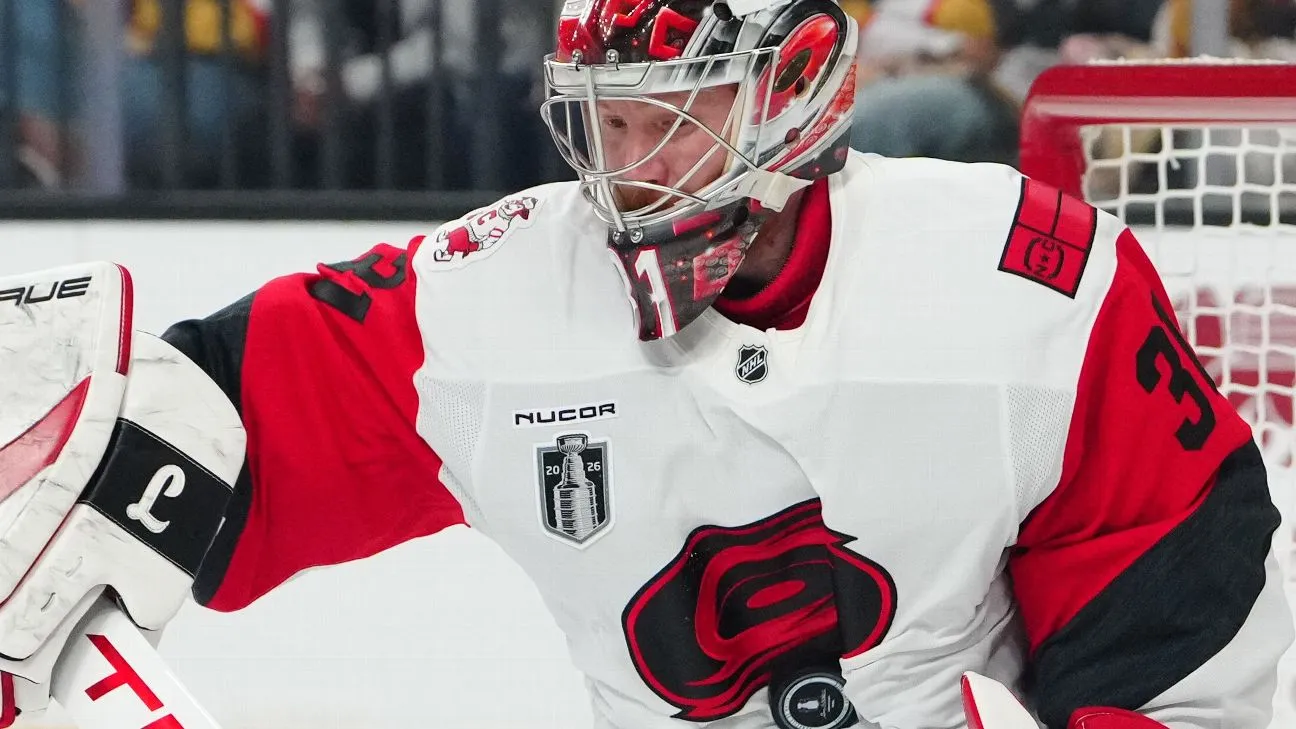
Andersen signed a one-year contract with the Edmonton Oilers on July 1 carrying a $1 million base salary and $1.8 million in performance bonuses.
Contract structure rewards availability over volume
The deal carries a $1 million cap hit yet can reach $2.8 million if Andersen meets the listed thresholds of 10 games, 20 games and 50 percent participation in each playoff round. NHL.com reported the structure the same day free agency opened. The Oilers simultaneously traded Darnell Nurse to San Jose for Shakir Mukhamadullin and Zack Sharp, creating the necessary space. This combination of a traded veteran contract and an incentive-heavy signing limited Edmonton’s immediate cap burden while preserving flexibility for the 2026-27 season.
The same day Sergei Bobrovsky agreed to terms elsewhere, confirming Andersen’s move stood as one of the more notable goalie transactions. The 36-year-old arrived after posting a 16-14-5 record in the regular season with Carolina and appearing in 13 of the Hurricanes’ 16 playoff wins before an injury sidelined him for the final three games won by Brandon Bussi. The Oilers therefore acquired a recent Stanley Cup contributor at a fraction of the cost paid to established starters.
Roster retool pairs Andersen with Jarry and Levi
Edmonton added Devon Levi via trade and retained Tristan Jarry, forming a three-goalie group anchored by Andersen’s experience. The tandem configuration allows coach Kris Knoblauch to deploy Andersen in 35-40 regular-season games while monitoring his 36-year-old frame. The bonus triggers reward incremental playing time rather than a fixed high salary, contrasting with the seven-year, $42 million contract some teams had floated in prior cycles.
The Nurse trade removed a $9.25 million cap hit and returned two young defensemen, directly enabling the Andersen signing and additional depth additions such as Ryan Shea and Kasperi Kapanen. General manager Stan Bowman described the sequence as a deliberate retool that addressed multiple roster holes in a single day. The resulting goaltending group therefore costs less in committed dollars than the previous starter-plus-backup combination while carrying higher upside through performance incentives.
Historical precedent favors short-term veteran additions
Edmonton’s goaltending carousel has featured more than a dozen netminders since 2016. Andersen becomes the latest attempt to stabilize the position with a proven postseason performer rather than another long-term commitment. The one-year term mirrors successful short deals the franchise executed with other veterans, allowing evaluation without multi-year risk. Should Andersen reach the full bonus package, the Oilers will have paid a proven Cup winner $2.8 million for a single season—an amount comparable to rental players who delivered similar results in past playoffs.
The structure also protects against injury or diminished performance because only games played activate the escalators. This measured approach aligns with the salary-cap realities that forced the Nurse trade in the first place. Edmonton now enters training camp with a defined hierarchy and measurable performance targets tied directly to compensation.
Frequently Asked Questions
Sources

Par Mike Jonderson
Mike Jonderson is a passionate hockey analyst and expert in advanced NHL statistics. A former college player and mathematics graduate, he combines his understanding of the game with technical expertise to develop innovative predictive models and contribute to the evolution of modern hockey analytics.