










Bedard and Celebrini could command AAVs of $15 million or more this summer as the NHL cap rises to $104 million for 2026-27.
Rising cap fuels higher benchmarks
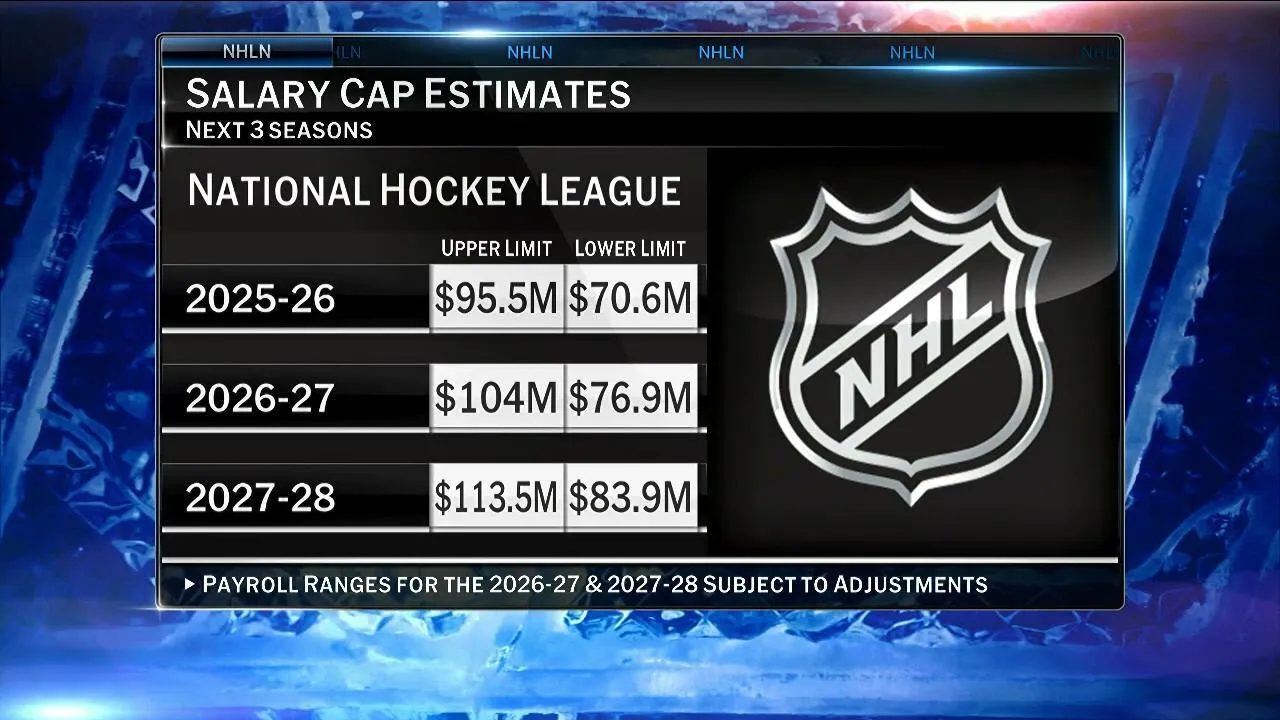
The salary cap stands at $95.5 million for 2025-26 before jumping to $104 million in 2026-27 and $113.5 million the year after. Dave Pagnotta noted on Sirius XM that these jumps will push RFA numbers higher than prior cycles. Bedard’s entry-level deal expires this summer while Celebrini becomes extension-eligible on July 1. Both players will anchor their clubs’ future payrolls as the highest-paid players on their respective teams.
Pagnotta contrasted the current class with past RFAs by highlighting how the cap trajectory from $104 million to the low $120s in three seasons will inflate offers. Teams must absorb these hits without offer-sheet drama, which Pagnotta dismissed as unlikely. The result is contracts that reflect league-wide escalation rather than individual leverage.
Chicago and San Jose will absorb the largest immediate impacts. Bedard’s projected AAV sits near $12 million on a three-to-four-year bridge or climbs toward $15-17 million on a longer term. Celebrini’s shorter-term projection starts at $15 million, positioning him ahead of Bedard within twelve months.
Team payroll consequences
Dallas already eyes an extension for Jason Robertson to avoid similar RFA pressure. Anaheim’s Pat Verbeek must secure Leo Carlsson and Cutter Gauthier quickly to prevent training-camp holdouts like those involving Mason McTavish and Trevor Zegras. The Ducks’ history shows the cost of delay.
New Jersey and Buffalo face parallel decisions with Simon Nemec and Zach Benson. Each club will weigh short-term bridges against full-term commitments that lock in escalating cap hits. Pagnotta emphasized that full-term deals could set new single-season highs at $16-18 million AAV.
The Blackhawks and Sharks gain roster stability but lose flexibility for complementary signings. Both organizations must plan extensions around these cornerstone numbers while the cap climbs another $9.5 million by 2027-28.
Market precedent for young stars
Kirill Kaprizov’s $17 million AAV remains the current ceiling. Neither Bedard nor Celebrini is expected to match it yet, but their deals will narrow the gap. Pagnotta stated the numbers will “look a little high” to observers accustomed to pre-2025 benchmarks.
Celebrini’s extension window closes before the new CBA alters maximum lengths, giving San Jose leverage for an eight-year maximum. Bedard’s talks have already resumed with differing length options under discussion. Both negotiations will influence every subsequent RFA class.
Frequently Asked Questions
Sources

Par Mike Jonderson
Mike Jonderson is a passionate hockey analyst and expert in advanced NHL statistics. A former college player and mathematics graduate, he combines his understanding of the game with technical expertise to develop innovative predictive models and contribute to the evolution of modern hockey analytics.