







The Pittsburgh Penguins made a bold move when they selected Ben Kindel with the 11th overall pick in the 2025 NHL Draft. Many draft experts considered it a reach at the time, with the Calgary Hitmen center ranked significantly lower by most scouting services. Fast forward to mid-November, and that decision looks increasingly brilliant as the 18-year-old has established himself as a legitimate contender in what’s shaping up to be a highly competitive Calder Trophy race.
Kindel’s journey from draft day question mark to legitimate NHL regular has been nothing short of impressive. With five goals and seven points through his first 15 games, he’s not just surviving at hockey’s highest level—he’s thriving. His performance has earned him ice time alongside Sidney Crosby on the top line and a spot on the Penguins’ first power-play unit with future Hall of Famers. For an 18-year-old in his rookie season, these are remarkable accomplishments that demonstrate the confidence head coach Dan Muse and the organization have in his abilities.
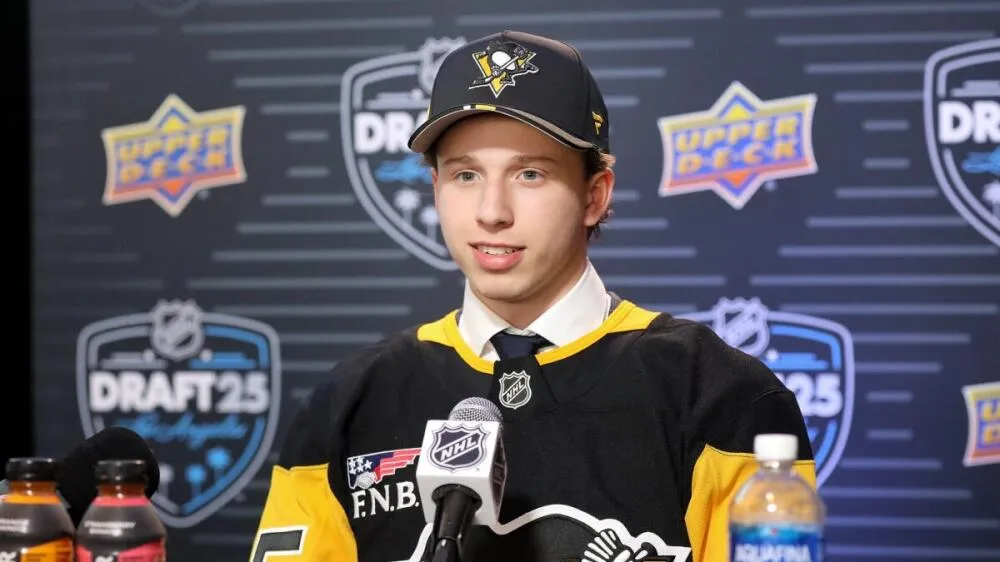
Why Ben Kindel is emerging as a Calder Trophy contender for the Penguins rookie class
The Calder Trophy conversation typically centers around high-profile first overall picks or highly-touted prospects with significant junior or international experience. This year’s race features names like Matthew Schaefer of the New York Islanders, the first overall selection in 2025, and Ivan Demidov of the Montreal Canadiens, who was NHL.com’s preseason favorite for the award after a strong season in the KHL.
Schaefer has posted impressive numbers for an 18-year-old defenseman, recording five goals and 11 points in 15 games. Demidov, who turns 20 in December and was selected fifth overall in the 2024 draft, has tallied four goals and 13 points in 15 games. These are the names dominating early Calder discussions, but Kindel’s production puts him firmly in the conversation alongside them.
What makes Kindel’s case compelling is his goal-scoring prowess. His five goals tie him for second among all eligible rookies, a remarkable achievement considering he was widely regarded as a reach on draft day. According to Pittsburgh Hockey Now, this production has come while playing primarily as the Penguins’ third-line center—no small feat when the top two centers are Crosby and Evgeni Malkin.
The 18-year-old forward has demonstrated a maturity beyond his years, showcasing offensive instincts, defensive responsibility, and a hockey IQ that has impressed coaches and teammates alike. Bryan Rust, who has skated on Kindel’s wing, offered high praise: “He’s been awesome. He’s going out there. He’s working hard. He’s an extremely smart kid. Knows where to be on the ice. Knows which plays to make. And when you combine that intelligence with his skill level, obviously good things are going to happen.”
Kindel’s defensive awareness has been particularly noteworthy. While many 18-year-olds struggle with the defensive responsibilities required at the NHL level, Kindel has embraced that side of the game. He’s worked extensively with Penguins assistant coach Nick Bonino, himself a former 200-foot center, on refining his defensive zone coverage and patience in not overextending himself against skilled NHL opponents.
The draft day decision that’s paying dividends for the Penguins rookie forward
When Kyle Dubas and the Penguins’ front office selected Kindel 11th overall, they faced criticism from draft analysts and fans who felt the pick was premature. Kindel was ranked considerably lower by most major scouting services, and conventional wisdom suggested better-ranked players were still available.
However, Dubas explained the decision-making process candidly on draft night. Vice President of Player Personnel Wes Clark and the area scouts had identified Kindel early in the 2024-25 season as a player they believed in strongly. After finishing with 99 points in 65 games for the Calgary Hitmen of the Western Hockey League, Kindel’s case only grew stronger.
“We understand he’s not the biggest guy, but you look at the production and you look at the intelligence and the skillset, and where we came to in the last couple of days is that if we passed on him, we had intel that he wasn’t going to go much further beyond [our pick],” Dubas said that night. “And we just didn’t want to look back on it and say, ‘Geez, why did we pass on this guy that had 99 points and then stepped up his game in the playoffs?’”
That confidence from Clark and the scouting staff has proven prescient. Kindel had a strong training camp, made the opening night roster, and survived the crucial nine-game threshold that would have allowed the Penguins to send him back to junior hockey without activating the first year of his entry-level contract. On October 30th, Kindel played his 10th game with Pittsburgh, officially beginning his three-year entry-level deal signed on July 8th.
The official NHL Penguins website reported that Kindel became the fifth-youngest player in franchise history to make his NHL debut when he took the ice in the season opener. That historic distinction set the tone for what has been a remarkable start to his professional career.
Clark’s advice to Kindel has resonated throughout his early NHL career: stay hungry, never look back, and maintain the mentality of an undrafted player. “He’s definitely a big motivator of mine,” Kindel said. “It’s always that kind of mindset, even now. Still stay hungry, still want to accomplish more things, as a team and as an individual.”
Ben Kindel’s path to Calder Trophy recognition mirrors other Penguins rookie success stories
The Penguins have a rich history of developing young talent, and Kindel’s emergence fits within that tradition. His poise and composure recall other successful rookies who’ve worn the black and gold, though few have made such an immediate impact at such a young age.
What sets Kindel apart is not just his offensive production but his complete game. Head coach Dan Muse has been particularly impressed with Kindel’s defensive instincts, noting that it’s easy to see his offensive abilities—evidenced by his early goals—but the defensive side has been equally impressive for such a young player.
“I think a big part of that area is just the mindset, like having a competitive mindset, and just kind of using my hockey sense,” Kindel explained. “Like, I’ve always taken a lot of pride in that part of the game and respected that side of the game and guys that play that game well.”
Kindel has modeled his game after Montreal’s Nick Suzuki, another center known for his 200-foot play. Working with Bonino in Pittsburgh, Kindel has focused on patience in the defensive zone, learning not to overextend himself against NHL-level talent who can exploit overeagerness.
“Working with Bones in the defensive zone on just being patient and not overextending myself… and just kind of like, taking a step back and reading the game versus going and pressuring all over the place,” Kindel said. “Because if you get running around against a lot of these skilled players in the NHL, they’ll make you pay.”
Kindel’s athletic pedigree has undoubtedly contributed to his success. His parents, Steve Kindel and Sara Maglio, were both professional soccer players and continue to work in the sport. From them, Kindel learned crucial lessons about mental toughness and physical preparation that have translated seamlessly to hockey’s highest level.
His ability to process information and apply it in games has impressed the coaching staff. Muse noted that whatever they teach Kindel, he demonstrates the capacity to implement it immediately in game situations. “He’s processing the information that’s being shown to him,” Muse said. “That’s a positive as well.”
How the Penguins rookie stacks up against other Calder Trophy candidates
The 2025-26 rookie class is generating significant excitement across the NHL, with several players emerging as legitimate Calder contenders. Similar to how Matthew Schaefer has established himself as an Islanders Calder Trophy frontrunner with his record-setting start, Kindel’s production places him among the top rookies despite receiving less preseason attention.
The Calder race currently features several distinct storylines. Schaefer, as the first overall pick, arrived with enormous expectations and has delivered, particularly impressive for an 18-year-old defenseman. Demidov brought KHL experience and offensive creativity, making him the preseason favorite. Other names in the mix include Jimmy Snuggerud of St. Louis, Alexander Nikishin of Carolina, Zeev Buium of Minnesota, Beckett Sennecke of Anaheim, and Oliver Kapanen of Montreal.
Kindel’s five goals tie him for second among eligible rookies, trailing only the leaders in what’s shaping up to be a highly competitive race. His seven total points in 15 games demonstrate consistent production, though he’ll need to maintain or increase that pace to stay in contention throughout the season.
One factor that could benefit Kindel is the Penguins’ competitive position. While team success shouldn’t theoretically impact an individual award, voters often gravitate toward players on winning teams. Pittsburgh’s strong start provides Kindel with a platform and opportunity to showcase his talents in meaningful situations.
His versatility has been another selling point. Kindel has primarily centered the third line but has proven capable of moving up the lineup when needed. He’s skated alongside Crosby on the top line and earned a spot on the first power-play unit, demonstrating the trust the coaching staff has in his abilities across different roles and responsibilities.
Perhaps most impressively, Kindel has shown no signs of being overwhelmed by the moment. Rust noted this composure: “Nothing seems to faze him. There is no moment that seems to be too big for him, even when he’s out there with our first power play, and he’s out there talking to Sid and everything… if I was that age and I was doing that, I’d be a little bit starstruck.”
The rookie’s immediate impact mirrors broader trends in Calder Trophy consideration
As the NHL continues to get younger and faster, the Calder Trophy conversation has evolved. More rookies are making immediate impacts, and 18-year-olds competing for the award are no longer anomalies. Kindel represents this trend perfectly—a player who bypassed additional development time in junior hockey to contribute meaningfully at the NHL level.
Much like Jakub Dobes has emerged as a Calder candidate for the Montreal Canadiens through strong goaltending performance, Kindel’s emergence shows that Calder races can include unexpected names who exceed their draft-day projections. Both players demonstrate that production and performance matter more than pre-draft rankings once the puck drops.
The Penguins have been careful in managing Kindel’s development despite his early success. As Dubas has mentioned on multiple occasions, there are several thresholds to monitor with rookie players. Beyond the nine-game mark that Kindel has cleared, there’s also the 40-game threshold, which would count as a full year toward unrestricted free agent status. Additionally, decisions loom regarding potential participation in the World Junior Championship.
“This is another checkpoint,” Muse said. “We’re going to be continuing to evaluate. We’re going to be continuing to work with him, and using all departments and all resources we have to make sure that everything we’re doing is the best thing for him now and for the future.”
This thoughtful approach to development doesn’t diminish Kindel’s Calder candidacy—it enhances it. The fact that an organization would consider sending an 18-year-old producing at his level to the World Juniors speaks to their long-term thinking and commitment to his growth. Whatever decision they make will be in Kindel’s best interest, even if it means temporarily removing him from Calder consideration.
For now, Kindel remains focused on daily improvement and team success. His quiet confidence, combined with genuine humility, has endeared him to coaches and teammates. “He knows he’s going to come and work and not take anything for granted,” Muse said. “He’s been showing that there from the first day. That’s probably one of the things that’s gotten him to this point.”
The season remains young, and Calder races are notoriously unpredictable. Players will experience hot streaks and cold spells. Injuries can derail promising campaigns—Kindel himself took a heavy hit against Los Angeles but fortunately returned to the game. The long NHL season tests both physical and mental endurance, particularly for 18-year-olds adjusting to the professional grind.
However, if Kindel continues his current trajectory, there’s no reason he shouldn’t be mentioned alongside Schaefer, Demidov, and other Calder frontrunners. His goal-scoring ability, complete 200-foot game, hockey intelligence, and composure under pressure give him all the tools necessary to contend for rookie of the year honors. The Penguins took a chance on draft day by selecting him 11th overall, and that gamble is paying off in spectacular fashion. As the season progresses, Ben Kindel’s name deserves to be firmly planted in every Calder Trophy conversation.

Par Mike Jonderson
Mike Jonderson is a passionate hockey analyst and expert in advanced NHL statistics. A former college player and mathematics graduate, he combines his understanding of the game with technical expertise to develop innovative predictive models and contribute to the evolution of modern hockey analytics.