







The Boston Bruins are facing a defensive crisis early in the 2025-26 season, and the struggles of their top pairing have become impossible to ignore. After dropping six consecutive games and allowing goals at crucial moments, head coach Marco Sturm has been forced to confront a harsh reality: the partnership between Charlie McAvoy and Mason Lohrei simply isn’t working. With the team surrendering seven goals in their latest defeat to the Anaheim Ducks despite scoring five of their own, questions about the defensive structure have reached a boiling point.
The Bruins’ defensive woes aren’t entirely new territory for fans who suffered through last season’s struggles. However, the expectation was that a healthy McAvoy and a maturing Lohrei would provide stability at the top of the depth chart. Instead, the pairing has become a liability, posting alarming metrics and being on the ice for costly goals. As the losses pile up and the team searches for answers, the Boston Bruins top pair shakeup has become not just a topic of discussion but an urgent necessity for a franchise trying to salvage its season.
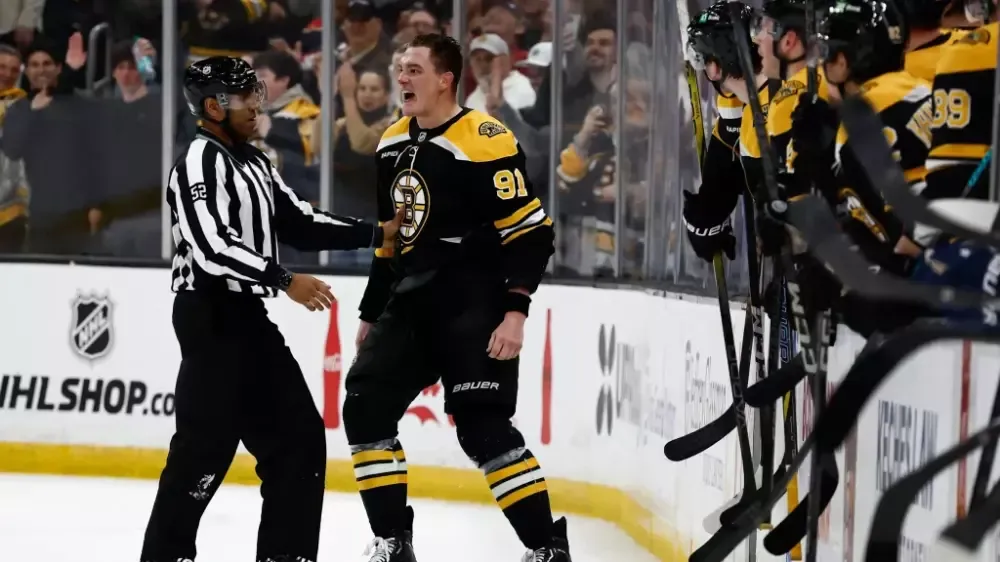
Why the Boston Bruins top pair shakeup is overdue
Through nine games, the statistical evidence against the McAvoy-Lohrei pairing has become overwhelming. The duo has accumulated 6.13 expected goals against, a staggering figure that dwarfs the next closest defensive pair at 3.87. More concerning than the numbers themselves is what they represent: a fundamental disconnect in defensive coverage and decision-making at the most critical moments.
The eye test confirms what the analytics suggest. During the Ducks game, McAvoy and Lohrei appeared lost in coverage on Troy Terry’s game-winning goal. As Lohrei got spun around in the defensive zone, McAvoy moved toward the puck, leaving Terry wide open for an uncontested finish. Moments later, Mikael Granlund danced around the pair for an empty-net goal that punctuated a disastrous third period.
Sturm hasn’t held back in his assessment of the situation. After the Panthers game on October 21, he was direct about Lohrei’s performance, stating: “Those two goals were on [Lohrei]. Can’t deny it.” It’s a rare display of public criticism from a coach, but one that signals the urgency of the situation. When your head coach is calling out specific players by name, changes are imminent.
The pairing’s struggles extend beyond individual plays. They’ve been on the ice for the most goals against of any Bruins defensive duo, and many of those goals have come at inopportune times—late in periods, during crucial moments when the team needs a stop, or when protecting a lead. For a pair expected to be the team’s shutdown unit, these are unacceptable trends.
What makes this situation particularly frustrating for the Bruins organization is that both players possess elite skills. McAvoy is a Norris Trophy-caliber defenseman when at his best, capable of controlling both ends of the ice. Lohrei is a highly skilled offensive defenseman who excels in transition and can push play forward. Yet together, they’ve created a combination that’s less than the sum of its parts, as reported by The Hockey Writers.
Potential solutions for the Boston Bruins top pair shakeup
The most obvious solution to the Bruins’ defensive problems would be reuniting McAvoy with Hampus Lindholm. In a perfect scenario, Lindholm would be the ideal partner for McAvoy’s aggressive, high-octane style. Lindholm is Boston’s best two-way defenseman, possessing a complete 200-foot game that can cover for McAvoy when he jumps into the rush or takes calculated risks.
During the 2024-25 season, McAvoy and Lindholm spent only 63 minutes together, but those minutes were productive. The pairing controlled the pace of play and posted an expected goals for percentage of 53.5%, demonstrating their ability to tilt the ice in Boston’s favor. The problem? Lindholm is currently dealing with an injury that has kept him off the ice and prevented this natural partnership from forming.
Until Lindholm returns to full health, the Bruins need an interim solution. One option is pairing McAvoy with Nikita Zadorov, who brings a completely different element to the table. While Zadorov may not be ideally suited for top-pairing minutes, the duo did show promise in limited time together. They won the score differential battle and controlled 52.1% of the expected goals share, suggesting they can at least stabilize the situation.
Zadorov’s physical presence and defensive reliability could allow McAvoy to play his game more freely. Unlike with Lohrei, McAvoy wouldn’t need to constantly worry about covering for his partner’s defensive lapses. Instead, he could focus on what makes him elite: jumping into the rush, pinching at the right moments, and using his skating ability to create offensive chances while still maintaining defensive responsibility.
As for Lohrei, sheltering him on the third pairing might be the best path forward for his development. He’s at his best when the puck is on his stick, excelling in transition and showing offensive instincts beyond his years. By reducing his minutes and placing him in less challenging matchups, the Bruins could allow him to build confidence while working on the defensive aspects of his game that need refinement.
The coaching perspective on the Boston Bruins top pair shakeup
Marco Sturm’s public comments reveal a coach reaching his breaking point with his team’s defensive lapses. Following the seven-goal debacle against Anaheim, Sturm didn’t mince words: “We’re all embarrassed. Those breakdowns in big moments, that can’t happen. That’s the frustrating point for me because we’ve [succeeded] in the past. Why not now?”
The frustration in Sturm’s voice is palpable, and it reflects a broader organizational concern. The Bruins have the talent to compete, but defensive breakdowns are sabotaging their efforts game after game. When you score five goals and still lose by two, as they did against the Ducks, the problem isn’t scoring. It’s preventing the other team from scoring more.
Sturm’s willingness to call out players publicly represents a shift in approach. Rather than protecting his players from criticism, he’s holding them accountable for their mistakes. This strategy can be risky—some players respond well to public challenges, while others retreat into their shells. The coming games will reveal whether Lohrei and McAvoy can respond positively to this pressure or if more drastic changes will be necessary.
The coaching staff faces a delicate balancing act. On one hand, they need to maintain the confidence of their young players like Lohrei, who represents an important part of the team’s future. On the other hand, they can’t afford to let the season slip away while waiting for development to occur. With every loss, the margin for error shrinks, and the pressure to make changes intensifies.
What’s particularly telling is Sturm’s reference to past success. He knows this group is capable of better performance because they’ve demonstrated it before. That makes the current struggles even more maddening and suggests that the issues are correctable—if the right adjustments are made soon enough.
What the Boston Bruins top pair shakeup means moving forward
The next few weeks will be crucial for determining the direction of Boston’s season. With the speedy Colorado Avalanche on the schedule—a team that already had their way with the Bruins earlier this season—the pressure is mounting to find defensive solutions quickly. The Avalanche’s skilled forwards will expose any defensive weaknesses, making this an important litmus test for whatever changes Sturm implements.
Brandon Carlo’s absence has created a domino effect throughout the defensive lineup. Carlo’s steady, reliable presence on the right side provided the Bruins with a dependable shutdown option who could handle top competition. Without him, the team has struggled to establish consistent pairings, and players have been forced into roles they aren’t ready to handle. The search for a suitable replacement or internal solution remains ongoing.
Looking at the bigger picture, the Bruins’ window for contention isn’t infinite. With core players in their prime years and significant salary cap commitments made to this roster, the team cannot afford a lost season due to correctable problems. Management invested heavily in players like Zadorov specifically to shore up the defense. Now it’s time to deploy those assets in the most effective manner possible, even if it means uncomfortable conversations and lineup changes.
The development of Lohrei adds another layer of complexity to these decisions. The Bruins view him as a key piece of their future defensive core, and they don’t want to damage his confidence or development by putting him in situations where he’s set up to fail. However, they also can’t sacrifice the present for the future. Finding the right balance—perhaps through reduced minutes, easier matchups, or a different defensive partner—will be essential for both Lohrei’s growth and the team’s success this season, as discussed in Yahoo Sports’ coverage of the team’s defensive projections.
The Boston Bruins top pair shakeup is no longer a matter of if, but when and how. With mounting losses, vocal criticism from the coaching staff, and undeniable statistical evidence of failure, change is inevitable. The question is whether those changes will come soon enough to salvage the season and whether the adjustments will address the root causes of the team’s defensive breakdowns. As the Bruins prepare for their next challenge, all eyes will be on the defensive pairings and whether Sturm has the courage to make the bold moves necessary to turn this season around. The clock is ticking, and in the NHL, patience runs out quickly when wins don’t follow.

Par Mike Jonderson
Mike Jonderson is a passionate hockey analyst and expert in advanced NHL statistics. A former college player and mathematics graduate, he combines his understanding of the game with technical expertise to develop innovative predictive models and contribute to the evolution of modern hockey analytics.