






The Buffalo Sabres’ overtime struggles continued Thursday night at TD Garden, falling 4-3 to the Boston Bruins after Marat Khusnutdinov’s winner just over two minutes into the extra frame. It marked the third consecutive overtime defeat for Buffalo, and while they earned a point to extend their point streak to five games, the manner in which this one slipped away left a bitter taste. The Sabres dominated possession and dictated play for long stretches, but opportunistic finishing from Boston and a costly mistake in overtime cost them a chance at two points on the road.
Despite the loss, there were encouraging signs for Lindy Ruff’s squad. Buffalo fought back from two separate two-goal deficits to force overtime, showing resilience that had been missing in previous seasons. However, their inability to close out games and convert dominant possession into victories remains a glaring concern as they search for their first road win of the campaign.
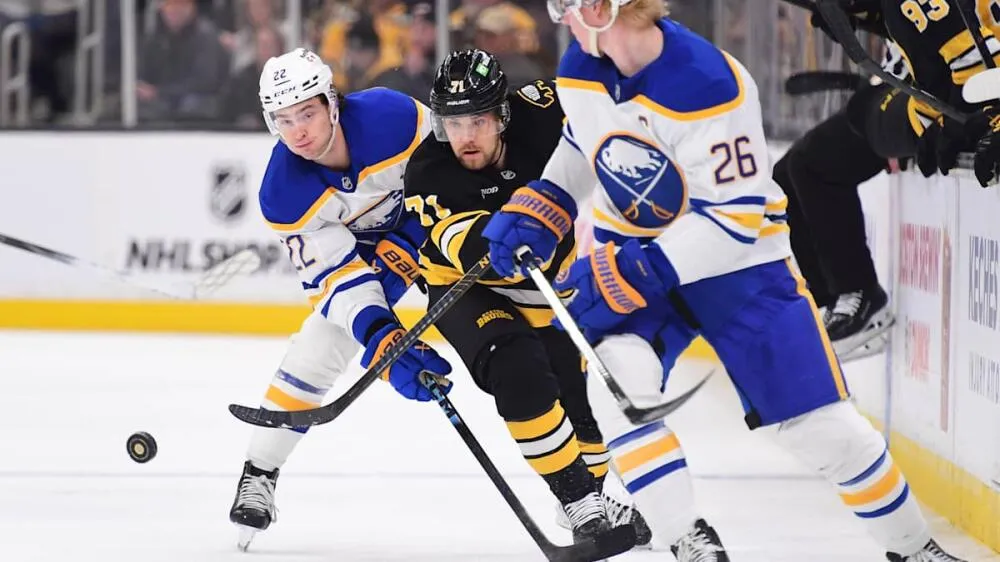
Offensive dominance meets opportunistic finishing in Buffalo Sabres 4-3 overtime loss to Boston Bruins takeaways
The statistical story of this game tells a tale of dominance that didn’t translate to the scoreboard. The Sabres peppered Joonas Korpisalo with 40 shots compared to Boston’s 22, a nearly two-to-one advantage that should have resulted in a comfortable victory. High-danger chances favored Buffalo 19-8, while they also led in blocked shots (15-7) and hits (22-9).
Yet hockey isn’t played on paper, and the Bruins made the most of their limited opportunities. Buffalo’s visit to TD Garden was expected to be a measuring stick game, and while they controlled territory, Boston’s clinical finishing proved the difference. Korpisalo, making his second consecutive start after 33 saves against the Islanders, was exceptional in earning a season-high 37 stops.
The Sabres’ aggressive forechecking and sustained offensive zone time created numerous chances, but Korpisalo stood tall when needed. Buffalo cycled the puck effectively and generated traffic in front of the Boston net, particularly in the third period when they scored twice to erase a two-goal deficit. The ability to maintain pressure and create quality looks was evident throughout.
What separates winning teams from competitive ones is the ability to finish those chances. While Buffalo got pucks to the net, too many shots came from low-percentage areas or were handled comfortably by Korpisalo. The Sabres’ best opportunities came when they simplified their approach and attacked the paint, as evidenced by their third-period comeback when Josh Doan and Alex Tuch scored from dangerous areas.
The offensive output should provide some confidence moving forward, but Ruff knows that dominating possession means nothing without results. “We missed way too many good opportunities,” the Buffalo coach said postgame. “We were making their goalie the First Star of the Game for the first two periods.”
Buffalo’s power play showed signs of life with Rasmus Dahlin’s goal in the second period, but they needed more from their special teams given the amount of zone time they generated at even strength. Converting dominance into goals remains the challenge for this talented but inconsistent offensive group.
Late-period goals continue to haunt Buffalo in 4-3 overtime loss to Boston Bruins
Momentum is a fickle thing in hockey, and the Sabres have struggled to maintain it when they’ve seized control of games. For the second consecutive contest, Buffalo surrendered a crushing goal late in a period that shifted momentum back to their opponent. Mark Kastelic’s scramble goal with just 21 seconds remaining in the second period restored Boston’s two-goal cushion at 3-1.
The timing couldn’t have been worse for Buffalo. Dahlin had just scored on the power play to cut the deficit to 2-1 at 16:01, energizing the visitors and putting pressure on the Bruins. The Sabres appeared poised to carry that momentum into the intermission, but Kastelic’s goal off a Tanner Jeannot rebound crushed that hope.
This scenario has become an alarming pattern. Against Columbus in their previous game, Buffalo held a 2-1 lead before allowing a late equalizer that changed the complexion of that contest. These breakdowns at critical junctures are costing the Sabres valuable points and undermining otherwise solid defensive efforts.
Closing out periods requires discipline, attention to detail, and mental fortitude. With under a minute remaining, teams must prioritize defense and manage the puck responsibly. The Sabres’ lapse allowed Boston to create a scramble in front of Alex Lyon, and Kastelic simply beat everyone to the rebound.
Ruff and his coaching staff must address this trend immediately. While earning points in five straight games shows progress, allowing opponents to seize momentum at the worst possible times prevents Buffalo from taking the next step. These are the fine margins that separate playoff teams from those on the outside looking in.
The Sabres can’t afford to let late-period goals become a defining characteristic of their season. Tightening up in the final minutes of periods must become a priority, especially when they’ve worked hard to establish control or narrow a deficit.
Rasmus Dahlin’s roller coaster performance highlights Buffalo Sabres 4-3 overtime loss to Boston Bruins takeaways
The Sabres’ star defenseman experienced the highest of highs and lowest of lows in this game. For 60 minutes of regulation, Dahlin looked like the elite, franchise-altering player Buffalo envisioned when they selected him first overall in 2018. His power-play goal to make it 2-1 gave the Sabres life, a perfectly placed one-timer from the left point that beat a screened Korpisalo.
Even more impressive was Dahlin’s setup on Tuch’s game-tying goal with under six minutes remaining in the third period. After a face-off win in the offensive zone, Dahlin displayed excellent vision to find Tuch streaking through the slot, threading a pass that allowed the winger to beat Korpisalo near post. It was a play that showcased Dahlin’s offensive instincts and playmaking ability.
For a player who had struggled to find his game through the season’s first 11 contests, this performance represented a potential turning point. Dahlin was engaged, making smart decisions with the puck, and contributing in both ends of the ice. His offensive contributions kept Buffalo in the game and ultimately forced overtime.
Then came the overtime turnover that will haunt him. With possession in the offensive zone and a chance to create offense, Dahlin lost an edge and fell to the ice. Fraser Minten seized the opportunity, sparking a 3-on-1 rush that ended with Khusnutdinov beating Lyon short side for the winner. It was a gut-wrenching way to end an otherwise strong performance.
“We have a chance to get two points and I [messed] up there,” Dahlin admitted after the game. “That just can’t happen. We worked so hard to come back in the game. Really good game by the team to come back, just a tough ending.”
The mistake underscores the challenge Dahlin faces this season. Flashes of brilliance are undermined by critical errors at inopportune moments. Similar to other defensive lapses that have plagued teams, these mistakes in key situations can define games. For Buffalo to compete for a playoff spot, they need consistent excellence from their number-one defenseman, not a roller coaster of spectacular plays followed by costly turnovers. Building on the positives from this game while eliminating the critical errors must be Dahlin’s focus moving forward.
Third straight overtime loss exposes Buffalo Sabres 3-on-3 vulnerabilities
The Sabres’ overtime record is becoming a serious concern. Three consecutive losses in the extra frame, all after earning at least a point in regulation, represent four lost points in the standings. In a tight Eastern Conference playoff race, those points could prove the difference between making the postseason and watching from home.
What makes this overtime loss particularly frustrating is the circumstances surrounding it. Unlike the previous two games where Buffalo blew third-period leads, they battled back from two-goal deficits twice in this contest. The character they showed to force overtime deserved a better fate than a 2:07 defeat off a defensive breakdown.
Jordan Greenway’s penalty inside the final two minutes of regulation forced the Sabres to play shorthanded for the remainder of the period, burning penalty kill time and energy that would have been valuable in overtime. While they successfully killed the penalty, it affected their freshness and momentum heading into 3-on-3 play.
The overtime winner exposed Buffalo’s defensive vulnerabilities in open ice. Dahlin’s turnover was compounded by poor gap control and decision-making that allowed Boston to generate a 3-on-1 rush. In 3-on-3 hockey, one mistake is often fatal, and the Sabres made several on the decisive sequence.
Overtime success requires a combination of defensive responsibility and offensive creativity. Teams must balance aggression with caution, knowing that one mistake can end the game in seconds. Buffalo has struggled to find that balance, either being too passive and allowing opponents to dictate play or being too aggressive and leaving themselves vulnerable to odd-man rushes.
The Sabres need to address their overtime play through video study and practice time. Identifying tendencies, working on defensive coverage in open ice, and developing better decision-making in 3-on-3 situations must become priorities. While earning a point is better than none, continuing to lose winnable games in overtime will prevent Buffalo from climbing the standings and building the confidence needed for a playoff push.
The Buffalo Sabres’ 4-3 overtime loss to Boston encapsulates both their promise and their problems. They possessed the puck, created chances, and showed resilience in erasing two-goal deficits. Yet defensive lapses, late-period goals, and overtime struggles prevented them from earning two points they largely deserved. As they return home to face Washington, the focus must be on converting possession dominance into victories and shoring up the defensive mistakes that have cost them valuable points. The talent is evident, but consistency and attention to detail will determine whether this team realizes its potential or becomes another cautionary tale of unfulfilled promise. With 71 games remaining, there’s plenty of time to correct these issues, but the clock is ticking on their playoff aspirations.

Par Mike Jonderson
Mike Jonderson is a passionate hockey analyst and expert in advanced NHL statistics. A former college player and mathematics graduate, he combines his understanding of the game with technical expertise to develop innovative predictive models and contribute to the evolution of modern hockey analytics.