







The Buffalo Sabres head to the Delta Center on November 12, 2025, seeking to snap a three-game losing streak as they face the Utah Mammoth in what promises to be an intriguing Western Conference matchup. With both teams struggling recently—Buffalo sitting at 5-6-4 and Utah at 9-7-0—this game could serve as a turning point for either squad. The Sabres will be particularly motivated to earn a statement victory on the road, especially as they navigate a depleted lineup that has tested their organizational depth throughout this early season stretch.
The game carries added emotional weight as Josh Doan and Michael Kesselring return to Salt Lake City for the first time since being traded from Utah to Buffalo in exchange for JJ Peterka. Meanwhile, the Mammoth will look to leverage home ice advantage as they search for solutions to their recent offensive struggles, having managed just 2.3 goals per game over their last six contests. With puck drop scheduled for 9:00 p.m. ET, both teams understand the urgency of securing two points before their respective slumps deepen further.
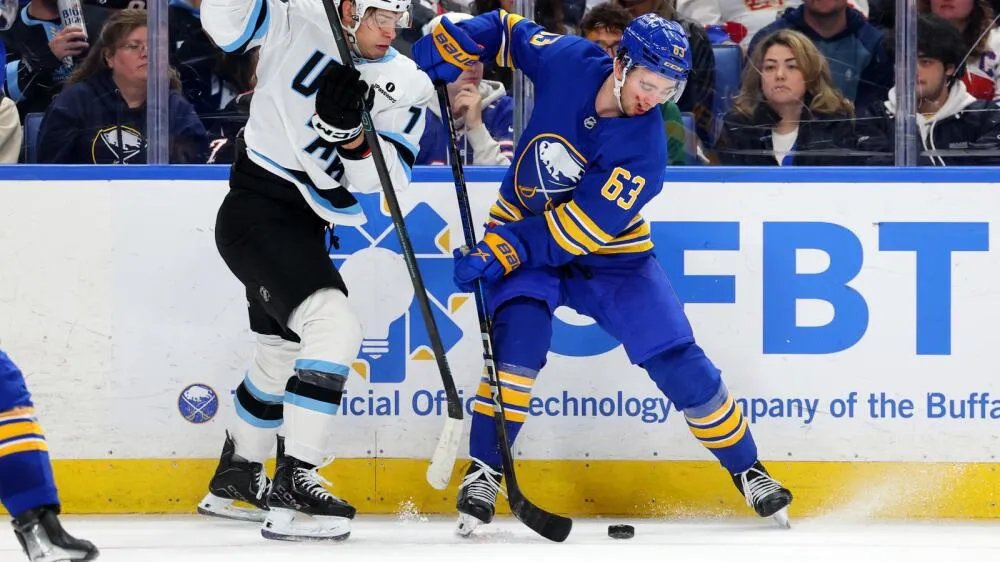
Buffalo Sabres vs Utah Mammoth projected lineup November 12, 2025: Forward combinations taking shape
The Sabres forward lines for this matchup reveal significant lineup adjustments forced by illness and injuries plaguing the roster. The top line remains intact with Tage Thompson centering Ryan McLeod and Alex Tuch, a trio that has provided consistency when Buffalo’s depth has been tested. Thompson continues to be the offensive catalyst the Sabres need, while Tuch’s two-way play has been invaluable during this challenging stretch.
On the second line, Josh Doan slots in alongside Tyson Kozak and Jordan Greenway in what will be an emotionally charged return to Utah for Doan. The young forward has shown flashes of potential since joining Buffalo and will be eager to make an impact against his former organization. Greenway’s physical presence should complement Doan’s skill set, while Kozak provides a responsible two-way game from the center position.
The third line features Isak Rosen, Noah Ostlund, and Jack Quinn—a unit with considerable offensive upside if they can find chemistry. Ostlund notably scored Buffalo’s lone goal in their previous 2-1 loss to Utah on November 4, and he’ll look to build on that performance. According to the matchup from earlier in November, the Sabres struggled to generate sustained offensive pressure, making this line’s production crucial.
The fourth line of Josh Dunne, Peyton Krebs, and Beck Malenstyn rounds out Buffalo’s forward corps with an emphasis on energy and defensive responsibility. This unit will be tasked with limiting Utah’s top players while providing occasional offensive contributions. The Sabres’ forward depth has been severely tested with Jason Zucker, Jiri Kulich, and Zach Benson all out of the lineup due to various ailments.
Buffalo Sabres vs Utah Mammoth projected lineup November 12, 2025: Defensive pairings and goaltending decisions
Buffalo’s defensive structure for this contest reflects both the challenges of injuries and some strategic adjustments. The top pairing of Bowen Byram and Conor Timmins brings a blend of mobility and offensive instincts, though questions remain about their defensive zone consistency. Byram has been adjusting to increased responsibilities this season, while Timmins provides steady veteran presence.
The second pairing features Jacob Bryson alongside Michael Kesselring, who like Doan, makes his return to Utah after being acquired in the trade that sent Peterka to the Mammoth. Kesselring’s size and reach should prove valuable against Utah’s skilled forwards, while Bryson’s skating ability allows for quick transitions. This pairing will likely draw significant minutes against Utah’s top offensive threats.
Mattias Samuelsson and Owen Power form the third defensive duo, with Samuelsson returning after taking a maintenance day during practice. Power, the former first overall pick, continues to develop into the franchise defenseman Buffalo envisioned, though his performance has been inconsistent at times. The absence of Rasmus Dahlin from the lineup removes Buffalo’s most dynamic offensive defenseman, placing additional pressure on this group to contribute in all three zones.
Between the pipes, Colton Ellis is expected to make his second NHL start after winning his debut on October 22 against Detroit with a 4-2 victory. Ellis’s opportunity comes as Ukko-Pekka Luukkonen is listed as scratched, suggesting the Sabres are managing his workload or potentially addressing a minor issue. Alex Lyon serves as the backup, providing insurance should Ellis struggle. This goaltending decision adds an element of unpredictability to Buffalo’s defensive structure, as Ellis remains relatively unproven at the NHL level.
Buffalo Sabres vs Utah Mammoth projected lineup November 12, 2025: Utah’s offensive weapons ready to strike
The Mammoth counter with their own formidable lineup, led by a dynamic top line of Clayton Keller, Logan Cooley, and Nick Schmaltz. This trio has been Utah’s offensive engine throughout the season, with Keller particularly impressive in the previous meeting against Buffalo. He contributed to both Utah goals in that 2-1 overtime victory, assisting on one and scoring the game-winner. The chemistry between these three playmakers creates constant scoring threats through their ability to interchange positions and create space.
Utah’s second line features JJ Peterka between Barrett Hayton and Dylan Guenther, with Peterka facing his former teammates for the first time since the trade. The German winger has quickly found chemistry with his new linemates and provides the speed and finishing ability that makes this line dangerous. Guenther’s shot remains one of the most lethal weapons in Utah’s arsenal, while Hayton’s defensive awareness balances the unit’s two-way play.
The third line of Lawson Crouse, Jack McBain, and Michael Carcone brings physicality and depth scoring to Utah’s attack. Crouse’s power-forward style creates havoc in front of the net, while McBain continues to develop into a reliable two-way center. Carcone adds skill and creativity, making this third unit more than capable of capitalizing on scoring chances. Given Utah’s recent offensive struggles—averaging just 2.3 goals per game during their current rough patch—this line’s contribution could prove decisive.
Kailer Yamamoto, Kevin Stenlund, and Brandon Tanev compose the fourth line, emphasizing energy and defensive responsibility. Tanev’s relentless forechecking sets the tone for Utah’s bottom six, while Yamamoto’s speed creates occasional odd-man rushes. Stenlund provides size and faceoff proficiency down the middle. The Mammoth’s forward depth should give them an edge in this matchup, particularly if they can exploit Buffalo’s injury-depleted roster over four lines.
Buffalo Sabres vs Utah Mammoth projected lineup November 12, 2025: Utah’s defensive structure and netminding approach
Utah’s blue line is anchored by Mikhail Sergachev and Dmitri Simashev on the top pairing, combining veteran savvy with emerging talent. Sergachev brings championship experience and offensive capabilities from the point, while the young Simashev continues to impress with his skating ability and defensive positioning. This pairing will likely match up against Buffalo’s top offensive players, making their performance crucial to limiting Thompson and Tuch.
The second defensive pair of Nate Schmidt and John Marino provides stability and experience. Schmidt’s mobility and puck-moving abilities complement Marino’s defensive-first approach, creating a balanced tandem capable of shutting down opponents while contributing to the transition game. Both veterans understand situational hockey, which should prove valuable in a tight contest where special teams and momentum swings could determine the outcome.
Ian Cole and Nick DeSimone round out Utah’s defensive corps on the third pairing, bringing veteran presence and physical play. Cole’s experience in high-pressure situations steadies the group, while DeSimone has carved out a role as a reliable depth defender. The absence of Sean Durzi due to upper-body injury removes one of Utah’s most offensively gifted defensemen, but this group has shown resilience in maintaining defensive structure.
Karel Vejmelka is projected to start in goal for the Mammoth after Utah held an optional morning skate and indicated they would dress the same 18 skaters from their 4-2 loss to Ottawa. Vejmelka has been inconsistent this season, but he’s capable of stealing games when he finds his rhythm. Vitek Vanecek provides a capable backup option should the Mammoth opt for a goaltending change. With both teams struggling defensively of late—Buffalo allowing 3.7 goals per game and Utah surrendering 4.3 goals per game during their respective losing streaks—the goaltending matchup between Ellis and Vejmelka could ultimately decide this contest.
Buffalo Sabres vs Utah Mammoth projected lineup November 12, 2025: Key injuries shaping both rosters
Buffalo’s injury situation has reached critical levels, forcing the organization to dig deep into their prospect pool and AHL affiliate in Rochester. Josh Norris remains on injured reserve with an upper-body injury, while Justin Danforth also sits on IR with a lower-body ailment. The absences of Jason Zucker and Jiri Kulich due to illness further deplete Buffalo’s forward depth, removing two players who were expected to contribute offensively.
Perhaps most significantly, Zach Benson’s lower-body injury removes one of Buffalo’s most promising young forwards from the lineup. Benson’s absence forces other young players like Rosen and Ostlund into expanded roles, accelerating their development timeline whether they’re ready or not. The Sabres reassigned forward Carson Meyer to Rochester on Tuesday, suggesting they feel comfortable with their current forward configuration despite the numerous absences.
On defense, Rasmus Dahlin’s absence cannot be overstated. The Swedish defenseman serves as Buffalo’s quarterback on the power play and logs heavy minutes in all situations. His offensive creativity from the blue line and transition game are irreplaceable, forcing the remaining defensemen to shoulder increased responsibilities. The fact that Mattias Samuelsson returned from his maintenance day provides some relief, but Buffalo’s blue line depth remains tested.
Utah faces fewer injury concerns but still deals with significant absences. Sean Durzi’s upper-body injury removes a key offensive contributor from the back end, while Alex Kerfoot’s lower-body issue and Juuso Valimaki’s injury thin Utah’s depth. The Mammoth’s decision to dress the same lineup from their loss to Ottawa suggests they’re comfortable with their available personnel and seeking continuity rather than lineup experimentation. This stability could prove advantageous against a Buffalo team still adjusting to numerous roster changes.
Buffalo Sabres vs Utah Mammoth projected lineup November 12, 2025: Special teams battle and tactical considerations
Special teams will likely play a pivotal role in determining the outcome of this matchup, particularly given both teams’ recent defensive struggles. Buffalo’s power play has been inconsistent without Dahlin orchestrating from the point, placing additional pressure on Thompson and Tuch to generate chances from different looks. The Sabres’ inability to convert with the extra attacker has contributed to their recent slide, managing just 2.4 goals per game over their last seven contests.
Utah’s power play counters with significant firepower, featuring Keller, Schmaltz, and Guenther as primary threats. The Mammoth have demonstrated the ability to strike quickly when given opportunities, though their recent scoring drought suggests they’re pressing and forcing plays rather than letting chances develop naturally. The penalty kill units for both teams must remain disciplined, as any defensive breakdowns could prove costly in what projects as a low-scoring affair.
Five-on-five play will test both teams’ structural integrity and system adherence. Buffalo has struggled to maintain defensive zone coverage during their losing streak, allowing opponents to generate high-danger chances from the slot and below the goal line. Head coach Lindy Ruff faces the challenge of simplifying the game plan while still providing enough offensive structure for his injury-depleted forward group to create scoring opportunities.
Utah must rediscover the defensive commitment that fueled their seven-game winning streak earlier in the season. During that stretch, the Mammoth limited opponents to just 2.1 goals per game while their offense produced timely goals. The recent slide has seen those numbers flip dramatically, suggesting defensive breakdowns and lack of attention to detail rather than a fundamental system failure. The team that executes their structure most consistently will likely emerge victorious in this encounter.
Buffalo Sabres vs Utah Mammoth projected lineup November 12, 2025: Storylines and momentum shifts to monitor
The return of Doan and Kesselring to Utah adds compelling theater to this contest. Both players will undoubtedly face heightened emotions playing against their former organization for the first time, and how they channel those feelings could impact their performance. Doan, in particular, has spoken about his development path and appreciation for his time in Utah’s system, making this return bittersweet rather than adversarial.
Similarly, Peterka’s first game against Buffalo carries significant weight. The German forward was a popular teammate during his time with the Sabres, and the trade caught many by surprise. His performance will be scrutinized by Buffalo fans and management alike, particularly if he produces against his former club. These emotional subplots often inspire elevated performances, suggesting both traded players could factor prominently in the outcome.
From a standings perspective, Buffalo desperately needs points to stop their slide before it derails their season entirely. At 5-6-4, the Sabres remain within striking distance of playoff positioning, but continued losing will create a deficit that proves insurmountable. The character of this team will be tested during this road swing through the Western Conference, and a victory in Salt Lake City could serve as the catalyst for turning their season around.
Utah, despite their recent struggles, remains in solid playoff position at 9-7-0. However, their 1-5-0 record since the winning streak ended raises questions about whether that hot stretch was sustainable or merely a temporary surge. The Mammoth have shown they can compete with elite teams when playing their system, but they’ve also demonstrated vulnerability when trailing or facing adversity. How they respond to this challenge against a desperate Buffalo team will reveal much about their playoff credentials and mental fortitude.
The contrast in recent performances between these teams makes this matchup particularly intriguing. Buffalo enters having lost three straight but showed fight in their 6-3 defeat to Carolina, suggesting they’re not far from breaking through. Utah’s 4-2 loss to Ottawa was more concerning, as the Mammoth failed to generate sustained pressure and looked disjointed defensively. Both teams understand that November games carry weight in the playoff race, making this contest between two struggling clubs potentially season-defining.
As the puck drops at 9:00 p.m. ET at the Delta Center, fans watching on Utah16, MSG-B, or TVAS will see two teams searching for answers. For similar lineup analysis and projections throughout the season, the Utah Mammoth’s matchup against Ottawa provides context for how their recent performances have evolved. The detailed information from NHL.com’s official preview confirms the projected lineups and injury situations that will shape this encounter. Whether Ellis can build on his successful NHL debut or Vejmelka can rediscover his form may ultimately decide which team breaks their losing streak and gains crucial momentum heading into the heart of the season.

Par Mike Jonderson
Mike Jonderson is a passionate hockey analyst and expert in advanced NHL statistics. A former college player and mathematics graduate, he combines his understanding of the game with technical expertise to develop innovative predictive models and contribute to the evolution of modern hockey analytics.