





The Seattle Kraken engineered a spectacular third-period comeback on Thursday night, erasing a two-goal deficit to defeat the Chicago Blackhawks 3-2 at United Center. Three unanswered goals in the final frame, capped by Jaden Schwartz’s power-play tally with just 2:18 remaining, propelled the Kraken to victory and snapped Chicago’s impressive six-game point streak. The dramatic finish left Blackhawks head coach Jeff Blashill visibly frustrated with his team’s effort, while Kraken players celebrated a character win that showcased their resilience.
Joey Daccord stood tall between the pipes for Seattle, turning aside 22 shots, while Spencer Knight made 24 saves in a losing effort for Chicago. The game featured several notable storylines, including the NHL debut of Oscar Fisker Molgaard, a controversial hit that forced Andre Burakovsky from the contest, and a costly penalty by Connor Bedard that directly led to the game-winning goal. As the final horn sounded, the Kraken improved to 10-5-5 on the season while the Blackhawks fell to 10-6-4, creating new questions about consistency for both squads.
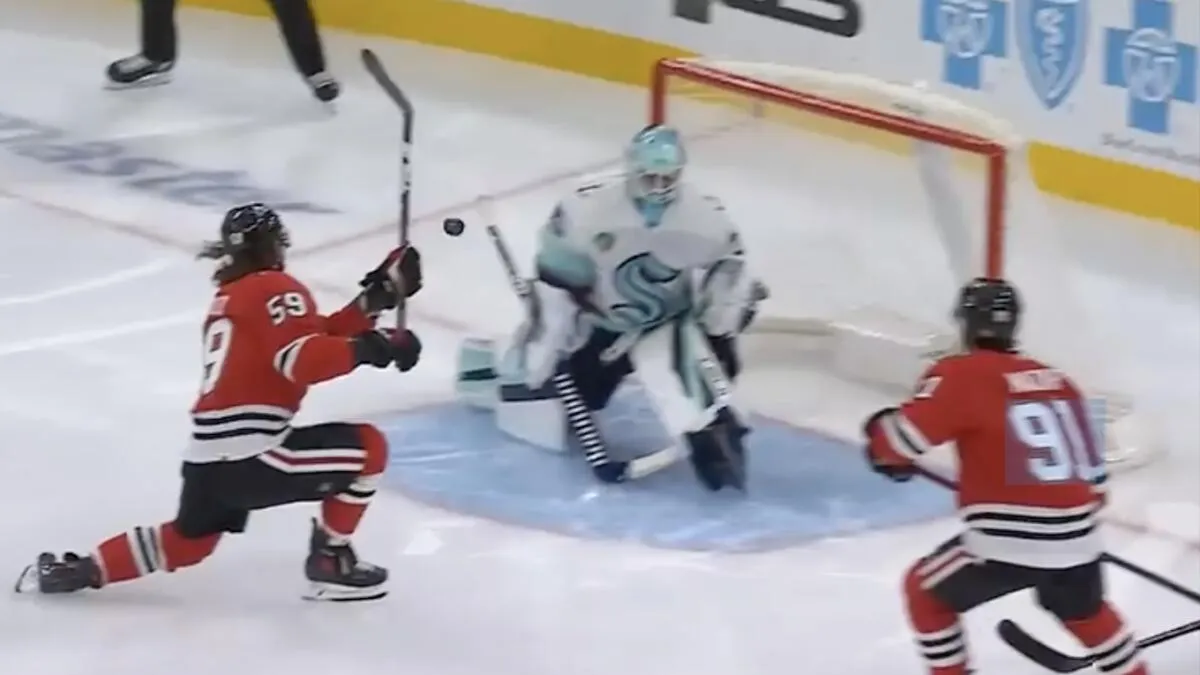
How the Kraken mounted their unlikely comeback
Seattle entered the third period facing a 2-0 deficit and looking dead in the water after managing just 15 shots through 40 minutes of play. Tyler Bertuzzi had opened the scoring 43 seconds into the second period, converting a feed from Teuvo Teravainen for his 10th goal of the season. Teravainen later doubled Chicago’s lead with a power-play marker at 10:07, finishing a brilliant one-handed pass from Bertuzzi that caught the Kraken penalty kill completely flat-footed.
The intermission proved transformative for Seattle. Tye Kartye ignited the rally just 5:09 into the third, deflecting Brandon Montour’s point shot past Knight after the puck caromed off Oscar Fisker Molgaard. The young Danish forward, playing in his first NHL game, earned his first career point on the play, becoming just the second Danish player in league history to record a point in his debut. Shane Wright tied the game 2:04 later, redirecting Ryker Evans’ wrist shot from the high slot while positioned perfectly in front of the crease.
The momentum had completely shifted. Seattle outshot Chicago 12-3 in the final period, overwhelming the Blackhawks with sustained offensive pressure and aggressive forechecking that created multiple high-danger scoring chances. The breakthrough came when Bedard, frustrated by a perceived missed hooking call, drew an unsportsmanlike conduct penalty at 15:44 of the third period. The Kraken power-play unit capitalized immediately, with Montour feeding Schwartz at the side of the crease for the decisive goal that slipped between Knight’s legs.
Critical takeaways from Thursday night’s thriller
Seattle’s third-period transformation revealed championship character
The Kraken’s response after two lackluster periods demonstrated the mental toughness of a team growing into a serious playoff contender. Rather than folding after falling behind 2-0, Seattle made crucial adjustments between periods that completely changed the game’s complexion. Their forecheck became more aggressive, their defensive gap control tightened significantly, and they began winning the puck battles along the boards that they had been losing earlier.
“I don’t know if it was anything in specific, but we’ve got to try and start the game like that instead of waiting two periods because obviously there was a difference in our play,” Kartye admitted after the game. His honesty reflects a team aware of its inconsistency but also capable of elevating its performance when it matters most. The Kraken’s ability to generate 12 shots in the third period while limiting Chicago to just three demonstrates their potential to dominate play against quality opposition.
This resilience has become a hallmark of Seattle’s season. Thursday’s victory marked their third win when trailing after two periods, placing them among the league leaders in comeback victories. As the season progresses, this never-say-die attitude will serve them well in tight playoff races where every point becomes precious.
Chicago’s collapse exposed concerning consistency issues
For the Blackhawks, the loss represents a significant step backward after building momentum during a six-game point streak. Head coach Jeff Blashill didn’t mince words in his postgame assessment, calling out his team’s lack of preparation and compete level. “We had too many guys who weren’t ready,” Blashill stated bluntly. “I talk all the time (that) it’s an everyday league, and we had too many guys who weren’t ready to compete and play hard hockey.”
The numbers support his frustration. After controlling the second period with 14 shots to Seattle’s six, Chicago completely disappeared in the third, mustering only three shots on Daccord. Their defensive structure, which had been solid through two periods, crumbled under Seattle’s pressure. The Blackhawks’ top lines went quiet when it mattered most, and their inability to generate any offensive zone time in the final frame allowed the Kraken to dictate the game’s tempo completely.
The loss of Burakovsky to an upper-body injury after Ryan Lindgren’s hit compounded Chicago’s problems. Burakovsky, who had been producing consistently alongside Bedard, was ruled out for Friday’s matchup in Buffalo. His absence creates a significant hole in the Blackhawks’ top-six forward group that will test the team’s depth in coming games.
Special teams and discipline decided the outcome
Both teams scored on the power play, but Seattle’s man-advantage unit delivered when the game hung in the balance. The Kraken converted at a crucial moment, capitalizing on Bedard’s ill-timed penalty to score the winner. Bedard’s frustration stemmed from a perceived missed hooking call on a scoring chance, but his reaction proved costly. “Obviously, in the moment, you think it’s a penalty, but I have to control my emotions in a better way,” Bedard acknowledged. “I put our team in a vulnerable spot there, so just got to be better.”
Chicago’s penalty kill, which had been excellent during their point streak, failed them at the worst possible time. The Kraken’s power-play unit moved the puck with precision, using Montour’s speed to create space before finding Schwartz for the tap-in. The sequence highlighted Seattle’s improved special teams play, which has been a focus for coach Lane Lambert throughout the season.
The Blackhawks’ own power play, which converted on Teravainen’s goal, generated chances early but couldn’t produce when the game tightened in the third. Their inability to draw penalties and capitalize on man-advantage opportunities ultimately proved as costly as their defensive lapses.
Rookie milestones and veteran leadership mattered
Oscar Fisker Molgaard’s NHL debut provided a significant bright spot for the Kraken organization. The 20-year-old Danish center notched his first career point on Kartye’s goal and became only the second Danish player ever to record a point in his league debut. Centering the fourth line alongside fellow youngsters Kartye and Jani Nyman, Molgaard played 6:50 across 12 shifts, delivering a hit and demonstrating responsible defensive positioning.
“It’s pretty surreal,” Molgaard said of his debut. “It’s a childhood dream coming true, so yeah, I’ve been waiting for this moment my whole life. Good to get the first one out of the way.” His immediate contribution validates Seattle’s player development system and provides the organization with another promising young center in their pipeline.
On the veteran side, Montour’s two-assist performance showcased his importance to Seattle’s offensive structure. His ability to activate from the blue line and create offense from the point has made him indispensable. Jamie Oleksiak also played in his 700th NHL game, reaching a milestone that reflects his steady presence on the Kraken blueline and his value as a locker-room leader.
What this result means for both teams moving forward
Seattle’s victory strengthens their position in the Pacific Division standings and validates their identity as a resilient, never-quit hockey club. The win extends their road trip success and builds momentum heading into Saturday’s matchup in Pittsburgh. More importantly, it demonstrates their ability to win different ways—both with dominant starts and dramatic comebacks. As the season enters its quarter mark, the Kraken appear well-positioned for a playoff push, though consistency remains their primary challenge.
For Chicago, the loss serves as a wake-up call after a successful stretch of hockey. The Blackhawks must address their third-period letdowns and ensure they’re bringing the necessary compete level every night. Bedard’s postgame accountability offers hope that the young superstar will learn from his mistake, but the team needs more consistent support from its supporting cast. Friday’s game in Buffalo becomes a crucial test of their ability to bounce back from disappointment and re-establish their defensive identity.
The injury to Burakovsky creates an opportunity for other forwards to step up, potentially giving Frank Nazar or Lukas Reichel more significant roles in the top-six. How Chicago adjusts its forward lines and responds to adversity will define whether this loss becomes an isolated stumble or the start of a troubling trend.
The Kraken’s comeback victory reminds us that in today’s NHL, no lead is safe and special teams can decide games in an instant. Seattle’s ability to capitalize on Chicago’s mistakes while showcasing their own resilience makes them a dangerous opponent as the season progresses. For the Blackhawks, the painful lesson in discipline and consistency provides valuable experience for a young team still learning what it takes to win at the highest level every single night.
Frequently Asked Questions

Par Mike Jonderson
Mike Jonderson is a passionate hockey analyst and expert in advanced NHL statistics. A former college player and mathematics graduate, he combines his understanding of the game with technical expertise to develop innovative predictive models and contribute to the evolution of modern hockey analytics.