

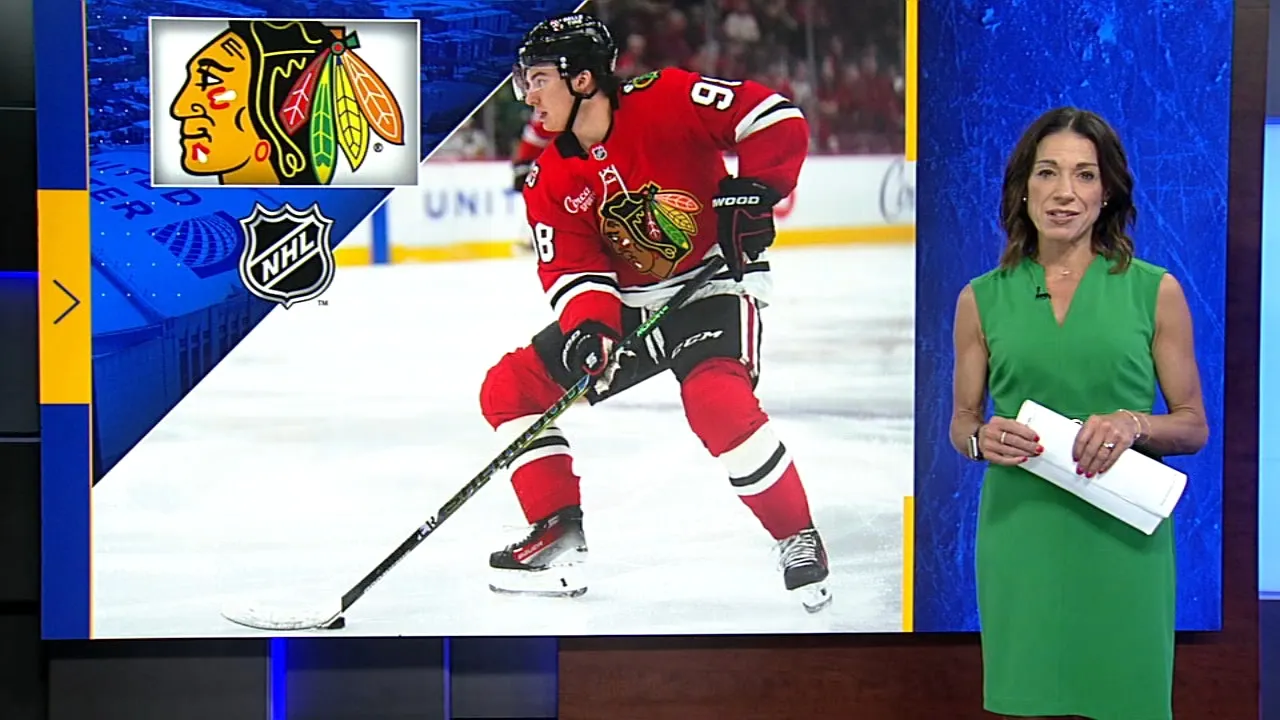
Connor Bedard agreed to a five-year $75 million contract extension with the Chicago Blackhawks on July 18 2026 carrying a $15 million annual cap hit.
Contract structure and cap impact
The deal runs from the 2026-27 season through 2030-31 and covers exactly one year of unrestricted free agency.
Year-one compensation includes a $7.2 million salary plus a $9.8 million signing bonus for a total of $17 million.
Subsequent years reduce base salary by $1 million each season while the $9.8 million signing bonus remains constant, producing the $15 million AAV.
The contract consumes 14.4 percent of the projected salary cap, nearly identical to Auston Matthews’ second deal at 14.3 percent.
Full no-movement protection applies only in the final year.
Market context and player decisions
Leo Carlsson’s five-year $90 million offer-sheet match at $18 million AAV set the 2026 benchmark.
Bedard’s $15 million AAV slots him third behind Carlsson and Kirill Kaprizov’s $17 million.
Agent Don Meehan confirmed Bedard never considered an offer sheet and remained committed to Chicago’s rebuild.
General Manager Kyle Davidson highlighted Bedard’s rapid rise to elite status since the 2023 draft.
Bowen Byram’s six-year $12.5 million AAV extension already occupies additional cap space alongside Frank Nazar and other prospects.
Strategic implications for both sides
The shorter term follows Matthews’ pattern of mid-length deals that maximize value across multiple contracts as the cap rises.
Chicago gains cost certainty through Bedard’s prime years while retaining flexibility to add talent before the 2031 offseason.
Bedard enters 2026-27 as the third-highest-paid player in the NHL at $15 million AAV.
The structure leaves the Blackhawks positioned to pursue further extensions without immediate cap strain.
All eyes now turn to Adam Fantilli’s negotiations in Columbus for the next comparable.
Frequently Asked Questions
Sources

Par Mike Jonderson
Mike Jonderson is a passionate hockey analyst and expert in advanced NHL statistics. A former college player and mathematics graduate, he combines his understanding of the game with technical expertise to develop innovative predictive models and contribute to the evolution of modern hockey analytics.