













The Dallas Stars’ early-season struggles continued at American Airlines Center on Thursday night as they fell 3-2 in overtime to the Los Angeles Kings. Adrian Kempe’s quick strike just 37 seconds into the extra period extended Dallas’ losing streak to four games, dropping them to 3-3-1 after a promising 3-0-0 start. What appeared to be a rejuvenated team under new head coach Glen Gulutzan has hit a significant speed bump, with the Stars now searching for answers to snap out of their slump.
While the loss was disappointing, the Stars showed considerable improvement in their overall play compared to recent performances. They controlled possession with a 58-48 advantage in shot attempts and generated more scoring chances at even strength than their opponents. However, the inability to convert these opportunities into goals continues to haunt Dallas, and the Los Angeles Kings capitalized on their chances when it mattered most.
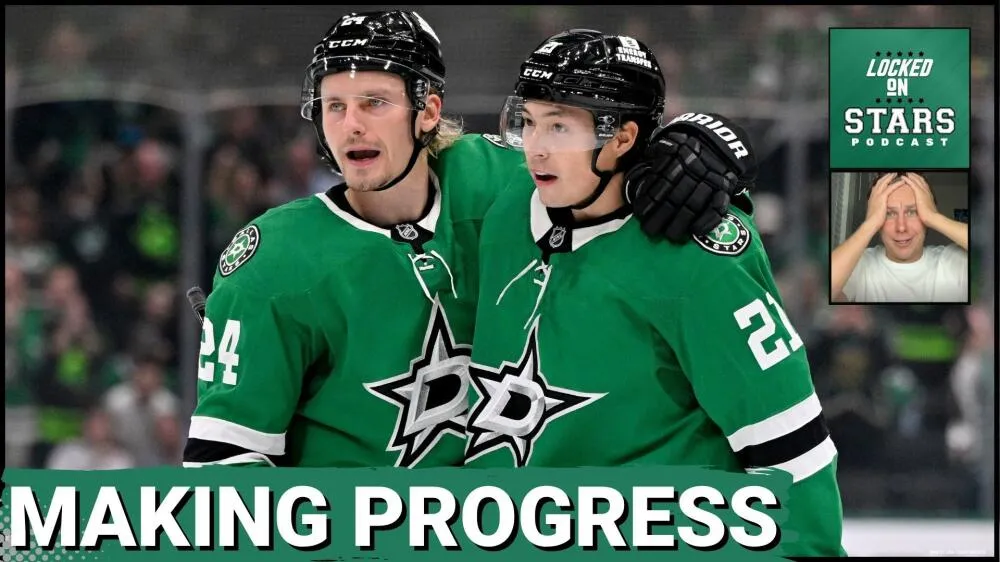
The power play carries the offensive load in the Dallas Stars 3-2 overtime loss to Los Angeles Kings takeaways
The most glaring positive from Thursday’s contest was the continued excellence of the Stars’ power play, which accounted for both Dallas goals. After finishing 17th in the NHL last season with a 22% success rate, the special teams unit has undergone a remarkable transformation under Gulutzan’s guidance. Currently ranked third in the league with a 31.8% conversion rate through seven games, the power play has become the team’s most reliable source of offense during this difficult stretch.
Jason Robertson opened the scoring for Dallas on the man advantage early in the second period, tying the game at 1-1 after former Stars forward Corey Perry had given Los Angeles the lead on a 5-on-3 opportunity late in the first. Robertson’s quick release and positioning in front of Darcy Kuemper have been hallmarks of his game, and he continues to produce despite the team’s struggles with three goals and seven points through seven games.
Wyatt Johnston added the second power-play marker early in the third period after Miro Heiskanen drew a high-sticking penalty. The top unit of Robertson, Johnston, Roope Hintz, Heiskanen, and Mikko Rantanen has developed impressive chemistry, with all five players logging more than six minutes of power-play time. The group went 2-for-5 on the night, demonstrating efficiency and execution when given the opportunity.
Robertson explained the unit’s success after the game: “I think it starts with winning the draw. Centermen have been bearing down, breakouts have been pretty solid, and retrievals are a big positive for us. We’re not one-and-done, we re-hunt, reload and re-attack. We’re starting to gel.”
The concern, however, is that the Stars have become entirely dependent on special teams for their offensive production. During their current four-game losing streak, Dallas has managed just seven goals compared to 15 in their first three victories. This dramatic drop-off reveals a troubling trend that extends beyond simple variance.
Five-on-five scoring drought defines Dallas Stars 3-2 overtime loss to Los Angeles Kings takeaways
The most significant problem facing the Stars is their complete inability to score at even strength. Despite dominating possession and generating numerous quality chances against the Kings, Dallas was shut out during 5-on-5 play for the second consecutive game. This deficiency has become the defining characteristic of their recent slide and represents the primary area requiring immediate improvement.
Coach Gulutzan acknowledged the issue directly in his post-game comments: “We were good in all departments except the most important one. Five-on-five, we’ve got to find some scoring. We had a lot of chances, we out-chanced them heavily five-on-five, but we’ve got to find the back of the net.”
The Stars’ top forwards are creating opportunities but failing to capitalize. Hintz, Rantanen, Matt Duchene, and Tyler Seguin have all struggled to contribute offensively during this stretch, putting additional pressure on Robertson and Johnston to carry the load. The loss of depth scoring that departed during the summer is becoming more apparent with each passing game.
This even-strength drought is particularly concerning given Dallas’ identity as a team built on strong 5-on-5 play. The Stars cannot rely solely on power-play opportunities to sustain offensive production over an 82-game season. High-danger chances need to result in goals, and finishing ability must improve dramatically if Dallas hopes to compete with the elite teams in the Western Conference.
The overtime loss encapsulated this struggle perfectly. Despite outshooting Los Angeles and controlling territorial play for extended stretches, the Stars couldn’t find the decisive goal when the game was on the line. Kempe’s overtime winner came on a two-on-one rush during a counter-attack, punishing Dallas for their inability to convert their own chances moments earlier.
Defensive concerns emerge in Dallas Stars 3-2 overtime loss to Los Angeles Kings takeaways
While offensive struggles have dominated the conversation, defensive lapses have also contributed to the losing streak. The Stars allowed two goals against the Kings that could have been prevented with better execution and awareness. Former Dallas defenseman Cody Ceci scored from distance approximately a minute after Robertson’s equalizer, immediately erasing the momentum the Stars had built.
The penalty kill, which was a strength throughout last season at 82.0% (fourth in the NHL), has regressed dramatically to start the new campaign. Currently sitting at 65.2% and ranked 30th in the league, the unit allowed Perry’s goal on a 5-on-3 situation late in the first period. The sequence began when Rantanen took a cross-checking penalty in the offensive zone, followed by Ilya Lyubushkin’s high-sticking infraction during the kill.
Jake Oettinger, typically one of the league’s most reliable netminders, has also experienced an uncharacteristic start to the season. While he made several excellent saves to keep Dallas in the game against Los Angeles, he has allowed at least one questionable goal in nearly every outing. The defensive structure in front of him needs tightening, and communication between the goaltender and his defensemen requires improvement.
Thomas Harley and the defensive corps have struggled with consistency, occasionally losing track of assignments and allowing dangerous odd-man rushes. The transition from former coach Pete DeBoer’s system to Gulutzan’s approach may require additional time, but the immediate results have been concerning. Defensive zone coverage needs to become more disciplined, particularly in protecting the slot area.
The overtime period exemplified these defensive breakdowns. Kempe’s winning goal came just 37 seconds into the 3-on-3 session when Los Angeles executed a textbook counter-attack. Better gap control and support positioning might have prevented the Kings from generating such a clean two-on-one opportunity in a critical moment.
Perspective and patience needed for Dallas Stars 3-2 overtime loss to Los Angeles Kings takeaways
Despite the frustration surrounding this losing streak, context matters significantly when evaluating the Stars’ early-season performance. At 3-3-1 through seven games, Dallas is hardly alone among contenders experiencing growing pains. The Toronto Maple Leafs hold an identical 3-3-1 record, while the two-time defending champion Florida Panthers sit at 4-5-0. The Tampa Bay Lightning have stumbled to a 1-4-2 start, and the Edmonton Oilers and Minnesota Wild are both 4-3-1.
The Western Conference, in particular, has demonstrated remarkable parity early in the season. Even the Kings, who defeated Dallas on Thursday, carry a 3-3-2 record and have experienced their own inconsistencies. October results rarely determine playoff positioning, and teams traditionally need 20-25 games to establish their true identity under new coaching systems.
Johnston emphasized the importance of maintaining proper perspective: “There are some positives, but at the end of the day, you’ve got to win. I think there are definitely some things we did well. You want the process to be right, but you also really want to win.”
Gulutzan’s approach focuses on process over results, trusting that improved execution will eventually translate to victories. The possession metrics and scoring chance generation against Los Angeles suggest the Stars are moving in the right direction. They forced Kuemper to make several difficult saves and controlled territorial play for significant portions of the game. These underlying numbers indicate better results should follow if the team continues playing this way.
The “new coach bump” that propelled Dallas to a 3-0-0 start has worn off, and the team now faces the reality of implementing a new system while maintaining competitive standards. Patience from both players and fans will be required as Gulutzan continues installing his structure and philosophy. With 75 games remaining, there’s ample time for the Stars to find their rhythm and establish themselves as legitimate contenders in the Central Division.
The schedule offers no respite, however, as the Carolina Hurricanes visit American Airlines Center on Saturday. This presents another challenging test for a Stars team desperate to end their losing streak and build momentum. How Dallas responds to adversity in the coming weeks will reveal much about their character and championship aspirations.
The path forward requires contributions from throughout the lineup, particularly from the veteran core that has underperformed during this stretch. If Hintz, Rantanen, Duchene, and Seguin can rediscover their offensive touch while the defense tightens its coverage, the Stars possess the talent to overcome this early-season slump. The power play provides a foundation to build upon, and once the even-strength scoring returns, Dallas should regain its winning form. For now, the focus must remain on incremental improvements and trusting the process Gulutzan has established.

Par Mike Jonderson
Mike Jonderson is a passionate hockey analyst and expert in advanced NHL statistics. A former college player and mathematics graduate, he combines his understanding of the game with technical expertise to develop innovative predictive models and contribute to the evolution of modern hockey analytics.