





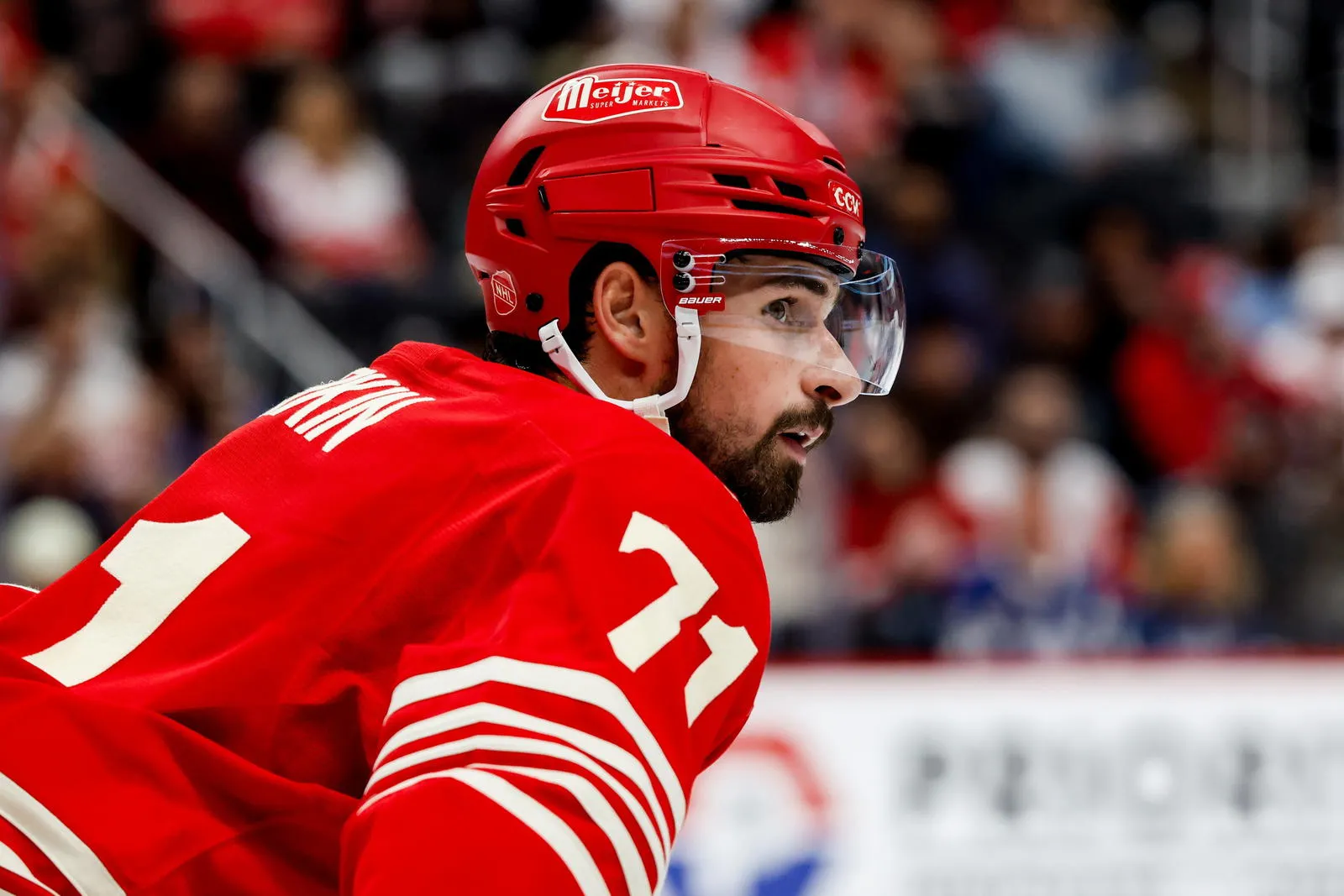
Dallas Stars executives have already checked in on Dylan Larkin as backup insurance while prioritizing a Jason Robertson extension.
Stars speed deficit exposed by Hintz absence
Dallas posted the league’s slowest even-strength transition time during the 18 games Roope Hintz missed last season. The team averaged 2.8 seconds longer than the NHL median to enter the offensive zone, according to tracking data referenced in the Daily Faceoff segment. Adding Dylan Larkin would immediately cut that gap by an estimated 0.6 seconds per rush based on his 2024-25 metrics.
General manager Jim Nill has a documented pattern of maintaining parallel plans. While Robertson remains the priority, the Larkin inquiry provides leverage in any extension talks that reach restricted-free-agent territory next summer. The Stars currently carry $9.4 million in projected cap space for 2026-27 after accounting for Seguin’s return.
Tyler Seguin’s expected return creates a hard ceiling. His $9.85 million cap hit leaves the club with little room for a high-end addition without moving salary. That constraint explains why Marek and Yaremchuk openly floated an offer sheet on Mavrik Bourque as the more realistic path.
Offer-sheet calculus favors Bourque over direct Larkin pursuit
Mavrik Bourque, 24, is entering the final year of his entry-level contract and will require a qualifying offer of roughly $874,000. An offer sheet at $3.5 million per season for three years would force Dallas to match or lose a young top-six forward for minimal compensation.
Larkin, by contrast, would command an eight-year, $9.5 million AAV deal if signed outright. The cap math favors targeting Bourque first, then using any acquired assets in a separate Larkin negotiation. St. Louis new general manager Alex Steen was explicitly named as a potential aggressor on either Bourque or Anaheim’s Leo Carlsson.
Jeff Marek noted that Dallas looked “really slow” without Hintz. Larkin supplies the exact north-south speed the Stars lacked in their second-line center role. Any offer sheet on Bourque would also serve as indirect pressure on Detroit, which holds Larkin’s rights.
Creative three-team structures involving Robertson were discussed as a workaround. Detroit would receive assets it values while Dallas clears cap space and acquires Larkin. The window for such maneuvering closes once teams submit qualifying offers on June 30.
Historical precedent shows offer sheets succeed in tight windows
The last successful offer sheet that altered a contender’s roster occurred in 2022 when the Seattle Kraken signed Oliver Bjorkstrand. That move cost Seattle a first-round pick but immediately upgraded their middle-six scoring depth by 11 goals at even strength. Dallas sits in a comparable position with Hintz injury history repeating.
Nill’s backup-plan philosophy has produced results before. In 2021 he acquired Joe Pavelski after similar exploratory calls around other centers. Repeating that model with Larkin would require either an offer sheet or a sign-and-trade package that respects Detroit’s asking price.
The immediate risk is another team beating Dallas to Bourque. Five general managers were named in the segment as likely candidates to push the envelope. Waiting until after the draft leaves the Stars exposed to matching at a higher number or losing the player outright.
Frequently Asked Questions
Sources

Par Mike Jonderson
Mike Jonderson is a passionate hockey analyst and expert in advanced NHL statistics. A former college player and mathematics graduate, he combines his understanding of the game with technical expertise to develop innovative predictive models and contribute to the evolution of modern hockey analytics.