











The Dallas Stars face a devastating blow to their 2025-26 campaign as veteran forward Tyler Seguin is expected to miss the remainder of the season with a torn ACL in his right knee. The injury occurred during Tuesday night’s matchup against the New York Rangers at Madison Square Garden, cutting short the 33-year-old’s season after just 27 games. Coach Glen Gulutzan delivered the grim news to reporters on Wednesday, confirming what many feared after seeing Seguin helped off the ice in visible pain.
This development represents another significant setback for Seguin, who fought diligently to return from hip surgery that limited him to just 20 regular-season games in 2024-25. Having recently celebrated his 1,000th NHL game milestone on October 30, the timing of this injury feels particularly cruel for a player who had been a model of durability this season prior to the incident.
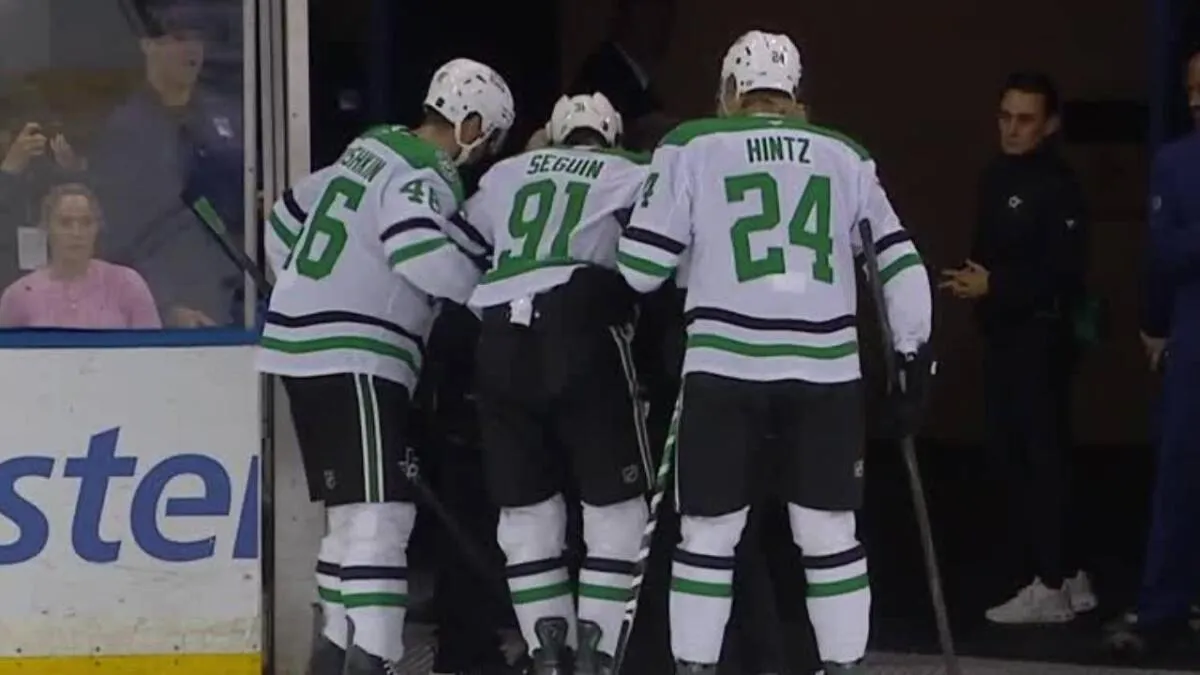
How the Tyler Seguin torn ACL injury happened at Madison Square Garden
The incident unfolded early in the first period during the Stars’ 3-2 overtime loss to the Rangers. Seguin had only logged two brief shifts before disaster struck at the 1:44 mark. While battling for puck possession near the boards, Seguin became entangled with Rangers defenseman Vladislav Gavrikov, causing his right knee to twist awkwardly. The veteran forward immediately went down in obvious distress, unable to put weight on his leg or skate off under his own power.
Multiple teammates and an athletic trainer rushed to assist Seguin, who required significant support just to reach the tunnel leading to the visiting locker room area. The scene at Madison Square Garden was somber, with Stars players visibly concerned as one of their core leaders and offensive contributors was helped off the ice. Initial fears about the severity materialized when medical scans revealed the complete tear of his anterior cruciate ligament, necessitating surgical intervention and a lengthy rehabilitation process.
Gulutzan addressed the media with a heavy tone, acknowledging the emotional weight of the diagnosis. “We didn’t get great news today,” the coach admitted. “Haven’t spoken to Tyler yet, but probably just letting everybody know that he’s going to be out for a significant amount of time — probably the rest of the season.” The straightforward assessment left no room for optimism about a quick recovery or potential return for playoff hockey.
The recovery timeline and what it means for Seguin’s future
ACL injuries typically require 6-9 months of recovery following surgery, effectively eliminating any possibility of Seguin returning for the 2025-26 postseason. For a player already in his mid-thirties, this type of injury raises legitimate questions about long-term career prospects and the ability to return to elite-level performance. The anterior cruciate ligament is crucial for knee stability, particularly for hockey players who rely on explosive skating, quick directional changes, and powerful stride mechanics.
Seguin’s resilience was already tested during the previous campaign when he underwent hip surgery that sidelined him for most of the regular season. His successful comeback for the playoffs—where he contributed eight points in 18 games during the Stars’ run to the Western Conference Final—demonstrated his commitment and work ethic. Gulutzan specifically praised this dedication, noting, “I didn’t live it with him last year, but I did talk to our leadership group here and what I did know is just how hard he worked and the effort that he put in to come back last year and how diligent he was.”
The veteran center had been enjoying a productive season before the injury, tallying 17 points through 27 games, including seven goals and 10 assists. He had appeared in every contest this season, making the sudden rupture of his ACL even more difficult to process for both player and organization. His leadership presence in the locker room may prove even more difficult to replace than his on-ice production, as Gulutzan identified him as someone who had impressed him most with his “leadership ability” since the coach’s arrival.
Dallas Stars injury crisis deepens ahead of playoff push
The Stars were already navigating significant injury challenges before Seguin’s devastating diagnosis, creating a roster management nightmare for Gulutzan and general manager Jim Nill. Forward Matt Duchene has missed 23 consecutive games and 24 of 25 contests overall after sustaining an upper-body injury from a hit by Minnesota Wild defenseman Jake Middleton on October 14. While Duchene’s return appears imminent—potentially “sooner than later” according to Gulutzan—the team will need him to shoulder a much heavier burden in Seguin’s absence.
The injury situation has forced Dallas to adopt a “next man up” mentality, though the quality of replacements matters significantly when losing a player of Seguin’s caliber. Nathan Bastian drew into the lineup for Wednesday’s game against the New Jersey Devils, marking a homecoming of sorts as he faced his former team. Bastian had played good hockey in limited minutes this season but represents a depth option rather than a top-six replacement.
The mounting injuries across the NHL have become a league-wide concern, with compressed schedules and intense physical demands taking their toll on rosters. Gulutzan acknowledged this reality while maintaining focus on his own locker room. “There’s lots of injuries piling up, and lots of games, so we just got to keep moving forward,” he explained. “There’s lots of guys that their opportunity is born from some of this misfortune. We just have to take that away: It’s next guy up, next guy’s opportunity and run with it.”
Roster adjustments and potential trade deadline implications
Dallas currently sits second in the Central Division with a 17-5-5 record, positioning themselves as legitimate Stanley Cup contenders despite the adversity. However, losing Seguin’s 826 career points and playoff experience creates a void that internal options alone may not fill. Young players like Mavrik Bourque will receive increased opportunities and responsibilities, presenting a chance to prove they can contribute at a championship level.
The Stars possess depth at forward, but Seguin’s unique combination of scoring touch, playmaking vision, and two-way responsibility makes him irreplaceable in the truest sense. His absence affects power-play units, penalty kill configurations, and even defensive zone faceoff responsibilities. The coaching staff must now reconfigure line combinations and special teams assignments while maintaining the team’s competitive edge in a challenging Western Conference landscape.
Management faces difficult decisions as the March trade deadline approaches. While the organization maintains confidence in its internal depth, losing a $9.85 million cap hit player for the season creates financial flexibility to explore external additions. The question becomes whether Nill should pursue a rental forward to bolster scoring or trust his developmental pipeline to produce under pressure. The team’s performance over the next month will heavily influence this calculus.
What Tyler Seguin torn ACL means for the Stars’ championship window
The Stars advanced to the Western Conference Final last season and entered 2025-26 with legitimate Cup aspirations. Their strong start validated those expectations, but championship windows can close rapidly in the salary cap era, especially when core players suffer significant injuries. Seguin represents one of the final links to the team’s 2020 Stanley Cup Final appearance, and his playoff pedigree would have been invaluable during a deep postseason run.
Dallas must now determine whether their current roster construction can survive a best-of-seven series against elite competition without one of its most experienced forwards. The Colorado Avalanche, Vegas Golden Knights, and Edmonton Oilers all pose formidable threats, each capable of exploiting depth weaknesses. While the Stars’ defensive corps and goaltending remain strengths, championship teams need scoring from throughout their lineup, particularly from established veterans who have performed under playoff pressure.
The psychological impact cannot be understated. Teammates who witnessed Seguin’s grueling rehabilitation from hip surgery last season now see him facing another mountain to climb. The locker room must channel this disappointment into motivation without allowing it to become a distraction. Gulutzan’s leadership will be tested as he navigates not just X’s and O’s but also the emotional management of a group that has lost a respected voice and proven performer.
For Tyler Seguin, the path forward involves surgery, rehabilitation, and the mental fortitude to overcome consecutive season-altering injuries. His contract runs through the 2026-27 season at a $9.85 million annual average value, meaning the Stars remain invested in his long-term health and productivity. The organization will provide comprehensive medical support, but the grind of ACL recovery demands patience and persistence from even the most disciplined athletes.
Dallas must now prove their organizational depth and resilience can compensate for losing one of their most important players. The coming months will reveal whether this injury derails a promising season or becomes a rallying point that strengthens team identity. As Gulutzan noted, “That’s what good teams do is they just keep pushing forward with the players that they have.” The Stars must now embody that philosophy or watch their championship aspirations fade.
Frequently Asked Questions

Par Mike Jonderson
Mike Jonderson is a passionate hockey analyst and expert in advanced NHL statistics. A former college player and mathematics graduate, he combines his understanding of the game with technical expertise to develop innovative predictive models and contribute to the evolution of modern hockey analytics.