





The Detroit Red Wings have completed their first quarter of the 2025-26 campaign, and the results present a fascinating tapestry of individual growth, veteran leadership, and areas demanding attention. With 20 games in the books, we’ve seen enough to evaluate player performances while acknowledging the small sample size caveat. This first stretch has revealed which players have taken the next step in their development, which veterans continue to deliver consistent value, and where head coach Todd McLellan might need to shuffle his lineup cards as the season progresses.
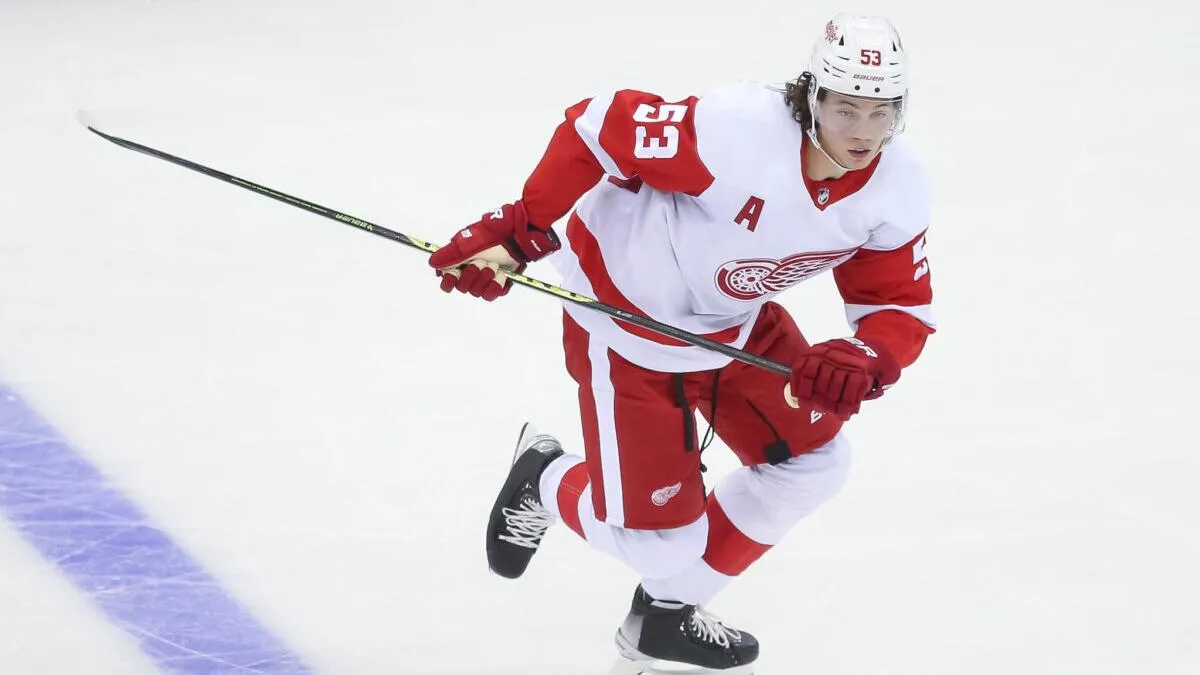
Elite performers leading the charge
Dylan Larkin has cemented his status as the Red Wings’ undisputed heartbeat, posting 9 goals and 14 assists through 20 games while serving as the engine that drives Detroit’s top line. His two-way game has reached new heights, with improved faceoff numbers and a noticeable commitment to defensive responsibility that sets the tone for the entire roster. The captain’s 23 points place him among the league’s top producers, and his plus-5 rating demonstrates his ability to tilt the ice even in difficult matchups. Larkin’s leadership extends beyond the scoresheet, as teammates consistently praise his work ethic and ability to elevate those around him.
Lucas Raymond has transformed from promising young winger to legitimate superstar, leading the team with 11 goals and 18 assists. His 29 points represent a dramatic improvement from last season’s opening quarter, and his underlying metrics are even more impressive. Raymond’s 56.3% expected goals share reveals his dominance at even strength, while his power-play production has become the focal point of Detroit’s man-advantage units. The chemistry between Raymond and Larkin has developed into one of the league’s most dangerous forward pairings, forcing opposing coaches to burn their top defensive assignments against Detroit’s top line night after night.
On the blue line, Moritz Seider continues to anchor the defense while adding offensive punch that was missing earlier in his career. With 4 goals and 12 assists, Seider leads all Red Wings defensemen in scoring and has logged a team-high 24:18 of ice time per game. His ability to control possession and exit the defensive zone cleanly has improved dramatically, reducing the high-danger chances against that plagued previous seasons. Seider’s partnership with Simon Edvinsson has evolved into a legitimate top pairing that can match up against any opponent’s best players.
Solid contributors and rising stars
Patrick Kane’s renaissance continues unabated at age 37, as the future Hall of Famer has delivered 7 goals and 15 assists while playing the mentor role to perfection. Kane’s line with Marco Kasper and Alex DeBrincat has become Detroit’s most productive secondary unit, generating scoring chances at a rate that rivals many teams’ top lines. His vision and playmaking ability remain elite, with Kane often making passes that leave spectators and opponents alike wondering how he spotted the opening. The veteran’s work with Kasper on faceoffs and defensive positioning has accelerated the young center’s development exponentially.
Speaking of Marco Kasper, the 21-year-old Austrian has exceeded even the most optimistic projections with 6 goals and 10 assists while playing responsible minutes against quality competition. His two-way game has drawn comparisons to a young Bo Horvat, and his ability to drive possession from the center position has given McLellan a reliable option for defensive zone starts. Kasper’s faceoff percentage has climbed to 48.3%, a marked improvement from his rookie campaign, and his penalty-killing work has made him a trusted option in all situations.
Simon Edvinsson has settled into his role as Seider’s partner with remarkable poise, contributing 2 goals and 9 assists while providing the physical edge this pairing needs. At 6-foot-6 and 222 pounds, Edvinsson uses his reach and positioning to break up plays before they develop, and his improved gap control has reduced the number of odd-man rushes against. The young Swede’s confidence with the puck has grown exponentially, as evidenced by his increased involvement in the offensive zone and his willingness to join the rush when opportunities present themselves.
John Gibson has provided exactly what the Red Wings hoped for when they acquired him from Anaheim, posting a .915 save percentage and 2.58 goals-against average in his first 14 starts. His ability to make the timely save has masked some defensive breakdowns, and his puck-handling skills have helped Detroit’s breakout game immensely. Gibson’s performance in back-to-back situations has been particularly impressive, giving the coaching staff confidence to ride him in challenging schedule stretches.
Depth pieces and developing talent
The Red Wings’ bottom-six forward group has been a mixed bag through the first quarter, with several players showing flashes while struggling with consistency. J.T. Compher has provided steady two-way play and chipped in 4 goals and 6 assists, though his offensive production hasn’t matched his contract expectations. Michael Rasmussen has used his size effectively but needs to convert more chances, with just 3 goals despite generating quality opportunities.
Andrew Copp’s return from injury has solidified the third line, giving Detroit a shutdown center who can take defensive zone draws and free up Larkin and Kasper for more favorable matchups. Copp’s 2 goals and 7 assists don’t jump off the page, but his underlying metrics show a player who tilts possession in Detroit’s favor and makes life easier on the goaltenders.
On defense, Albert Johansson has been a pleasant surprise as a depth option, playing 16 minutes per night and showing he belongs at this level. His smooth skating and puck-moving ability have translated well, and his partnership with Erik Gustafsson has given the coaching staff a reliable third pairing that can handle third-line competition.
Young forwards Jonatan Berggren and Elmer Söderblom have rotated in and out of the lineup, with each showing glimpses of their potential. Berggren’s speed and forechecking have created turnovers, while Söderblom’s 6-foot-8 frame and soft hands make him a unique weapon when he’s involved. However, both players need to find consistency to secure regular lineup spots as the season progresses.
Areas requiring improvement
Several Red Wings players have underperformed through the first 20 games, creating concerns about their long-term fit in Detroit’s plans. Alex Lyon’s backup goaltending has been shaky, with an .885 save percentage in four appearances, raising questions about the team’s depth at the position. While Gibson has been durable, the Red Wings need better insurance behind their starter.
Erik Gustafsson’s offensive contributions haven’t offset his defensive lapses, as he’s been on the ice for too many high-danger chances against. His power-play work remains valuable, but even-strength struggles have limited his trustworthiness in close games.
Tyler Motte and Austin Watson have provided energy but little offensive punch, combining for just 1 goal despite ample opportunities in the bottom six. Their penalty-killing work has been solid, but the team needs more production from its depth forwards to compete consistently.
The most concerning development has been Ben Chiarot’s play, as the veteran defenseman has looked a step slow and has been caught out of position frequently. With a minus-8 rating and just 2 points, Chiarot’s $4.75 million cap hit has become a significant burden, and his presence in the top four has created matchup problems that opponents have exploited.
Goaltending breakdown and special teams
John Gibson’s acquisition has transformed Detroit’s goaltending situation from a question mark into a strength. His .915 save percentage at five-on-five ranks among the league’s top starters, and his ability to make the first save look routine has stabilized a defense that still experiences occasional breakdowns. Gibson’s rebound control has improved from his Anaheim days, and his communication with the defense corps has reduced coverage confusion.
The penalty kill has been a bright spot, operating at 82.1% efficiency and ranking in the league’s top ten. Andrew Copp, Marco Kasper, and Michael Rasmussen have formed a reliable forward trio, while Moritz Seider and Simon Edvinsson have given the coaching staff confidence to play their top defensemen in shorthanded situations. The addition of veteran penalty-kill specialist Tyler Motte has provided another option for key defensive zone draws.
Conversely, the power play has been streaky despite abundant talent. Operating at 19.4%, the man-advantage unit has struggled with zone entries and shot generation when opponents apply aggressive pressure. While Lucas Raymond and Patrick Kane have produced points, the second unit has been ineffective, managing just 3 goals in 35 opportunities. The coaching staff may need to experiment with different personnel combinations to maximize their offensive weapons.
Forward line chemistry and deployment
The top line of Larkin, Raymond, and DeBrincat has been electric, generating 35 points and controlling 57% of expected goals when together. Their offensive zone possession has been relentless, with Larkin winning key faceoffs and Raymond’s vision creating space for DeBrincat’s shot. This trio has been deployed in all situations, including late-game leads, where their two-way responsibility has been crucial.
The Kasper line with Kane and Vladislav Tarasenko has provided secondary scoring that was missing last season. Tarasenko’s net-front presence and Kane’s playmaking have created space for Kasper to drive the middle of the ice, resulting in consistent offensive pressure. This line’s ability to maintain possession in the offensive zone has reduced the defensive burden on Detroit’s bottom six.
The bottom-six rotation has been less stable, with McLellan experimenting with various combinations to find the right mix of defense and offense. Michael Rasmussen’s size and defensive awareness have made him a fixture on the fourth line, but the coaching staff continues searching for the right wingers to complement his style. The versatility of players like J.T. Compher and Andrew Copp has allowed for in-game adjustments, though a consistent identity for these lines remains elusive.
Defensive pairings and transition game
The Seider-Edvinsson pairing has emerged as a legitimate shutdown duo, with both players complementing each other’s strengths. Seider’s physicality and offensive instincts pair well with Edvinsson’s reach and positioning, creating a partnership that can handle tough minutes while contributing offensively. Their ability to exit the defensive zone cleanly has reduced opponent forechecking effectiveness and created more controlled offensive entries.
The second pairing of Jeff Petry and Albert Johansson has been sheltered somewhat, starting more shifts in the offensive zone against weaker competition. Petry’s experience has steadied Johansson, who continues gaining confidence with increased responsibility. However, this pairing’s occasional lapses have led to high-danger chances against, something the coaching staff monitors closely.
The third pairing rotation has been problematic, with Erik Gustafsson and Ben Chiarot struggling to find consistency. Gustafsson’s offensive contributions are valuable, but his defensive positioning creates anxiety. Chiarot’s physical presence is useful, but his foot speed has been exposed by quicker opponents. This pairing’s struggles have forced McLellan to lean heavily on his top two pairs, potentially creating fatigue concerns as the season deepens.
Individual player grades and expectations
Based on performance relative to role and salary, here are the first-quarter grades for key Red Wings players:
A-grade: Elite performers
- Dylan Larkin (9 goals, 14 assists): His complete game and leadership justify every penny of his contract
- Lucas Raymond (11 goals, 18 assists): Superstar numbers and dominant underlying metrics
- Moritz Seider (4 goals, 12 assists): Developing into the franchise defenseman the Red Wings envisioned
- John Gibson (.915 SV%): Stability in net that transforms the entire team
B-grade: Above expectations
- Patrick Kane (7 goals, 15 assists): Continued excellence and mentorship
- Marco Kasper (6 goals, 10 assists): Sophomore leap looks very real
- Simon Edvinsson (2 goals, 9 assists): Top-pairing defender emerging before our eyes
- Andrew Copp (2 goals, 7 assists): Shut-down center doing the dirty work
C-grade: Meeting expectations
- Alex DeBrincat (8 goals, 11 assists): Solid production but some inconsistency
- J.T. Compher (4 goals, 6 assists): Two-way play valuable despite limited offense
- Michael Rasmussen (3 goals, 5 assists): Physical presence and defensive work appreciated
D-grade: Below expectations
- Erik Gustafsson (1 goal, 5 assists): Offensive contributions don’t offset defensive issues
- Ben Chiarot (2 goals, 3 assists): Cap hit becoming problematic for performance level
- Alex Lyon (backup goaltending): Shaky performances create depth concerns
As the Red Wings move beyond the first quarter, several questions remain. Can Gibson maintain his performance level through a heavier workload? Will the young core continue their upward trajectory? And perhaps most importantly, can the coaching staff find solutions for the struggling depth pieces before their performance drags down the entire team? The first 20 games have shown a team with legitimate playoff potential, but consistency and depth remain the primary obstacles between Detroit and their first postseason appearance since 2016.
Frequently Asked Questions

Par Mike Jonderson
Mike Jonderson is a passionate hockey analyst and expert in advanced NHL statistics. A former college player and mathematics graduate, he combines his understanding of the game with technical expertise to develop innovative predictive models and contribute to the evolution of modern hockey analytics.