










The Detroit Red Wings find themselves at a crossroads in the 2025-26 season, and the path forward requires decisive action. With just four goals in their last four games and an offense that continues to sputter despite lineup changes, the reality is clear: internal fixes aren’t enough anymore. Patrick Kane’s return from injury and Nate Danielson’s promotion to the NHL roster haven’t sparked the offensive surge that general manager Steve Yzerman and head coach Derek Lalonde desperately need. The Red Wings’ playoff aspirations hang in the balance, and the solution may lie outside the organization.
This isn’t just about adding depth or making minor adjustments. Detroit needs a legitimate top-six forward who can contribute immediately and elevate the players around them. The challenge lies in what the Red Wings are willing to sacrifice to acquire such a player, and whether the available options on the trade market align with both their immediate needs and long-term contention window.
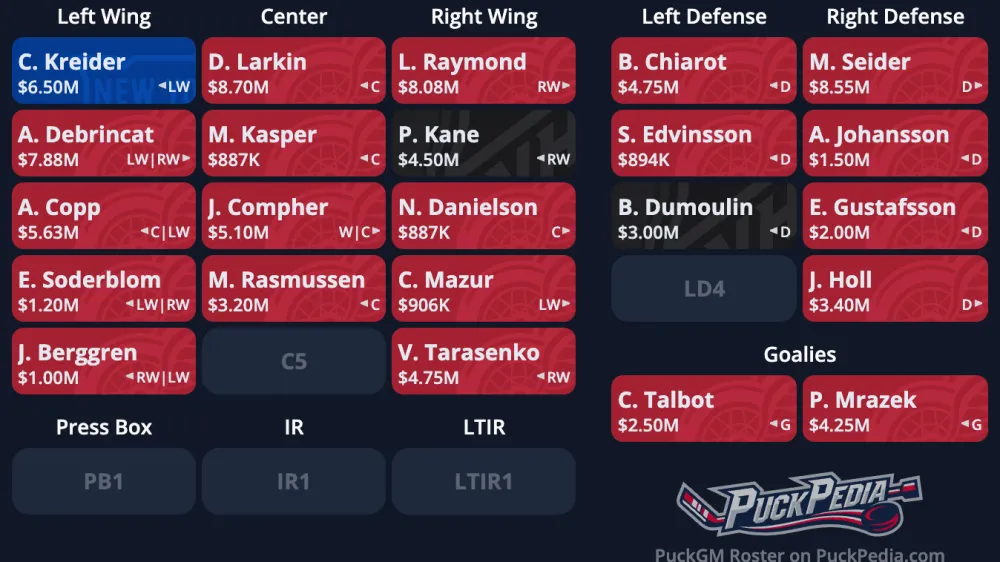
Why the Detroit Red Wings need a top-six forward trade now
The offensive numbers tell a sobering story. Detroit’s scoring has dried up at the worst possible time, with the team struggling to generate consistent offensive pressure even with their full complement of players healthy. The issue extends beyond just goal production—it’s about creating quality scoring chances, maintaining offensive zone time, and forcing opposing defenses to respect multiple lines.
Current forwards like Alex DeBrincat and Lucas Raymond have shown flashes of brilliance, but they need complementary pieces to truly thrive. Dylan Larkin continues to shoulder an enormous burden as the team’s captain and primary center, but even his consistent two-way play can’t mask the team’s overall offensive deficiencies. The middle-six forwards haven’t provided the secondary scoring necessary for a playoff-caliber team.
What makes this situation particularly urgent is the competitive landscape of the NHL. The Eastern Conference playoff race remains tightly bunched, with minimal separation between wild card contenders and teams outside the picture entirely. Every game matters, and waiting until the trade deadline could mean the difference between a playoff berth and another disappointing season. Teams in similar situations have learned that proactive moves often yield better returns than reactive desperation deals.
The Red Wings have tried internal solutions, from line juggling to increased ice time for younger players, but these adjustments haven’t moved the needle. According to Inside The Rink’s analysis, Detroit simply doesn’t have enough goals in this team to get them into the playoffs on paper. That harsh reality demands external help, and it demands it soon.
Potential trade targets for Detroit’s offense
Pavel Buchnevich of the St. Louis Blues represents one of the most intriguing options on the market. The 30-year-old left winger recently signed a massive six-year, $8 million per season deal, but his slow start with just two goals in 16 games has raised questions about whether the Blues might consider moving on. For Detroit, acquiring Buchnevich would be a calculated risk—betting that a change of scenery could restore the 50-60 point form he’s shown in previous seasons. His 6’1” frame and ability to play a physical game while contributing offensively fits the prototype Yzerman has typically targeted.
Jonathan Marchessault from the Nashville Predators offers another compelling option. Nashville’s veteran experiment has clearly faltered, and both Marchessault and Steven Stamkos could potentially be available as the Predators reassess their direction. Marchessault brings championship experience from his time with the Vegas Golden Knights and would provide an immediate boost to Detroit’s middle-six forward group. His leadership qualities and proven ability to perform in high-pressure situations could be invaluable for a young Red Wings team trying to break through.
Connor McMichael of the Washington Capitals represents a younger option that aligns perfectly with Yzerman’s typical player profile. At just 24 years old, McMichael scored 26 goals last season, with 22 coming at even strength. He skates well, competes hard, and can slot into any position in the top nine forward group. His versatility would be particularly valuable given Detroit’s constantly shifting line combinations as they try to find chemistry. McMichael feels like a player cut from the same cloth as Tampa Bay’s Anthony Cirelli—someone who does everything well without needing to be the focal point.
Jack Quinn from the Buffalo Sabres presents an interesting risk-reward proposition. The often-injured playmaking winger has shown glimpses of being a solid NHL producer when healthy. Buffalo’s desperate need for center depth could create an opportunity for Detroit to capitalize, though Quinn’s injury history makes him a gamble. His offensive upside, however, could make that risk worthwhile if Detroit can manage his workload properly throughout the season.
What Detroit must give up in a top-six forward trade
The uncomfortable truth about acquiring impact talent is that it requires sacrificing valuable assets. The Red Wings cannot expect to land a legitimate top-six forward without parting with quality prospects or draft picks. This reality conflicts with the patience many fans have exercised throughout Detroit’s lengthy rebuild, but The Hockey Writers reports that the Red Wings have a tremendously deep prospect pool to deal from.
At minimum, one of Detroit’s highly regarded prospects would need to be included in any significant deal. Names like Amadeus Lombardi, Elmer Soderblom, William Wallinder, Shai Buium, or Jesse Kiiskinen represent the caliber of prospect that could headline a trade package. Some analysts suggest that even Max Plante, Dmitry Buchelnikov, or one of the goaltending prospects—Sebastian Cossa or Trey Augustine—could be considered depending on the return.
The reasoning behind this willingness to move prospects stems from a simple reality: not all of these players will have NHL roles in Detroit. Looking at the projected 2027-28 forward lineup reveals a logjam of talent. Michael Brandsegg-Nygard, Marco Kasper, Carter Mazur, and others will be competing for limited roster spots. If Detroit can acquire a top-six forward who helps both immediately and fits within their long-term contention window, then prospects must be viewed as tradeable assets.
Draft picks would also need to be part of the equation. Detroit’s upcoming first-round selections should be considered available, though likely with protections attached to guard against catastrophic scenarios. Mid-round picks provide additional flexibility in trade negotiations, allowing the Red Wings to sweeten deals without sacrificing their top prospects. The combination of a strong prospect, a first-round pick, and potentially a mid-round selection could be enough to land a significant upgrade.
Complementary moves to maximize a top-six forward addition
Acquiring a top-six forward shouldn’t be Detroit’s only move. A secondary transaction to clear roster space and recoup some assets would help offset the initial investment while optimizing the lineup. Players like Andrew Copp, J.T. Compher, Michael Rasmussen, Jonatan Berggren, or Erik Gustafsson represent potential trade candidates who could be moved without significantly impacting the team’s core.
These secondary moves serve multiple purposes. First, they create the necessary roster spot for an incoming top-six forward without forcing Detroit to waive a prospect or younger player. Second, they provide modest cap relief—though the Red Wings currently sit with approximately $14 million in cap space, so this isn’t an urgent concern. Third, and perhaps most importantly, they could bring back draft picks or lottery ticket prospects that help restock Detroit’s asset cupboard after the primary trade.
The challenge with these complementary trades lies in the limited return these players would command. Given their production levels and cap hits, Detroit’s non-essential forwards won’t attract significant interest on the trade market. Teams looking for depth additions or salary cap gymnastics might bite, but expectations need to be tempered. The goal isn’t to win these secondary deals—it’s to make them functional components of a larger roster restructuring.
Potential trade partners for these depth moves include teams with cap space and a need for veteran presence: the Los Angeles Kings, Vancouver Canucks, Anaheim Ducks, and Chicago Blackhawks all make sense as potential landing spots. These teams might value the leadership and experience these players bring, even if the statistical production doesn’t jump off the page. A late-round pick or a former mid-round selection that Detroit had interest in during previous drafts could represent fair value.
Evaluating the risks of a Detroit Red Wings top-six forward trade
Every trade carries inherent risk, and acquiring a top-six forward involves several potential pitfalls. The most obvious concern is giving up too much for a player who doesn’t pan out. If Detroit trades a package of prospects and picks for a forward who struggles to produce or suffers an injury, the long-term consequences could be significant. The organization has invested years in rebuilding its prospect pipeline, and depleting it for a marginal improvement would be counterproductive.
Chemistry and fit present another layer of uncertainty. A player who thrives in one system or with certain linemates might struggle to replicate that success in Detroit. The Red Wings’ style of play, their offensive systems, and the players they’d be skating alongside all factor into whether a newly acquired forward can make an immediate impact. Recent history is littered with examples of high-profile trades that failed to deliver expected results due to poor fit.
The timing of such a move also carries risk. Making a significant trade now, before the traditional deadline, means committing to the current season’s playoff push. If injuries strike or the team’s defensive performance falters, Detroit could find themselves missing the playoffs despite the offensive upgrade. That would leave them without key prospects, without playoff revenue, and potentially facing difficult decisions in the offseason.
Contract considerations add another dimension to the risk assessment. Players like Buchnevich carry substantial cap hits that extend multiple years into the future. If Detroit acquires such a player and he doesn’t perform, they could find themselves with a burdensome contract that limits future flexibility. Yzerman has been careful to maintain cap maneuverability, and committing significant long-term money to the wrong player could undo years of prudent management.
The broader implications for Detroit’s contention window
This decision about whether to trade for a top-six forward transcends the immediate season. It represents a philosophical statement about where the Red Wings are in their competitive arc. Making an aggressive move signals belief that the current core is ready to compete for playoff spots and potentially more. Standing pat suggests that another year of development might be the wiser path, even if it means missing the playoffs again.
The Red Wings’ young core players—Raymond, DeBrincat, Kasper, and others—are entering critical stages of their development. Surrounding them with quality veterans who can contribute offensively could accelerate their growth and establish winning habits. Conversely, allowing them to navigate another disappointing season might create doubts about the organization’s commitment to winning or its ability to identify the right pieces.
Steve Yzerman’s track record suggests he won’t make a panic move just to appease frustrated fans. His methodical approach to team building has been evident throughout the rebuild, with careful attention to contract management and asset preservation. However, there comes a point where patience must give way to action, where the time for building transitions to the time for competing. Whether this season represents that inflection point remains the central question.
Looking at successful rebuilds around the league, teams that made the leap from rebuilding to contending often did so by making bold moves at critical junctures. The Florida Panthers’ willingness to trade for veterans and complement their young core eventually led to a Stanley Cup championship. The New Jersey Devils’ aggressive approach to adding talent has positioned them as legitimate contenders. Detroit must weigh whether their situation demands similar boldness or continued patience.
The Detroit Red Wings stand at a pivotal moment in their franchise trajectory. The offense needs help—that much is indisputable. Whether Steve Yzerman pulls the trigger on a significant trade for a top-six forward will reveal much about his assessment of this team’s readiness to compete. The pieces for such a deal exist: Detroit has tradeable prospects, draft capital, and roster players who could be moved to make room. The question isn’t whether they can make a trade—it’s whether they should.
As the season progresses and the playoff picture clarifies, the urgency around this decision will only intensify. Teams that wait too long often find themselves paying premium prices at the deadline or missing out on available talent entirely. For Detroit Red Wings fans hoping to see their team return to the playoffs, the next few weeks could determine whether this season ends in satisfaction or another year of disappointed expectations. The blueprint for improvement exists—now it’s up to Yzerman to decide if the time has come to execute it.
Frequently Asked Questions

Par Mike Jonderson
Mike Jonderson is a passionate hockey analyst and expert in advanced NHL statistics. A former college player and mathematics graduate, he combines his understanding of the game with technical expertise to develop innovative predictive models and contribute to the evolution of modern hockey analytics.