











The Detroit Red Wings have endured a painful offensive slump that has exposed the limitations of their current roster construction. With just six goals in their last five games and a string of disappointing performances, the need for external help has never been more apparent. General manager Steve Yzerman built this team to compete now, but the harsh reality is that the current group lacks the firepower to sustain success throughout an 82-game season. While lineup shuffles and internal promotions have been attempted, the clock is ticking on this season, and a bold move for a proven top-six forward may be the only way to salvage playoff hopes.
The Red Wings’ offensive struggles go beyond simple bad luck or cold streaks. Core players are underperforming, chemistry remains elusive, and the team’s over-reliance on the Dylan Larkin-Lucas Raymond duo has become painfully predictable for opposing defenses. Marco Kasper’s development hasn’t progressed as quickly as hoped, and veterans like Andrew Copp and J.T. Compher haven’t provided the secondary scoring punch needed to compete in a tight Eastern Conference. As the trade deadline approaches, Yzerman must seriously consider parting with valuable assets to acquire the offensive catalyst this team desperately needs.
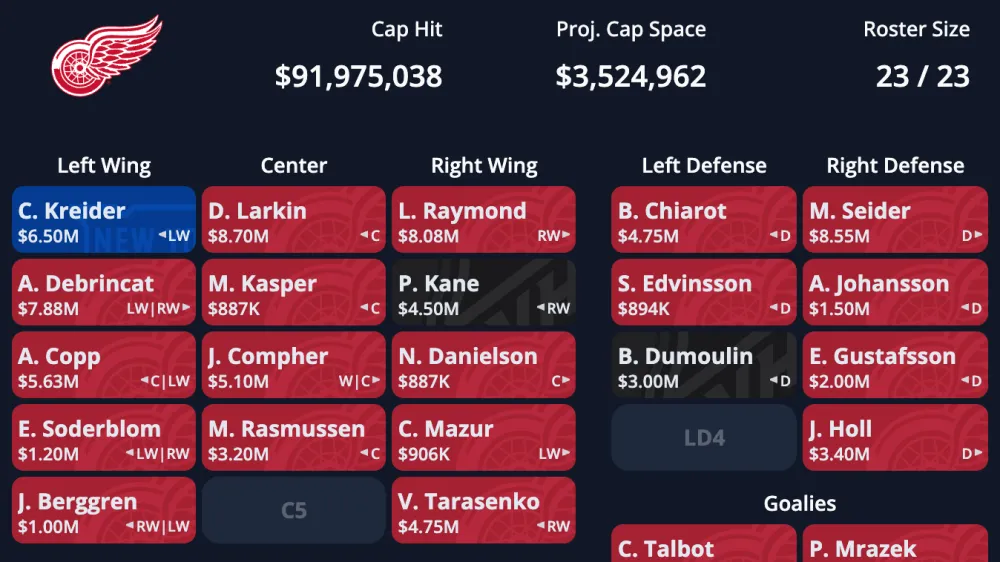
Why the Detroit Red Wings need a top-six forward trade to fix their offense immediately
The numbers tell a sobering story about Detroit’s recent offensive production. Scoring just six goals over a five-game stretch isn’t simply a cold streak—it’s a fundamental breakdown in the team’s ability to generate quality chances and finish plays. The Red Wings entered the season with aspirations of returning to the playoffs after an eight-year drought, but their current trajectory suggests those hopes may be fading without significant intervention.
The Red Wings’ top-six scoring drought has been particularly concerning because it involves players who were expected to carry the offensive load. Alex DeBrincat, who scored 27 goals last season, has struggled to find consistency despite playing alongside the skilled Patrick Kane. The chemistry that was supposed to develop between these two talented wingers hasn’t materialized, forcing head coach Todd McLellan to constantly tinker with his line combinations in search of any spark.
Marco Kasper’s underwhelming performance has been especially problematic. The young center showed promise during his late-season breakout last year, leading many to believe he was ready to take on a full-time second-line role. Instead, he has managed just three goals and zero assists through 16 games, resulting in his demotion to the third line and even a positional shift to left wing. His inability to develop into a reliable second-line center has created a domino effect throughout the lineup, forcing veterans into roles they’re not ideally suited for.
The Red Wings’ depth scoring has completely evaporated after a promising start to the season. Players like J.T. Compher, who posted 50 points in a previous season, have been unable to rediscover that form consistently. Michael Rasmussen, Jonatan Berggren, and Elmer Soderblom continue to battle for limited ice time, but none have proven capable of providing the offensive punch needed from middle-six forwards. This lack of secondary scoring places an unsustainable burden on the top line, which opposing teams can now key on defensively.
According to recent reporting from The Hockey Writers, the situation has become dire enough that multiple trades may be necessary to properly address the roster’s shortcomings. A single acquisition won’t be enough if that player simply pushes the problem further down the depth chart without addressing the overall lack of offensive talent. The Red Wings need impact players who can score consistently, not just additional depth pieces.
Potential trade targets for the Detroit Red Wings to upgrade their forward group
Identifying the right trade target requires balancing immediate need with long-term fit. The Red Wings aren’t in a pure rental situation—they need a player who can help both now and during their upcoming contention window. This narrows the field considerably, as pure rentals won’t justify the prospect capital Yzerman would need to surrender, while aging veterans on long-term deals could hamper future flexibility.
The St. Louis Blues present an intriguing trade partner given their position in the standings and potential willingness to move veterans. Their roster includes several players who could fit Detroit’s needs, though prying anyone loose will require significant assets. The Blues are in the midst of their own evaluation period, trying to determine which veterans fit their timeline and which could be moved for future assets.
Calgary Flames forwards could also be available as that organization continues its rebuild. The Flames have shown a willingness to move players when the return makes sense, and they possess several forwards who could slot into a top-six role for a contender. The key question is whether Yzerman would be willing to pay the premium price that teams typically demand for impact forwards, especially within the conference.
The Nashville Predators represent another potential partner, particularly given their disappointing start to the season. Players who were considered core pieces just months ago may now be available if the Predators decide to pivot toward a younger timeline. Nashville’s veteran forwards could provide the immediate impact Detroit needs while still having term remaining on their contracts to provide value beyond this season.
Any trade target acquisition must meet several criteria. The player needs to be versatile enough to play both center and wing, provide power-play production, and possess the defensive responsibility to fit McLellan’s system. Age is also a consideration—ideally, any acquired forward would be in his prime during Detroit’s projected contention window over the next three to five seasons. Finding a player who checks all these boxes while also being available at a price Yzerman can stomach will be the ultimate challenge.
What assets the Detroit Red Wings must sacrifice in a top-six forward trade
The uncomfortable reality is that acquiring impact talent requires surrendering valuable assets. The Red Wings have spent years rebuilding their prospect pool, but that depth now presents an opportunity to convert future assets into present help. Not all of Detroit’s prospects will have roster spots available when they’re ready for the NHL, making some of them logical trade chips.
Prospects like Amadeus Lombardi, William Wallinder, and Shai Buium represent the type of assets that could headline a trade package. These are legitimate prospects with NHL futures, but the Red Wings’ organizational depth means not all of them will have clear paths to significant roles in Detroit. Trading from a position of strength makes sense when the return addresses a pressing need.
Elmer Soderblom occupies a strange middle ground—technically an NHL player but young and unproven enough to appeal to rebuilding teams. His size and offensive potential make him an intriguing piece for teams willing to be patient with development. For Detroit, he’s caught in a numbers game, constantly rotating in and out of the lineup without ever getting a sustained opportunity to establish himself.
Draft picks will need to be part of any substantial trade package. The Red Wings’ first-round selections in upcoming drafts hold significant value, particularly if they’re unprotected. While parting with premium picks is always difficult, Detroit’s prospect pool is deep enough to absorb the loss. The team also possesses additional picks acquired through previous trades, providing flexibility in constructing trade packages.
Looking at Detroit’s trade targets and strategy for this season reveals the difficult decisions Yzerman faces. The general manager has been patient throughout the rebuild, rarely making impulsive moves. However, the combination of underperforming veterans and prospects not developing as quickly as hoped may force his hand. Making a significant trade would represent a philosophical shift—acknowledging that the current roster isn’t good enough and that external help is required.
The secondary moves Detroit must consider alongside a top-six forward acquisition
Acquiring a top-six forward solves one problem but potentially creates others. Roster space is finite, and adding a significant player means someone else must move out. This reality makes a secondary trade almost mandatory, both to clear roster space and to partially recoup some of the assets surrendered in the initial deal.
Andrew Copp represents the most logical candidate for a follow-up trade. His $5.625 million cap hit through 2027 is substantial for a player providing fourth-line production. While Copp brings intangibles like penalty-killing ability and leadership, the Red Wings need goal-scoring more than they need veteran depth. Moving Copp would free up both a roster spot and meaningful cap space, though his contract may be difficult to move without retaining salary.
J.T. Compher’s inconsistency makes him another potential trade candidate, though his recent promotion to second-line center complicates matters. If that move proves successful, he becomes more valuable to Detroit’s lineup. However, if it fails and the Red Wings acquire a center in their primary trade, Compher’s $5.1 million cap hit through 2028 makes him expendable. Teams seeking depth down the middle might find value in Compher’s two-way game.
Jonatan Berggren’s situation is particularly interesting because he still holds trade value despite limited ice time. The 25-year-old former second-round pick has shown offensive skill in the AHL and flashes at the NHL level, but he’s never received a sustained opportunity in Detroit’s lineup. For rebuilding teams willing to give him that opportunity, Berggren could be an attractive acquisition that costs minimal assets to obtain.
According to analysis from The Hockey News, the Red Wings may already be exploring trade options for Berggren given the roster crunch created by Nate Danielson’s promotion. While the return wouldn’t be substantial—likely a mid-round pick or a low-level prospect—it would at least provide some compensation for a player who appears to have no clear future in Detroit.
Michael Rasmussen rounds out the list of potential trade candidates. The 2017 ninth-overall pick has never developed into the power forward the Red Wings envisioned when they drafted him. At 28 years old with a $1.46 million cap hit, he’s affordable but not particularly impactful. A rebuilding team might take a chance on Rasmussen’s size and physicality, though the return would be modest at best.
The risks and potential rewards of aggressive Detroit Red Wings trading
Making a bold trade for a top-six forward isn’t without significant risk. The Red Wings could surrender multiple high-quality prospects and draft picks for a player who doesn’t fit the system, struggles with injury, or simply doesn’t elevate the team’s performance. General managers who swing big and miss often face consequences, and Yzerman’s patient reputation could take a hit if an aggressive move backfires.
Prospect evaluation is inherently uncertain. The player Detroit trades away could develop into a star elsewhere while the acquired forward underperforms. Fans and media would scrutinize such an outcome mercilessly, particularly given the franchise’s long playoff drought. The pressure to get this decision right is immense, which may explain Yzerman’s historical reluctance to make blockbuster trades.
Team chemistry is another concern. Adding a new top-six forward could disrupt existing relationships and line combinations that have shown occasional promise. The Red Wings have shuffled their lineup extensively this season, and introducing another variable could further delay the development of sustainable chemistry. McLellan would need to carefully integrate any new acquisition into the system without causing more disruption than benefit.
The financial implications extend beyond the current season. Taking on a player with term remaining on his contract affects future cap flexibility, potentially hampering Detroit’s ability to re-sign key players or pursue free agents. The Red Wings have several important contract extensions looming in coming years, and committing significant cap space to an acquired forward could create difficult decisions down the road.
However, the potential rewards justify these risks. A successful trade could transform the Red Wings from a bubble team into a legitimate playoff contender. Adding a proven scorer who elevates the performance of linemates while providing consistent offense would address the team’s most glaring weakness. The psychological boost of making a significant acquisition could also energize a roster that has struggled to meet expectations.
Playoff experience for Detroit’s young core has tremendous value. Players like Lucas Raymond, Moritz Seider, and Simon Edvinsson would benefit immensely from experiencing meaningful games in March and April. Even if the Red Wings don’t advance deep into the playoffs, simply returning to the postseason would represent significant progress and validate the rebuild’s direction.
Timeline considerations for a potential Detroit Red Wings forward trade
The trade deadline typically falls in early March, giving teams until then to make moves. However, waiting until the deadline creates problems for teams trying to integrate new players into their systems. Chemistry takes time to develop, and playoff-bound teams generally prefer to make significant acquisitions earlier, allowing new players to acclimate before the postseason push begins.
The Red Wings’ current position in the standings will heavily influence their approach. If they remain within striking distance of a playoff spot, Yzerman will feel increased pressure to act. Conversely, if they continue sliding down the standings, the argument for standing pat or even becoming sellers grows stronger. The next month of games will prove critical in determining Detroit’s deadline strategy.
Other teams’ situations will also affect the market. Sellers typically don’t emerge until late January or early February when their playoff hopes are definitively crushed. This creates a compressed timeline where multiple teams compete for a limited pool of available players. Being aggressive early could allow Detroit to secure a target before competition intensifies, though it also carries the risk of surrendering more assets than necessary.
Injuries league-wide can dramatically shift trade markets. A contender suffering a significant injury might suddenly become desperate for help, driving up prices for available forwards. Conversely, an injury to a potential trade target could remove them from consideration entirely. These unpredictable factors make timing crucial—moving too early or too late could prove equally costly.
The Red Wings must also balance immediate needs against long-term goals. While a rental player might provide the biggest short-term boost, does acquiring a pure rental align with the franchise’s stated philosophy of sustainable contention? These questions don’t have easy answers, and Yzerman must weigh multiple competing priorities when determining both the timing and nature of any trade.
The Detroit Red Wings face a critical juncture that will define their season and potentially their franchise trajectory. Standing pat with the current roster seems increasingly unten untenable given the offensive struggles plaguing the team. Steve Yzerman has built a reputation for patience and measured decision-making, but sometimes bold action is required to seize a closing window. The Red Wings have the prospect capital and draft picks necessary to acquire impact talent—the question is whether Yzerman will pull the trigger on the kind of aggressive move this team desperately needs. The next few weeks will reveal whether Detroit is serious about competing now or content to wait another year while their playoff drought extends further.

Par Mike Jonderson
Mike Jonderson is a passionate hockey analyst and expert in advanced NHL statistics. A former college player and mathematics graduate, he combines his understanding of the game with technical expertise to develop innovative predictive models and contribute to the evolution of modern hockey analytics.