





The Detroit Red Wings’ promising start to the 2025-26 season has hit a concerning roadblock as their top-six forwards struggle to find the back of the net with any consistency. After opening the campaign with an impressive 8-3 record that had fans dreaming of a long-awaited playoff berth, the Red Wings have stumbled to a 4-6 mark in their last ten games, with offensive production drying up at the worst possible time. The team has managed just four goals in their last four contests, including consecutive single-goal performances that have exposed significant vulnerabilities in their scoring depth beyond captain Dylan Larkin and Alex DeBrincat.
This Detroit Red Wings top-six scoring drought has become the defining storyline as the club navigates through its centennial season. While the team’s defense and goaltending have shown moments of competence, the inability to generate consistent offense from their highest-paid forwards has left head coach Todd McLellan scrambling for solutions. The situation is particularly troubling given the franchise’s nine-year playoff drought—the longest in team history—and the mounting pressure on general manager Steve Yzerman to deliver results after years of patient rebuilding.
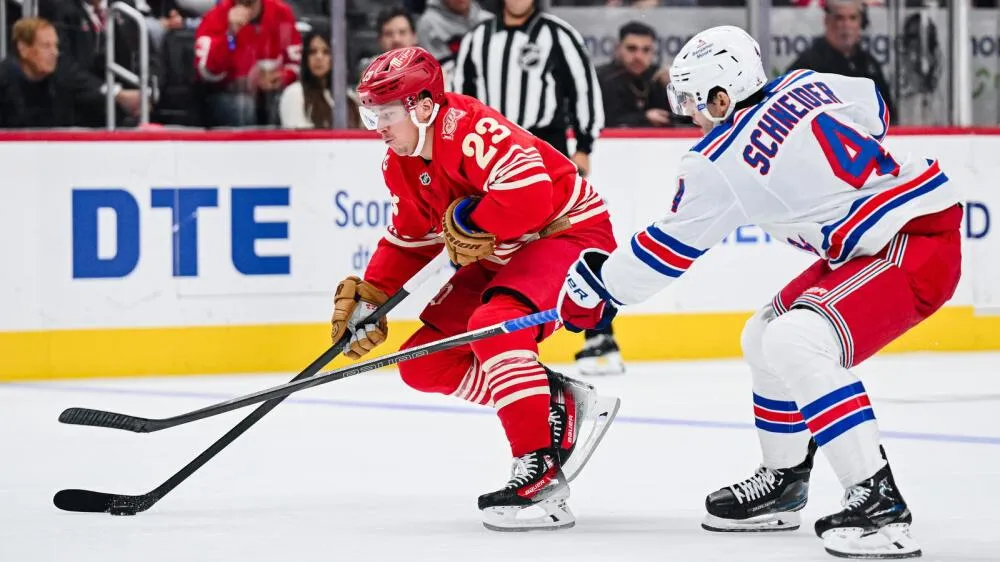
The numbers behind the Detroit Red Wings top-six scoring drought
The statistics paint a sobering picture of Detroit’s offensive struggles. Beyond Larkin and DeBrincat, who have combined for respectable production, the remaining top-six forwards have failed to carry their weight. Lucas Raymond, despite posting 13 points in 14 games early in the season, hasn’t looked like himself since suffering an upper-body injury in the opening weeks. His shooting percentage has dipped, and more importantly, his ability to create dangerous chances has diminished noticeably.
Patrick Kane’s return from injury hasn’t provided the expected spark either. The future Hall of Famer has struggled to find chemistry with his linemates, and his power-play prowess—which was a significant reason for his signing—has evaporated alongside the unit’s collective collapse. The Red Wings’ man advantage has converted just once in their last 20 opportunities, a catastrophic slump that has dropped them from elite status to league average at 18.9 percent.
Marco Kasper’s development has stalled after a promising finish to last season. The young forward has registered just three goals with no assists through his first stretch of games, and crucially, he’s been far less noticeable around the net than he was in the spring. His physical presence and puck pursuit—traits that made him such an intriguing prospect—have been largely absent during this Detroit Red Wings top-six scoring drought.
Emmitt Finnie, who earned a spot in the top six through strong training camp and preseason performances, has seen his confidence wane as the goals have dried up. While he showed flashes after McLellan shuffled the lines during a recent loss to Chicago, consistency remains elusive for the young forward trying to establish himself as a legitimate NHL scoring threat.
Special teams failures amplifying the offensive crisis
The power play’s implosion has compounded the even-strength struggles, turning what should be an advantage into a momentum killer. McLellan described the unit as “upside down” following an 0-for-4 showing against the New York Rangers, words that proved prophetic when the team went 0-for-5 in their next game against Chicago. For a team that converted at a 27 percent clip last season—good for top-five status league-wide—the current 18.9 percent success rate represents a dramatic regression.
The personnel remains largely unchanged from last year’s successful unit, which makes the collapse all the more perplexing. Kane’s absence due to injury initially provided a convenient explanation, but his return hasn’t reversed the trend. The Red Wings are struggling with clean zone entries, losing critical faceoffs, and failing to establish the net-front presence that made them so dangerous a year ago. Dylan Larkin shouldered some responsibility, pointing to costly faceoff losses as a contributing factor, but the problems run deeper than any single element.
McLellan has hinted at significant changes coming to the power-play personnel, noting that “every season’s its own” and that teams can’t simply rely on past success. His willingness to shake things up suggests he recognizes the current configuration isn’t working, regardless of what the roster looks like on paper. Whether that means incorporating younger players like Nate Danielson or fundamentally restructuring the units remains to be seen.
The penalty kill has performed adequately overall, sitting at 80 percent for the season, but a 3-for-3 disaster against Chicago—where the Blackhawks scored three goals on three shots in less than 35 seconds of total power-play time—demonstrated how quickly things can unravel when nothing is going right. Special teams, which can often be the difference between playoff teams and lottery participants, have become a major concern during this extended slump.
Getting to the dirty areas: Raymond’s blueprint for breaking through
Lucas Raymond offered perhaps the most honest assessment of what’s plaguing the Red Wings’ attack when he emphasized the need to “get to those dirty areas” where most goals are scored. His comments following a 4-1 loss to the Rangers revealed a player and team aware of their shortcomings but struggling to implement the necessary adjustments. “We’re not getting to those dirty areas right now where a lot of the goals are scored,” Raymond admitted. “We talked about it after the Vegas game, we knew it coming into this game, and it’s easy when it’s not going in to start looking for it even more.”
The Red Wings have historically been a perimeter team, generating chances through skilled entry plays and clean passing sequences. While that style produced 80 points for Raymond last season and helped the team compile respectable offensive numbers, it’s proven insufficient during this drought. Opposing goaltenders are seeing too many shots from manageable angles, getting clean looks at pucks that should be obscured by traffic, and rarely facing the chaos of scrambles around the crease.
Raymond’s emphasis on keeping things simple and trusting the room’s goal-scoring ability reflects both maturity and frustration. “We know we can score goals. We’ve got a lot of guys in this room that can score goals. So it’s just about trusting that,” he said. Yet trust alone won’t solve the problem—the Red Wings need a fundamental shift in their offensive approach, one that prioritizes getting inside the dots and making life miserable for opposing netminders.
McLellan echoed these sentiments when discussing the need for more “grunt time” and better play during cycles. “Those chances we can create,” the coach noted. “It’s the grind time, it’s the cycle time, it’s the grunt time, if you want to put it that way, where you really got to dig in.” His assessment suggests the coaching staff recognizes the issue but may be questioning whether the current roster has the necessary physicality and determination to consistently win those battles.
Larkin added his voice to the chorus, saying bluntly, “I don’t think we’ve been making it hard on goalies and driving to the net and creating scrums.” For a captain known for his honest evaluations, these words carry weight and signal that the leadership group understands exactly what needs to change to end this Detroit Red Wings top-six scoring drought.
Line juggling and roster decisions ahead
McLellan has already begun experimenting with his forward combinations in an attempt to spark production. During the Chicago loss, he moved DeBrincat up to the top line with Larkin and Raymond while dropping Finnie to the second unit alongside Kane and J.T. Compher. Earlier, he had inserted Compher at second-line center, pushing Kasper down to third-line wing. These changes reflect a coach willing to try different combinations, but they also reveal the lack of obvious internal solutions.
The recent recall of Nate Danielson for his NHL debut adds another dimension to McLellan’s lineup puzzle. Danielson registered four shots on goal in his first appearance and brings size plus battle ability that could address some of the team’s identified weaknesses. The question now becomes whether the Red Wings trust him enough to elevate him into a top-six role, perhaps as a facilitator alongside Kane, or if they’ll keep him in a sheltered third-line position while he adjusts to NHL pace.
Kasper’s struggles present another decision point. Does McLellan keep trying him in the top six, betting on the young forward to rediscover his confidence and physical game? Or does he accept that Kasper might be better suited for a third-line role where he can build his game back up without the pressure of matching up against opponents’ top defensive pairings? The coaching staff clearly believes in Kasper’s long-term potential—he wouldn’t have made the opening-night roster otherwise—but patience has limits when playoff positioning hangs in the balance.
The Kane situation deserves particular attention. Detroit brought in the veteran specifically to add offensive firepower and veteran savvy during crucial moments. His struggles—both individually and on special teams—represent one of the more disappointing aspects of this slump. At 37 years old, Kane may need more favorable matchups or different linemates to maximize his effectiveness, but the Red Wings’ depth limits McLellan’s options for sheltering him.
Broader context: Playoff pressure and franchise expectations
This Detroit Red Wings top-six scoring drought arrives at an inopportune time for a franchise desperate to end its historic playoff absence. Nine consecutive years without postseason hockey has tested the patience of one of the NHL’s most storied fanbases, and the early-season success had raised expectations that this might finally be the year Detroit returns to relevance. The current 9-7 record still positions them in the playoff hunt, but the recent trajectory suggests they could just as easily slip backward as surge forward.
The decision to adopt a “playoffs or bust” mentality heading into this centennial season reflected the organization’s belief that the rebuild had progressed far enough to demand results. Yzerman has methodically built through the draft, added key veteran pieces, and created what appeared on paper to be a deeper, more competitive roster. Yet this slump has exposed many of the same weaknesses that plagued previous editions—namely, insufficient scoring depth and an inability to sustain offense when the top line gets shut down.
The parallels to last season’s late collapse are impossible to ignore. Detroit faded badly down the stretch in 2024-25, finishing with a 39-35-8 record that left them on the playoff bubble but ultimately outside looking in. If this current offensive drought proves to be a preview of things to come rather than a temporary stumble, the franchise could be staring down a tenth consecutive year without playoff hockey—an outcome that would undoubtedly intensify scrutiny on both Yzerman’s roster construction and McLellan’s systems.
Goaltending has also been a minor concern, with offseason acquisition John Gibson delivering unremarkable results thus far. While some of his struggles can be attributed to poor defensive play in front of him, he’s also been beaten by stoppable shots, including a Tyler Bertuzzi five-hole goal that trickled through during the Chicago debacle. For a team not scoring enough, getting timely saves becomes even more critical, and Gibson hasn’t consistently provided those bailouts.
What comes next for Detroit’s sputtering offense
The Red Wings face a critical juncture as they prepare for their next game against Anaheim with several days to reassess and adjust. McLellan has promised “a lot of discussions over the next few days” regarding the power-play units, and lineup changes across the board seem likely. The coaching staff clearly recognizes that simply running out the same combinations and hoping for different results won’t solve this Detroit Red Wings top-six scoring drought.
Potential solutions include giving Danielson a longer look in meaningful minutes to see if his size and compete level can provide the net-front presence the team desperately needs. Moving Raymond to center—a position he’s played before—could be another option, potentially creating better balance across three lines rather than concentrating offense on just one. Reuniting combinations that worked during the early-season winning streak might also be worth revisiting, even if it means admitting recent experiments have failed.
Beyond tactical adjustments, the Red Wings need their highly-paid veterans to perform like veterans. Kane must find a way to impact games consistently, whether through his own production or by making his linemates better. Raymond needs to play through whatever lingering effects his injury might be causing and rediscover the dynamic skating and shot that made him an 80-point player. Kasper must tap into the physical, relentless forechecking style that earned him a roster spot in the first place.
The power play represents perhaps the most straightforward area for improvement, at least theoretically. These players have succeeded together before, which suggests mechanical or confidence issues rather than fundamental incompatibility. Clean entries, won faceoffs, better movement, and more shots from the slot—all fixable problems if the players execute the details. Whether McLellan’s promised changes involve personnel or systems adjustments, simply getting the power play back to league-average levels would significantly improve Detroit’s prospects.
The good news for Red Wings fans is that talent doesn’t disappear overnight, and slumps—even extended ones—eventually end. Detroit still controls possession in most games, generating 46 shots in their recent loss to Chicago, and the underlying numbers suggest they’re creating more than they’re finishing. Regression to the mean should eventually deliver more goals, particularly if the team commits to the hard-area play that Raymond identified as crucial.
The Detroit Red Wings top-six scoring drought has transformed a promising start into a concerning trend, but with 66 games remaining, there’s ample time to correct course. Whether they can make the necessary adjustments—both tactical and mental—will determine whether this season represents genuine progress or another frustrating chapter in the franchise’s extended playoff absence. The margin for error remains slim in a competitive Eastern Conference, making the next few weeks critical for establishing whether Detroit is truly a playoff contender or simply another team treading water in the middle of the pack. For a franchise celebrating its centennial, only one outcome will satisfy the faithful who’ve waited nearly a decade to see meaningful spring hockey return to Hockeytown.

Par Mike Jonderson
Mike Jonderson is a passionate hockey analyst and expert in advanced NHL statistics. A former college player and mathematics graduate, he combines his understanding of the game with technical expertise to develop innovative predictive models and contribute to the evolution of modern hockey analytics.