







The New Jersey Devils bounced back from a two-game skid with authority on Saturday night, delivering a dominant 4-1 performance against the Los Angeles Kings at Crypto.com Arena. After struggling through losses in Colorado and San Jose, the Devils needed a statement victory to regain their momentum, and they found it through stellar goaltending, exceptional penalty killing, and a balanced offensive attack. The win improved their record to 9-3-0, reaffirming their status as one of the early season’s most formidable teams in the Eastern Conference.
Coming off a freshly signed contract extension, Jacob Markström anchored the Devils’ resurgence with one of the finest goaltending performances of the season. Meanwhile, Dawson Mercer’s two shorthanded goals showcased the team’s ability to capitalize on special teams opportunities, and Brian Halonen netted his first career NHL goal. This comprehensive victory demonstrated that New Jersey’s early season success was no fluke, as they corrected the issues that plagued them during their brief losing streak.
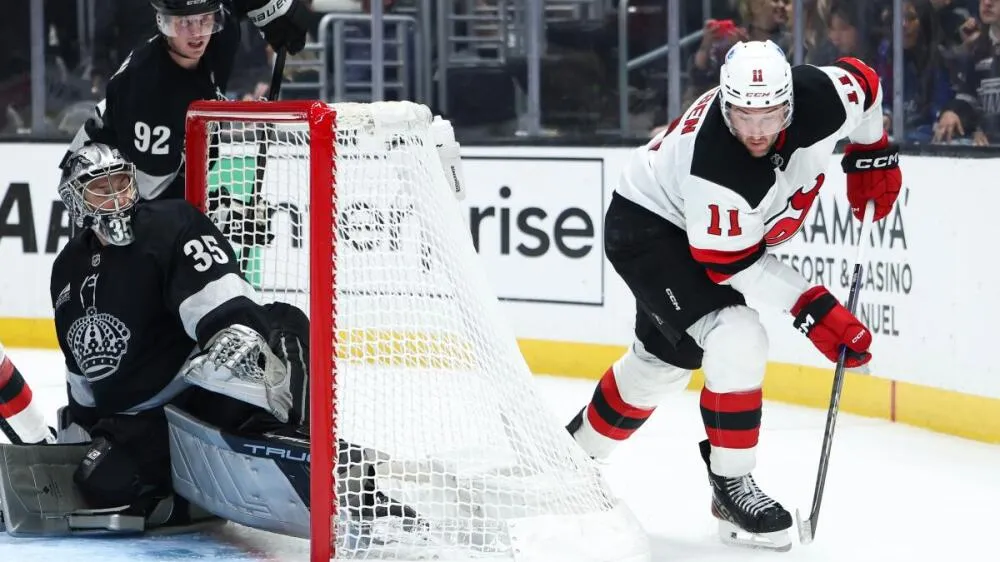
Jacob Markström’s stellar performance after contract extension highlights New Jersey Devils 4-1 victory over Los Angeles Kings takeaways
The timing couldn’t have been more perfect for Jacob Markström. Just days after signing a two-year, $12 million contract extension, the veteran goaltender delivered a performance that justified every dollar of the deal. Markström stopped an impressive 43 of 44 shots, posting a .977 save percentage that ranked among the season’s elite individual performances. His +3.12 goals saved above expected demonstrated that he was the primary reason the Devils walked away with two points.
What made Markström’s performance even more impressive was the context surrounding it. During the Devils’ opening eight-game winning streak, the goaltending tandem had been exceptional, consistently giving the team a chance to win. However, that narrative flipped during the first two games of the road trip. Markström and Jake Allen combined to post minus-6.53 goals saved above expected, unable to bail out a team that wasn’t playing its best hockey.
Against the Kings, Markström faced a barrage of shots, particularly in the second period when Los Angeles generated sustained offensive pressure. He turned away all five high-danger chances he faced, displaying the kind of positioning and reflexes that made him one of the league’s premier netminders during his tenure with the Calgary Flames. His ability to track pucks through traffic and remain composed under pressure proved contagious, settling down a Devils team that had looked shaky in recent outings.
Head coach Sheldon Keefe praised his goaltender’s performance in the post-game press conference, noting that Markström was “dialed in” and tracking pucks exceptionally well. The coach acknowledged that the team wasn’t at its best at various points throughout the game, but Markström’s excellence provided the foundation for victory. For those who questioned whether the 34-year-old goaltender still possessed the ability to be a difference-maker, this game served as a definitive answer.
Perhaps most encouraging for Devils fans was that Markström’s performance wasn’t an aberration. Prior to the game, he ranked 13th among 48 qualified goalies in high-danger save percentage at .833%, and his performance against the Kings only improved that mark. This consistency in stopping the most dangerous scoring chances suggests that his confidence and technical ability remain at elite levels, even as he enters the latter stages of his career.
The extension and subsequent performance also solidified the Devils’ goaltending situation for the immediate future. With Markström signed through the 2026-27 season and Jake Allen providing reliable backup support, New Jersey has the stability in net that championship contenders require. As the team showed resilience on the road, Markström’s presence between the pipes gives them confidence that they can win games even when not at their best defensively.
Penalty kill resurgence features prominently in New Jersey Devils 4-1 victory over Los Angeles Kings takeaways
One of the most concerning trends heading into Saturday’s matchup was the Devils’ penalty kill struggles. New Jersey ranked as the 8th-worst team in times shorthanded per game at 3.55, a troubling statistic that reflected both discipline issues and the impact of key injuries. The absence of Brett Pesce, Johnathan Kovacevic, and Cody Glass had severely hampered their ability to kill penalties effectively, with the unit converting at a dismal 33.3% clip in Colorado.
Against Los Angeles, the Devils went to the penalty box four times—though the final call on Timo Meier appeared questionable at best—and killed off every single one. But the penalty kill didn’t just survive; it thrived. Dawson Mercer converted two shorthanded goals, including an insurance marker and an empty-netter during a 6-on-4 situation. These weren’t lucky bounces or fluky plays; they were the result of aggressive penalty killing and smart reads of the Kings’ power play tendencies.
Mercer’s first shorthanded goal came on a brilliant individual effort where he anticipated a passing lane, created a turnover, and finished with precision. The play exemplified the aggressive, attacking mentality that Keefe has instilled in his penalty kill units. Rather than simply trying to survive two minutes of shorthanded play, the Devils actively sought opportunities to create offense, putting pressure on the Kings’ defensemen and forcing hesitation in their setup.
The transformation from the Colorado disaster to the Los Angeles success wasn’t accidental. The Devils made tactical adjustments, utilizing their speed to pressure puck carriers and clog passing lanes. Players like Nico Hischier and Erik Haula, who excel in 200-foot situations, took on larger penalty-killing responsibilities. This redistribution of duties helped compensate for the missing personnel while maintaining the unit’s effectiveness.
Beyond Mercer’s heroics, the penalty kill’s structural improvements were evident throughout the game. The Devils maintained better positioning in the defensive zone, limiting high-danger chances and allowing Markström to see shots cleanly. Their clearing attempts were more successful, reducing the amount of sustained zone time the Kings’ power play could generate. These fundamental improvements bode well for the team’s ability to stay out of trouble even when they commit penalties.
The discipline factor remains a work in progress, as four penalties in a single game isn’t ideal for any team hoping to control the pace of play. However, the knowledge that the penalty kill can not only survive but potentially score provides a psychological boost. Teams that can convert shorthanded opportunities force opponents to think twice about certain power play strategies, creating hesitation that can neutralize the man advantage.
Line adjustments prove effective in New Jersey Devils 4-1 victory over Los Angeles Kings takeaways
With Connor Brown listed as day-to-day with an injury, Sheldon Keefe faced the challenge of reconfiguring his forward lines to maintain offensive balance. His solution was to promote Stefan Noesen to the top line alongside Jack Hughes and Jesper Bratt, a move that paid immediate dividends. The trio dominated the pace of play, outshooting Los Angeles 19-13 in shot attempts and 9-4 in scoring chances during their ice time together.
While the newly formed top line didn’t register any goals, the underlying metrics told a story of complete territorial dominance. They controlled possession in the offensive zone, generated quality looks, and created havoc in front of Darcy Kuemper. The fact that they were caught for a goal against doesn’t diminish the quality of their overall performance—sometimes opposing teams make excellent plays, and results don’t always reflect process in small sample sizes.
Noesen’s promotion made sense on multiple levels. The veteran winger had proven his ability to play with elite talent during the previous season, contributing meaningfully to the Devils’ top-six forward group. His blend of physicality, hockey sense, and willingness to go to the dirty areas of the ice complemented the skill and speed of Hughes and Bratt perfectly. Where Ondrej Palat had struggled to produce alongside the team’s star playmakers—managing just one assist in 11 games—Noesen brought a different energy and style.
The reshuffled lines also created better balance throughout the lineup. Moving Palat down to play with Nico Hischier and Aleksandr Gritsyuk gave the second line more veteran presence and defensive responsibility. This configuration allowed Keefe to deploy different looks depending on game situations, trusting that he had multiple lines capable of contributing offensively while maintaining defensive structure.
Brian Halonen’s first NHL goal came as a result of the depth line contributions. Playing on the fourth line with Paul Cotter and Luke Glendening, Halonen exemplified the “next man up” mentality that championship organizations cultivate. His willingness to go to the net and finish a scoring opportunity showcased the kind of depth scoring that can make the difference in tight playoff races.
The line juggling also created interesting possibilities moving forward. If Noesen continues to excel alongside Hughes and Bratt, it provides Keefe with flexibility in how he deploys his top-nine forwards. He can mix and match based on matchups, looking for favorable situations that exploit opposing teams’ weaknesses. As highlighted in the game preview, the Devils’ depth has been a strength all season, and these line changes only reinforced that reality.
Special teams excellence defines New Jersey Devils 4-1 victory over Los Angeles Kings takeaways
Beyond the penalty kill’s exceptional performance, the Devils’ overall special teams play deserves recognition as a critical factor in their victory. Special teams often determine the outcome of tightly contested NHL games, and Saturday’s matchup was no exception. New Jersey’s ability to not only neutralize the Kings’ power play but actively score shorthanded goals transformed the game’s complexion.
The two shorthanded goals from Mercer represented more than just fortunate bounces. They reflected a philosophical approach to penalty killing that emphasizes aggression and pressure rather than passive defense. This mentality has been a hallmark of successful Devils teams throughout franchise history, dating back to their dynasty years when they pioneered neutral zone trap systems that created transition opportunities.
Los Angeles entered the game with a respectable power play unit featuring elite talents like Anze Kopitar, Adrian Kempe, and Kevin Fiala. The Kings’ ability to move the puck and create seam passes had generated success earlier in the season. However, the Devils’ pressure disrupted their rhythm, forcing turnovers and rushed decisions that led to scoring chances going the other way.
The empty-net situation that resulted in Mercer’s second shorthanded goal illustrated the Devils’ composure in critical moments. With the game still within reach for Los Angeles, New Jersey’s penalty killers didn’t panic when facing a 6-on-4 disadvantage. Instead, they remained patient, waited for their opportunity, and capitalized when it presented itself. This kind of situational awareness and execution separates good teams from great ones.
Looking beyond just the penalty kill, the Devils’ five-on-five play also deserved praise. They limited Los Angeles to quality chances at even strength, controlling possession and dictating the game’s tempo for significant stretches. The combination of strong even-strength play and exceptional special teams performance created a comprehensive victory that addressed many of the concerns that had emerged during the two-game losing streak.
The special teams success also boosted team morale and confidence. After struggling in Colorado and San Jose, the Devils needed to prove to themselves that they could execute their systems effectively. The penalty kill’s dominance provided that proof, giving the entire team a psychological lift that should carry forward into subsequent games.
Defensive structure improvements emerge from New Jersey Devils 4-1 victory over Los Angeles Kings takeaways
While Markström’s goaltending excellence rightfully garnered headlines, the defensive structure in front of him showed marked improvement from recent games. The Devils had allowed too many high-danger chances during their losing streak, putting unrealistic pressure on their goaltenders to make miraculous saves. Against the Kings, New Jersey tightened their coverage, limited odd-man rushes, and made Markström’s job more manageable despite the high shot volume.
The defensive pairing of Dougie Hamilton and Jonas Siegenthaler logged heavy minutes and performed admirably in all situations. Hamilton’s offensive instincts remained evident, as he jumped into rushes and contributed to the team’s puck movement out of the defensive zone. Siegenthaler provided the defensive reliability, making smart positioning decisions and winning battles along the boards. Their complementary skill sets created a shutdown pairing that could match up against the Kings’ top lines.
Brenden Dillon and Luke Hughes formed another effective pairing, with Dillon’s veteran presence helping guide the younger Hughes through challenging defensive situations. The Devils’ defensive depth has been tested by injuries to Pesce and Kovacevic, but players like Dennis Cholowski and Šimon Nemec have stepped up when called upon. This depth will be crucial as the season progresses and the grind of an 82-game schedule takes its toll.
The team’s defensive zone coverage showed more structure and communication than in previous games. Players were talking more on the ice, alerting teammates to threats and helping each other in difficult situations. The forwards, too, played more responsible defense, tracking back to support the defensemen and eliminating passing options for Kings forwards. This five-man defensive unit approach has been a staple of successful Devils teams, and its return was encouraging.
Limiting Los Angeles to just one goal despite facing 44 shots required more than just goaltending excellence. It demanded proper gap control, effective stick checking, timely shot blocks, and smart decision-making in transition. The Devils demonstrated all of these elements throughout the game, suggesting that their defensive identity—temporarily lost during the losing streak—had been rediscovered at precisely the right moment.
The Devils’ 4-1 victory over the Kings represented more than just two points in the standings. It was a statement game that addressed the concerns that had emerged during their brief slide. Markström’s goaltending excellence justified his contract extension while providing stability in net. The penalty kill’s transformation from liability to weapon gave the team an additional dimension. Line adjustments created better balance and opened up new strategic possibilities for Keefe to explore.
As New Jersey continues its road trip, the lessons learned and confidence gained from this performance will prove invaluable. The team demonstrated its ability to respond to adversity, make necessary adjustments, and execute a comprehensive game plan against a quality opponent. With Markström finding his form and the penalty kill operating at an elite level, the Devils have addressed two areas that threatened to derail their promising start. If they can maintain this level of play while getting healthier, they’ll remain one of the most dangerous teams in the Eastern Conference throughout the season.

Par Mike Jonderson
Mike Jonderson is a passionate hockey analyst and expert in advanced NHL statistics. A former college player and mathematics graduate, he combines his understanding of the game with technical expertise to develop innovative predictive models and contribute to the evolution of modern hockey analytics.