







The New Jersey Devils traveled to San Jose’s SAP Center hoping to shake off a disappointing 8-4 loss to the Colorado Avalanche two nights prior. Instead, they found themselves victimized by another disastrous start, falling 5-2 to the struggling Sharks in a game that exposed critical flaws in their recent play. After opening the season with an impressive 8-1-0 record, the Devils have now dropped consecutive games for the first time this season, raising serious questions about their ability to maintain consistency and handle adversity. What was supposed to be a bounce-back opportunity against one of the league’s weaker teams turned into another sobering reminder that early-season success doesn’t guarantee sustained excellence.
The loss marked a stark contrast to the Devils’ previous visit to California just six days earlier, when they dominated the Sharks en route to their seventh straight victory. This time, however, defensive breakdowns, questionable goaltending, and undisciplined play combined to sink New Jersey’s hopes of ending October on a positive note. Head coach Sheldon Keefe didn’t mince words after the game, making it clear that the team’s recent performances fell well below acceptable standards.
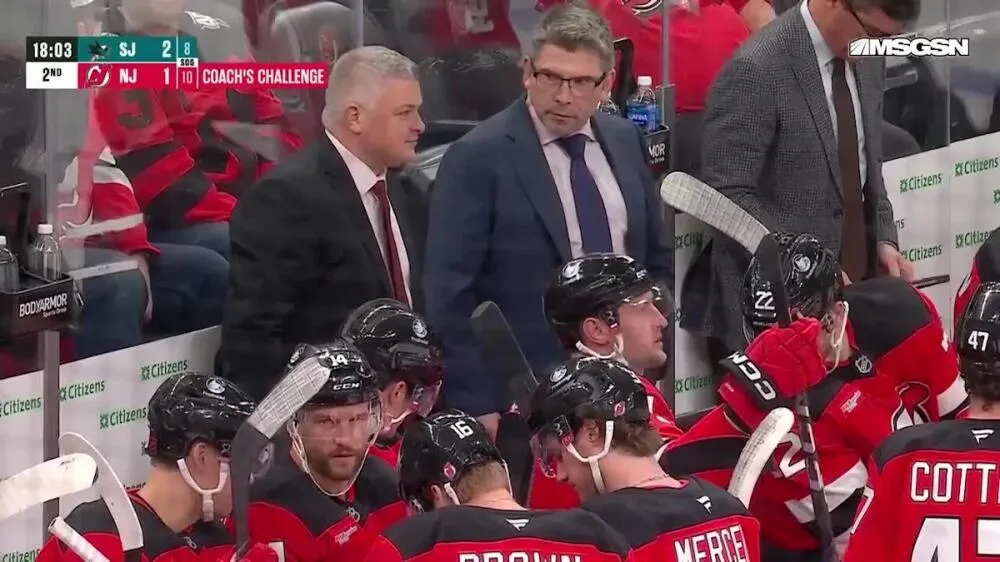
Catastrophic first period dooms Devils in New Jersey Devils vs San Jose Sharks 5-2 loss takeaways
For the second consecutive game, the Devils found themselves in an early hole they couldn’t escape. Just 42 seconds into the contest, Jonas Siegenthaler got caught flat-footed in transition, allowing William Eklund to break free on a clear breakaway. The speedy Sharks forward made no mistake, beating Jake Allen five-hole to give San Jose an immediate 1-0 lead. It was the second time in less than a week that Eklund had struck early against New Jersey.
The nightmare start set the tone for what would become arguably the Devils’ worst period of the young season. Sloppy play plagued New Jersey throughout the opening frame, including a too-many-men penalty that gave the Sharks their first power-play opportunity. While a Will Smith tripping penalty quickly canceled out San Jose’s advantage, the Devils’ lack of discipline foreshadowed more trouble ahead.
Just over eight minutes into the game, a failed clearing attempt by Simon Nemec led directly to Philipp Kurashev’s goal, doubling the Sharks’ lead to 2-0. The young defenseman’s mistake highlighted the team’s struggles in transition and inability to execute basic defensive zone exits under pressure. The Devils’ defensive miscues would continue to mount throughout the game, as they struggled to contain San Jose’s speed.
Things got worse three minutes later when Alex Wennberg deflected home a Mario Ferraro shot from the boards. According to MoneyPuck, Wennberg’s goal from 51.1 feet out at a 49.8-degree angle had just a 1.9% chance of finding the net—the kind of low-percentage shot that Jake Allen had routinely stopped during the team’s winning streak. For the second straight game, the Devils trailed 3-0, and their season-opening success felt like a distant memory.
Dawson Mercer provided a brief glimmer of hope late in the period, tipping home a Jack Hughes pass on the power play to cut the deficit to 3-1. However, the damage was done. San Jose had outshot New Jersey 15-9 in the frame and thoroughly dominated play, leaving the Devils with a mountain to climb in the final 40 minutes.
The early deficit once again exposed a troubling pattern for New Jersey: they are not a good comeback team. When forced to chase games, the Devils struggle to generate the sustained offensive pressure needed to erase multi-goal deficits. This weakness has become increasingly apparent during their recent slide.
Defensive regression without Brett Pesce evident in New Jersey Devils vs San Jose Sharks 5-2 loss takeaways
The absence of Brett Pesce has had a profound impact on the Devils’ defensive structure. According to Natural Stat Trick, in games where Pesce was healthy, New Jersey gave up just 11.5 high-danger chances per 60 minutes. Since losing him to injury, that number has ballooned to 14.5—a staggering 26% increase that has left the Devils’ goaltenders exposed far too often.
Odd-man rushes against have become commonplace over the past two games, with opposing forwards regularly finding themselves in dangerous scoring positions. The defensive lapses aren’t limited to one pairing or player; rather, they reflect a systemic breakdown in coverage and communication. Without Pesce’s steady presence and elite defensive instincts, the Devils’ blue line has looked disjointed and prone to costly mistakes.
The second period offered little reprieve despite the Devils controlling more of the play. Jack Hughes and Jesper Bratt dominated possession during their shifts, generating numerous scoring chances. However, Ondrej Palat struggled mightily to convert the opportunities his linemates created, and Alex Nedeljkovic stood tall in the Sharks’ net to preserve San Jose’s lead.
Late in the middle frame, the defensive issues resurfaced with devastating consequences. Will Smith beat Allen with a wrist shot to make it 4-1, and moments later, Tyler Toffoli deflected home another shot to push the lead to 5-1. The goals came against the run of play, but they exposed a harsh reality: when your defensive coverage breaks down and your goaltending doesn’t bail you out, games get ugly quickly.
The Devils managed just 13 shots in the second period, matching San Jose’s output but failing to generate enough quality chances to mount a legitimate comeback. The disparity between their offensive zone time and their actual scoring chances highlighted another issue—when the Devils do generate pressure, they’re not converting at the rate they did during their winning streak.
Sheldon Keefe’s frustration was palpable when discussing his team’s defensive lapses. “You cannot win in the National Hockey League with that as the baseline,” he told reporters after the game. “That’s unacceptable, and once again, you get what you deserve.” The message was clear: the Devils’ recent performances fell far below the standard expected of a playoff-caliber team.
Goaltending concerns emerge in New Jersey Devils vs San Jose Sharks 5-2 loss takeaways
Jake Allen entered the San Jose game having been exceptional throughout the Devils’ winning streak, but his performance against the Sharks raised legitimate concerns. During New Jersey’s eight-game winning streak, Devils goaltenders had stopped 4.29 goals above expected—a remarkable run that helped mask some defensive deficiencies. In the two-game skid, however, that number plummeted to minus-6.53 goals above expected, representing a complete reversal of fortune.
The stark turnaround means that with just average goaltending, the Devils would have surrendered approximately seven goals instead of 13 over their past two games. While that’s still not ideal, it would have kept New Jersey competitive in both contests rather than seeing them spiral into lopsided defeats. Allen’s performance in San Jose included at least one goal he’d desperately want back—Wennberg’s shot from distance that squeezed through despite having less than a 2% chance of becoming a goal.
To be fair, Allen faced numerous high-danger chances due to the porous defensive play in front of him. Breakaways, odd-man rushes, and deflections made his job extraordinarily difficult. However, elite goaltending has been a hallmark of successful Devils teams throughout franchise history, and during championship runs, netminders find ways to steal games even when the team in front of them struggles. Allen hasn’t been able to do that over the past two contests.
The goaltending concerns extend beyond Allen’s individual performance to questions about whether the Devils can consistently rely on their tandem to provide above-average results. During the winning streak, everything bounced their way—literally and figuratively. Goalies made improbable saves, posts were hit instead of netting goals, and fortunate bounces led to odd-man rushes going the other way. That un sustainable run of good fortune has evaporated, leaving the Devils exposed.
Dawson Mercer provided another brief spark early in the third period, deflecting a Dougie Hamilton bomb for his second power-play goal of the game to make it 5-2. The tally showcased Mercer’s net-front presence and his ability to capitalize on opportunities, but it was too little, too late. The Devils pushed for a third goal but couldn’t generate enough sustained pressure to threaten a legitimate comeback.
The power play’s success offered one of the few positive takeaways from an otherwise dismal performance. Both of Mercer’s goals came with the man advantage, demonstrating that when the Devils get set up in the offensive zone with time and space, they can still execute their systems effectively. However, relying on special teams to generate offense isn’t a sustainable formula for success, especially when the defensive breakdowns continue at five-on-five.
Self-inflicted wounds compound issues in New Jersey Devils vs San Jose Sharks 5-2 loss takeaways
Beyond the defensive breakdowns and goaltending struggles, the Devils repeatedly hurt themselves with avoidable mistakes. The too-many-men penalty in the first period exemplified the team’s lack of preparation and attention to detail. The Devils had six players on the ice for an extended period and nearly escaped detection before eventually getting caught. These types of unforced errors are entirely preventable and indicate a team that isn’t mentally sharp.
Similar undisciplined play plagued the Devils in Colorado, where Jacob Markstrom shot the puck over the glass in the opening seconds, leading to a quick Avalanche power-play goal. While every team makes mistakes over the course of an 82-game season, the concentration of self-inflicted wounds over the past two games suggests deeper issues with focus and execution. Championship-caliber teams don’t consistently beat themselves with preventable penalties and mental lapses.
Keefe’s willingness to give his team a pass after the Colorado loss evaporated following the San Jose defeat. After dropping a game to a legitimate Stanley Cup contender in the Avalanche, there was room for understanding—Colorado is a very good team capable of exploiting any mistake. However, losing to one of the league’s weakest teams in similar fashion removed any benefit of the doubt. The coach’s pointed criticism reflected his recognition that the team’s recent standard of play won’t cut it in a competitive Metropolitan Division.
The Devils’ road trip continues this weekend in Los Angeles, where they’ll face a Kings team that has had its own ups and downs this season. The matchup offers an opportunity for redemption, but it also presents challenges given the Devils’ recent struggles on the road and their inability to start games with the necessary intensity and focus.
Looking at the broader context, some regression from an 8-1-0 start was inevitable. No team maintains an .888 points percentage over a full season, and expecting everything to continue breaking the Devils’ way was unrealistic. Every bounce seemed to favor New Jersey during their winning streak—goaltenders made spectacular saves, lucky bounces led to odd-man rushes, and opposing players hit posts instead of scoring. That kind of fortune doesn’t last forever.
However, the manner of these defeats—back-to-back games where the Devils fell behind 3-0 early and never truly threatened to complete a comeback—reveals concerning patterns. The team’s inability to respond to adversity, their defensive breakdowns without Pesce, and their recent goaltending struggles all point to issues that require immediate correction. Role players who contributed during the winning streak have gone quiet, and even the team’s stars haven’t been able to elevate their games enough to compensate for the collective shortcomings.
The New Jersey Devils’ 5-2 loss to San Jose represents more than just a single defeat—it’s a wake-up call that their early-season success masked underlying vulnerabilities. Without Brett Pesce anchoring the defense, New Jersey has hemorrhaged high-danger chances against. Their goaltending, which was spectacular during the eight-game winning streak, has regressed dramatically. Most concerning, the team continues to hurt itself with undisciplined play and mental mistakes that have no place in professional hockey.
As the Devils head to Los Angeles to face the Kings, they’ll need to rediscover the intensity and attention to detail that fueled their hot start. Sheldon Keefe’s pointed criticism after the game signals that the grace period is over—his team must respond with a far better effort or risk seeing this two-game skid snowball into something more significant. The talent is there, but talent alone doesn’t win games in the NHL. New Jersey must prove they can handle adversity, protect leads, and avoid self-inflicted wounds if they hope to compete for a playoff spot in the brutal Metropolitan Division. The California road trip will reveal whether the Devils can learn from these painful lessons or if their early success was merely a mirage.

Par Mike Jonderson
Mike Jonderson is a passionate hockey analyst and expert in advanced NHL statistics. A former college player and mathematics graduate, he combines his understanding of the game with technical expertise to develop innovative predictive models and contribute to the evolution of modern hockey analytics.