






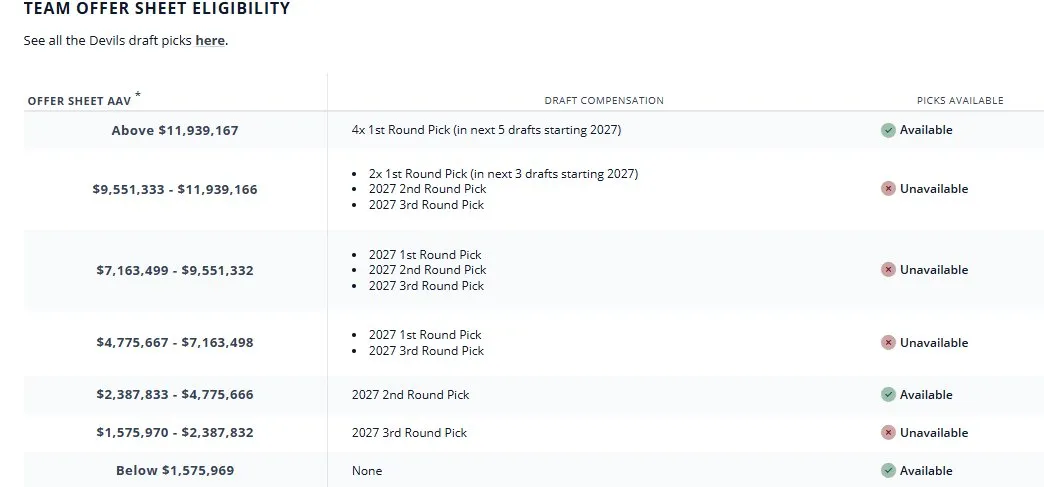
New Jersey Devils submitted a one-year offer sheet worth $4.775 million to Barrett Hayton on July 1, 2026.
Offer Sheet Mechanics Force Quick Choice
The Devils targeted Hayton with a single-season deal that matches his projected arbitration range exactly. Utah holds seven days from receipt to match or decline. Frank Seravalli confirmed the amount and noted the absence of any cap crunch for New Jersey.
Utah operates without immediate financial pressure yet faces a structural restriction if they match. Chris Johnston reported that matching prevents any trade of Hayton for a full calendar year. That clause walks the forward directly into unrestricted free agency the following summer.
New Jersey therefore gains leverage without committing multi-year money. A match by Utah keeps Hayton but eliminates the option to flip him for a second-round pick before the 2026-27 season begins. Declining the sheet lets Hayton depart for New Jersey while Utah receives no compensation.
The seven-day window runs until July 8. During that period Utah cannot negotiate extensions or explore sign-and-trade routes without first committing to the match.
Cap and Roster Implications
Barrett Hayton posted a $4.775 million cap hit under the offer sheet terms. That figure sits below several comparable middle-six forwards listed on the remaining free-agent market. Utah’s roster currently carries seven days of exclusivity before the restriction activates.
New Jersey avoided longer-term commitments that would have triggered higher annual averages. The one-year structure allows the Devils to evaluate fit before deciding on future raises. Utah, by contrast, risks losing the player outright or locking into a one-year rental with no trade flexibility.
Seravalli highlighted that Utah could otherwise have received a second-round pick in a preemptive trade. The offer sheet removes that path unless Utah declines and accepts the loss.
Hayton’s age of 26 positions him as a bridge player rather than a long-term anchor. The short deal therefore serves New Jersey’s timeline while compressing Utah’s options into a binary choice.
Market Context for Remaining UFAs
The Hayton sheet arrived on day one of free agency amid activity around Eeli Tolvanen and Patrick Kane. Tolvanen fielded four- and five-year offers according to David Pagnotta. Kane signaled no urgency for a July 1 signing per Pierre LeBrun.
Utah’s decision timeline overlaps with these parallel negotiations. Matching Hayton consumes roster and cap slots that could otherwise address other needs before July 8. Declining frees cap space but surrenders a 26-year-old center without draft return.
The remaining unrestricted free-agent list includes veterans such as Vladimir Tarasenko at a $4.75 million prior cap hit and Michael Bunting at $4.5 million. Those comparables underscore why the Devils selected the $4.775 million threshold.
New Jersey’s approach tests whether Utah values continuity enough to accept the trade moratorium. The outcome determines whether Hayton remains in Utah or joins the Devils for the 2026-27 campaign.
Frequently Asked Questions
Sources

Par Mike Jonderson
Mike Jonderson is a passionate hockey analyst and expert in advanced NHL statistics. A former college player and mathematics graduate, he combines his understanding of the game with technical expertise to develop innovative predictive models and contribute to the evolution of modern hockey analytics.