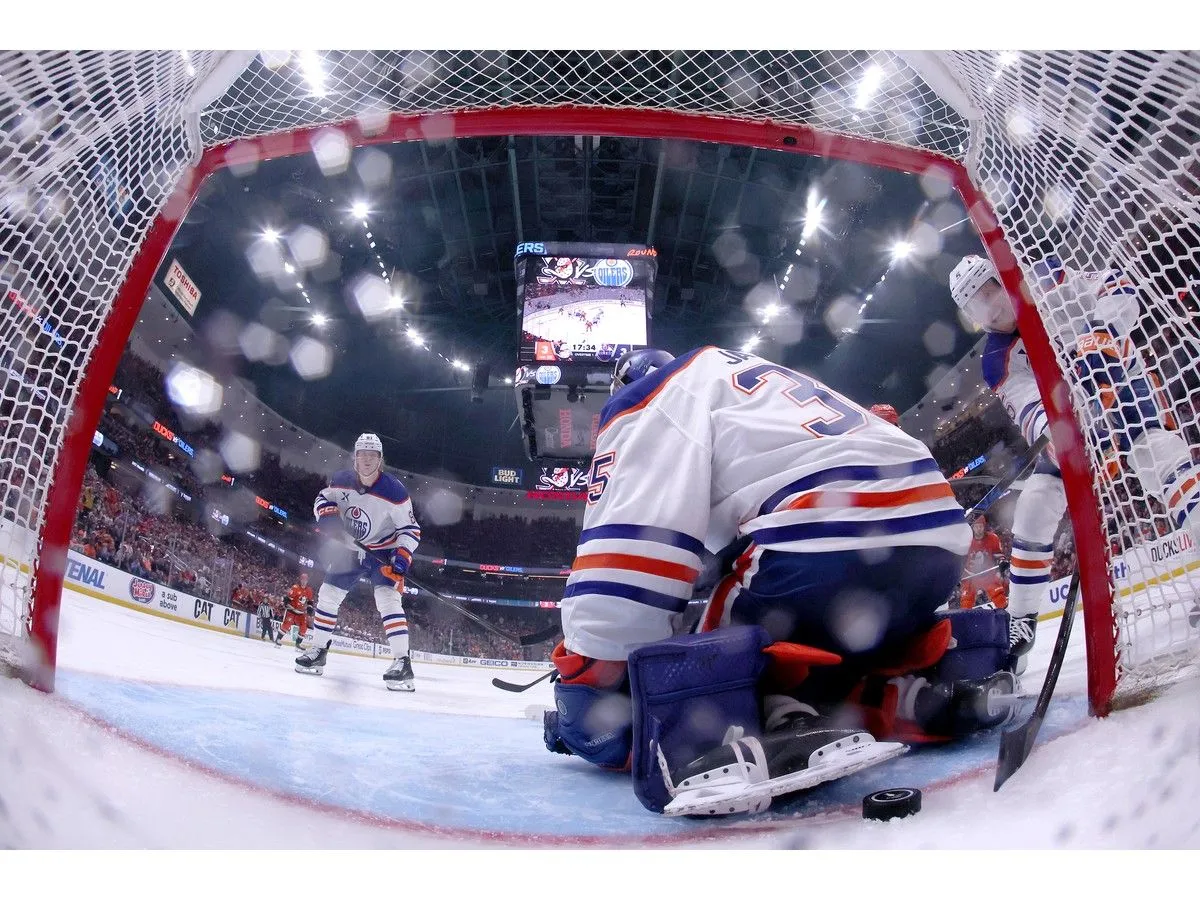
The Anaheim Ducks grabbed a commanding 3-1 series lead over the Edmonton Oilers in their first-round Stanley Cup playoff matchup with a dramatic 4-3 overtime win in Game 4 on April 26, 2026. The controversy erupted just 2:29 into the extra frame when Ducks forward Ryan Poehling fired a centering pass that deflected off Oilers defenseman Darnell Nurse’s skate and trickled through goaltender Tristan Jarry’s legs toward the goal line.[1][2]
On-ice officials huddled for nearly 90 seconds before signaling a goal, triggering an automatic video review from the NHL Situation Room. Replays, particularly from the overhead net camera, showed Jarry’s skate blade obscuring the puck and goal line, leaving viewers—and even officials—questioning if it fully crossed. The call stood due to a lack of indisputable evidence to overturn it.[3]
Oilers fans and players erupted in frustration, viewing it as a pivotal moment that could doom Edmonton’s season. The Ducks, meanwhile, celebrated their first home playoff win in eight years, building on a surprising regular-season surge under coach Joel Quenneville. This incident highlights ongoing debates about officiating accuracy in high-stakes hockey.
Breaking down the controversial play
Poehling’s shot originated as an innocent centering attempt from the side boards. It caromed off Nurse’s skate, evading Jarry’s poke check and sliding under his pad. Referee Jake Brenk, positioned behind the net, had an obstructed view amid the scrum.
Slow-motion replays confirmed the puck’s momentum carried it inches from the line, but Jarry’s skate covered the critical area. Multiple angles failed to provide a clear shot of separation between puck, line, and skate.
The on-ice delay amplified tensions. Officials consulted for over a minute before waving it good, a decision Oilers coach Kris Knoblauch called “not very definitive.”[4]
Game context added weight: Edmonton had tied it late in regulation with goals from Kasperi Kapanen, Ryan Nugent-Hopkins, and Evan Bouchard earlier in the series. Ducks’ power play, a season strength, set the stage for their push.
For Ducks fans, it recalled their team’s resurgence, detailed in this quarter-season analysis, where Quenneville’s impact propelled them past expectations.
Video review process under scrutiny
NHL rules stipulate that a goal called on ice stands unless indisputable video evidence proves otherwise. Here, the Situation Room reviewed multiple feeds but upheld the call, citing sufficient proof the puck crossed fully.[2]
Critics argue the bar is too high for overturns in close calls. The photo released by the league still showed Jarry’s skate in the way, fueling doubts.
Former Oilers goalie Devan Dubnyk blasted the initial on-ice signal: “It’s completely outrageous that they called it a goal on the ice.” He questioned how referees, not ideally positioned, made the call amid chaos.
Knoblauch echoed this: “I can’t see it going in. I can’t see the line. You can’t see any space between the blue line and the puck.”[4]
Reactions poured in online, with fans split. Some praised the review’s caution; others decried it as a robbery. See full hockey world reactions here.[3]
Calls for advanced puck-tracking technology
The NHL boasts NHL Edge, a sophisticated system tracking pucks via infrared emitters detected 60 times per second by arena cameras. It powers stats like shot speed and player zones but remains unused for officiating.[5]
Implementing it for reviews could eliminate subjectivity. Sensors under the goal line or net cameras could confirm crossings definitively, sparing endless debates.
Deputy Commissioner Bill Daly acknowledged challenges: “It is difficult to have a definitive technology that sees through all that traffic.” Yet, he noted the league pursues fail-proof solutions.
Dubnyk advocated strongly: “If you have the overhead camera inside the net detect the signals… we would have virtually indisputable evidence.”
This echoes past sports like soccer’s goal-line tech, proven reliable. Hockey’s resistance stems from tradition and implementation hurdles.
Ducks’ regular-season clashes with Oilers, like Quenneville’s 1,000th win in a thriller, underscore the rivalry’s intensity.
Reactions from players and coaches
- Kris Knoblauch (Oilers coach): Expressed disbelief at the call’s definitiveness, comparing it to offside challenges.
- Tristan Jarry (Oilers goalie): Felt the puck never cleared his skate fully.
- Ryan Poehling (Ducks): Insisted it was “obviously in.”
- Joel Quenneville (Ducks coach): Backed his player without hesitation.
Analysts like Jeff Friedman and Kevin Bieksa on Edmonton Journal called out referee positioning flaws.
Social media buzzed, with #OilersRobbed trending. McDavid protested post-goal, though he stayed pointless early in the series.
Oilers face elimination in Game 5, needing a response. Ducks’ young core, led by Leo Carlsson and Beckett Sennecke, thrives under pressure.
NHL’s path forward on officiating tech
Daly downplayed urgency among teams but admitted Sunday’s drama proves its value. Even imperfect tech beats current ambiguity.
Puck tracking for stats succeeds; adapting for goals seems logical. Trials could start next season.
This isn’t isolated—past playoffs saw similar disputes. Tech could preserve hockey’s passion without human error.
What it means for the series and beyond
The Ducks’ edge positions them for a stunning upset over star-studded Edmonton. Game 5 in Anaheim looms as must-win for Oilers, with McDavid needing to erupt.
Broader implications: Pressure mounts for goal-line tech adoption. Fans deserve closure, not outrage.
If implemented, it removes referee heat while honoring on-ice flow. Hockey evolves—time to embrace it.[1]
Frequently Asked Questions

Par Mike Jonderson
Mike Jonderson is a passionate hockey analyst and expert in advanced NHL statistics. A former college player and mathematics graduate, he combines his understanding of the game with technical expertise to develop innovative predictive models and contribute to the evolution of modern hockey analytics.