France’s Pierre Crinon has been sidelined for the remainder of the Milan Cortina 2026 Winter Olympics men’s hockey tournament following a fight with Canada’s Tom Wilson. The defenseman was ejected during a lopsided 10-2 loss to Canada on Sunday, February 15, but faced further discipline from his own federation.[1]
The French Ice Hockey Federation (FFHG) announced the suspension on Monday, citing Crinon’s post-fight behavior as a violation of Olympic values. This decision comes despite the International Ice Hockey Federation (IIHF) imposing no additional penalties beyond the game misconducts for both players.[2]
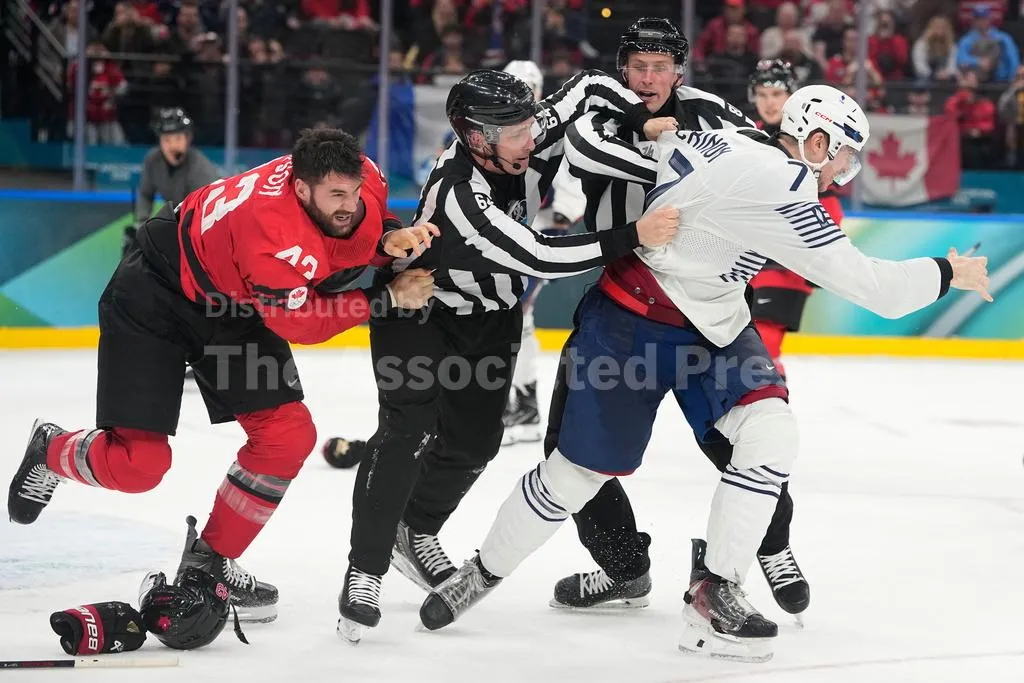
The fight that sparked controversy
Canada dominated France throughout the preliminary round matchup at Milano Santagiulia Arena, building a commanding lead by the third period. With the game out of reach at 10-2, tensions boiled over when Crinon delivered a high elbow or left forearm to the jaw of star forward Nathan MacKinnon.[1][3]
Wilson, known for his physical play in the NHL with the Washington Capitals, immediately confronted Crinon along the end boards. The two dropped the gloves in a rare Olympic scrap—the first significant fight since 1998—resulting in ejections for game misconducts under IIHF rules, which treat fighting more severely than the NHL’s five-minute major.[4]
As Crinon skated off the ice, he cupped his hands to his ears and waved to the crowd, drawing boos and even a thrown water bottle from a fan. This “provocative behavior,” as described by officials, played a key role in the federation’s response.[3]
The incident highlighted the physicality of Olympic hockey, where enforcers like Wilson provide protection for skilled players. For more on Wilson’s role in the game, check our piece on Canada’s Tom Wilson drops gloves in rare Olympic hockey fight.
Canada’s rout extended their unbeaten preliminary streak, capping group play perfectly. Details from that dominant performance are covered in Canada’s rout of France caps undefeated preliminary round in 2026 Olympics hockey.
French federation cracks down on Crinon’s actions
The FFHG acted swiftly, removing Crinon from the roster entirely. President Pierre-Yves Gerbeau met with the player, Chef de Mission Fabien Saguez, and staff to emphasize national team commitments. “Crinon’s provocative behavior upon leaving the ice… constitutes a clear violation of the Olympic spirit and undermines the values of our sport,” the federation stated.[2][3]
This ban ensures Crinon misses France’s critical qualification-round game against Germany on Tuesday, February 17. The winner advances to face Slovakia in the quarterfinals on Wednesday—a tall order for the underdogs without their physical defenseman.
Unlike the NHL, where fights are tolerated, IIHF protocols prioritize discipline to uphold the event’s prestige. The lack of further IIHF sanctions underscores that the French decision was internal and values-based.
France’s small hockey nation status amplifies such rulings, as captain Pierre-Edouard Bellemare noted post-game. Teammate Sacha Treille added, “It’s not something that you like to see in the Olympics. Nothing to say about it really.”[2]
Crinon’s checkered history resurfaces
Crinon’s selection for France’s Olympic roster was already debated due to his domestic league exploits with Brûleurs de Loups. Earlier in the 2025-26 season, he drew a seven-game suspension for repeatedly punching a maskless goaltender, injuring the player’s eye in a defenseless position on the ice.[5]
Critics labeled the act “unbelievable cowardice,” questioning his judgment and safety awareness. This history fueled backlash after the MacKinnon hit, with fans resurfacing clips online.
In French Ligue Magnus play, Crinon has multiple suspensions this year alone, painting him as a divisive figure—not a top-eight defenseman for international play, per analysts.
The Olympic stage magnified these issues, turning a marginal player into a lightning rod.
Impacts on France and Canada’s paths forward
France now faces Leon Draisaitl-led Germany without Crinon, testing their depth in a do-or-die scenario. An upset would pit them against powerhouse Slovakia next.
Canada, meanwhile, enters quarterfinals on Wednesday against the Czechia-Denmark winner, unbeaten and bolstered by Wilson’s three points (1G, 2A) in prelims. Coach Jon Cooper called him “outstanding” on and off the ice.[4]
Nathan MacKinnon praised Wilson’s protectiveness: “fantastic teammate” and “special person.”
Key tournament implications include:
- France: Lose physicality; focus on discipline vs. Germany.
- Canada: Top seed intact; Wilson available.
- IIHF: Reinforces zero-tolerance on fights.
For full context, see the ESPN report and Daily Faceoff analysis.[2]
Reactions pour in from players and pundits
Bellemare downplayed the scrap: “I mean, that wasn’t a fight. Let’s be honest… It was big hit on MacKinnon, and then there was another one on McDavid.” He acknowledged Canada’s response as inevitable.[3]
Social media erupted, with one fan noting Crinon’s goalie incident: “this is the guy people wanna defend.”[5]
Experts like Steven Ellis viewed Crinon as irrelevant in a blowout but symptomatic of fringe roster risks.
Wilson’s stand-up move earned NHL-style approval, rare in Olympics.
The federation’s firm stance sets a precedent for national teams prioritizing ethos over edge.
Crinon’s saga underscores the fine line between toughness and recklessness at the highest levels. As France battles for survival and Canada eyes gold, this episode reminds all that Olympic hockey demands more than skill—it requires embodying the games’ spirit. Watch for ripple effects in upcoming matches.
Frequently Asked Questions

Par Mike Jonderson
Mike Jonderson is a passionate hockey analyst and expert in advanced NHL statistics. A former college player and mathematics graduate, he combines his understanding of the game with technical expertise to develop innovative predictive models and contribute to the evolution of modern hockey analytics.