







The Chicago Blackhawks have spent decades establishing themselves as more than just a hockey franchise. Through intentional efforts to foster internal cohesion and external community engagement, the organization has built a culture that extends far beyond the ice surface. From supporting their captain during family medical emergencies to honoring Native American heritage and providing accessible youth hockey programs, the Blackhawks demonstrate how professional sports teams can become integral parts of the communities they represent.
The 2025-26 season has brought renewed energy to the organization, with early success reflecting not just improved talent, but a fundamental shift in how players, coaches, and the broader organization connect with each other and their fans. This transformation offers valuable lessons about building sustainable team culture in professional sports.
Building Chicago Blackhawks team culture and community building through family support
When Nick Foligno needed to step away from the team in October 2025 to be with his daughter Milana during follow-up surgery for her congenital heart defect, the organization’s response revealed everything about their cultural priorities. The captain returned to practice expressing profound gratitude for what he called his “second family” within the Blackhawks organization.
“We found a lot of comfort in the support of the hockey community, fans, old teammates and my second family here,” Foligno shared after returning. “It’s amazing when you go through a hard time how everyone bands together to send you a ton of support and love and prayers, and it was felt by our family.” According to The Hockey Writers, this moment crystallized the team’s commitment to supporting each other beyond hockey obligations.
The players themselves demonstrated their solidarity in meaningful ways. Before their 8-3 victory in St. Louis, the team dedicated the game to Milana, showing how personal connections strengthen collective performance. This wasn’t a manufactured moment for cameras—it was genuine care from teammates who had gotten to know the Foligno family personally.
This depth of relationship stems from intentional offseason bonding. Foligno invited several young Blackhawks to his hometown of Sudbury, Ontario, during the summer to train, skate, and simply spend time together. These players chose to invest their precious offseason days building relationships that would pay dividends during the grind of an NHL season. That commitment speaks volumes about the culture being cultivated within the organization.
The results are tangible. Through their first eight games of the 2025-26 season, the Blackhawks posted a 4-2-2 record, with no loss by more than one goal. While talent matters, the team’s resilience in close games reflects something deeper—players who genuinely care about each other fight harder when the outcome hangs in the balance.
Coaching philosophy driving Chicago Blackhawks team culture and community building
Head coach Jeff Blashill arrived in Chicago after seven seasons leading the Detroit Red Wings and three years as an assistant with the Tampa Bay Lightning. His time learning under Jon Cooper, widely regarded as one of the NHL’s elite coaches, shaped his philosophy about what truly matters in building winning teams.
“You can have all the X’s and O’s you want, but our number one job is to get the most out of our players,” Blashill explained. “And the way you do that, ultimately, is to build relationships. Hold them accountable, but be in the fight with them.” This player-centered approach creates an environment where athletes feel supported enough to push their limits while understanding their coaches demand excellence.
The implementation of this philosophy was evident during the Blackhawks’ Centennial season home-opener against Montreal. The team took 10 penalties in an emotional, hard-fought 3-2 loss. While the discipline needed improvement, Blashill saw something more important emerging. “If you don’t care about each other enough to fight for each other, you’re not gonna be a good team,” he said afterward. “So we’re going to make sure we look after each other.”
This willingness to accept short-term messiness while building long-term culture demonstrates sophisticated leadership. Blashill understands that young players need to learn how to care before they can learn when to restrain themselves. The coaching staff’s patience with the growth process, combined with clear accountability, creates psychological safety that allows players to develop authentically.
The respect flows both directions. Players consistently reference their trust in the coaching staff’s guidance and appreciate being treated as whole people rather than just athletes. Frank Nazar captured this sentiment when discussing the team’s ability to win close games: “I think that’s something that we’ve built the last few years. There’s been some hard times and some good times, but learning from losses and learning from mistakes, and losing. To be able to come out in games like this and understand what it takes to be mature and win games.”
Young players embracing Chicago Blackhawks team culture and community building
The organization’s youth movement extends beyond player development into cultural transformation. When Colton Dach, Artyom Levshunov, Landon Slaggert, Ryan Greene, Louis Crevier, and Frank Nazar boarded the team plane dressed as “Top Gun” fighter pilots before their game against Tampa Bay, they weren’t just having fun—they were demonstrating the camaraderie that defines successful teams.
This swagger and companionship represents exactly what the Blackhawks hope to cultivate. Young players confident enough to be themselves, comfortable enough with teammates to engage in playful group activities, and connected enough to want to spend time together away from mandatory team functions all contribute to the cohesive culture necessary for sustained success.
Ryan Donato, a veteran presence amidst the youth movement, has thrived in this environment. During a four-game goal streak and five-game point streak in October 2025, he could have easily focused on individual accomplishments. Instead, his post-game comments emphasized collective effort: “The young guys are hungry to win” and “everyone pushing from the same side.”
These aren’t empty platitudes. They reflect an organizational culture where veteran leadership models the right behaviors while young players bring energy and hunger. The blend creates mutual elevation—veterans stay engaged by mentoring the next generation, while young players benefit from experienced guidance delivered within a supportive framework.
The “Top Gun” moment coincided with Greene’s 22nd birthday, showing how the team celebrates individual milestones through collective participation. These small cultural touchpoints—acknowledging birthdays, dedicating games to family members, creating shared experiences—accumulate into the foundation of enduring team bonds.
Community engagement through Chicago Blackhawks team culture and community building
While internal culture matters tremendously, the Blackhawks’ community impact extends their influence far beyond the locker room. The organization’s relationship with Native American communities, particularly their namesake’s ancestral Sac & Fox Nation, demonstrates how professional sports franchises can honor their heritage responsibly while creating meaningful partnerships.
The Blackhawks have developed five formal partnerships and more than 15 advisory relationships with Native American organizations to guide their programming. This isn’t performative consultation—it’s genuine collaboration that shapes organizational decisions. According to the team’s official Native American initiatives page, these partnerships inform everything from grant programs to language preservation projects to game day materials.
The Youth Education Scholarship Program exemplifies this commitment. In collaboration with the Sac & Fox Nation’s education department, the Chicago Blackhawks Foundation funds four-year scholarships for tribal high school seniors pursuing college or university education. The Black Hawk Leadership Scholarship and Jim Thorpe Athletic Scholarship recognize students’ leadership skills and athletic accomplishments respectively, with multiple winners annually building toward a cohort of approximately 20 Sac & Fox youth scholars over five years.
The 2025 scholarship winners represent the program’s impact. James Lawrence McClellan, a member of the Thunder Clan and student-athlete from Bend, Oregon, embodies leadership and cultural pride. Breanna Pamela Butler, from a distinguished lineage within the Bear Clan and former Miss Sac & Fox Nation, uses her platform to educate others about tribal customs and language. Athletes Kanaan Taj Guerrero and Skye Nidya Ketcher both excel in their sports while remaining deeply connected to their heritage and community.
Beyond scholarships, the Blackhawks honor Native American Heritage Month each November with comprehensive celebrations. The 2023 event centered on the Powwow, a traditional gathering that provided an immersive experience for fans featuring dance competitions with over 65 competitors from across the country, indigenous food tastings, and artisan shops featuring Native goods from Chicago-based indigenous families. The Grammy-winning Northern Cree Drum Group performed during intermission, creating authentic cultural experiences rather than superficial acknowledgments.
Youth hockey development strengthening Chicago Blackhawks team culture and community building
The Little Blackhawks Learn to Play program represents perhaps the most direct community impact the organization creates. Developed jointly by the National Hockey League and NHL Players’ Association, the initiative offers families who might otherwise never access hockey an opportunity to experience the sport’s character-building benefits.
The program’s philosophy extends beyond skating and stick-handling. Learning to play hockey is more than just learning a game,” program materials explain. “More than skating, passing and stick-handling, hockey is about responsibility, respect and teamwork. As children learn the skills needed to succeed on the ice, they also build and solidify important character traits needed to succeed off the ice.”
Participants between ages 4-9 receive head-to-toe equipment, age-appropriate instruction, and certified coaching led by NHL Alumni in safe, fun environments. The 6-8 week sessions at local rinks across the Chicago area, and even extending to locations in Iowa and Indiana, remove the significant financial barrier that prevents many families from trying hockey. Equipment kits include jerseys, shoulder pads, gloves, elbow pads, helmets, shin guards, pants, skates, hockey socks, sticks, and equipment bags—everything a beginning player needs.
Each registration also includes a ticket to a Blackhawks home game, connecting grassroots development directly to the professional product. Young players who complete the Learn to Play program don’t just learn hockey skills—they become part of the Blackhawks community, experiencing firsthand how the organization they’re learning about on ice performs at the highest level.
The program’s reach demonstrates scale and commitment. Multiple rinks across the greater Chicago area host sessions throughout the season, from Northbrook to Naperville, Geneva to Wilmette, even extending to Dubuque, Iowa and Indianapolis, Indiana. This geographic distribution ensures accessibility regardless of where families live within the Blackhawks’ market.
Formalizing expectations for Chicago Blackhawks team culture and community building
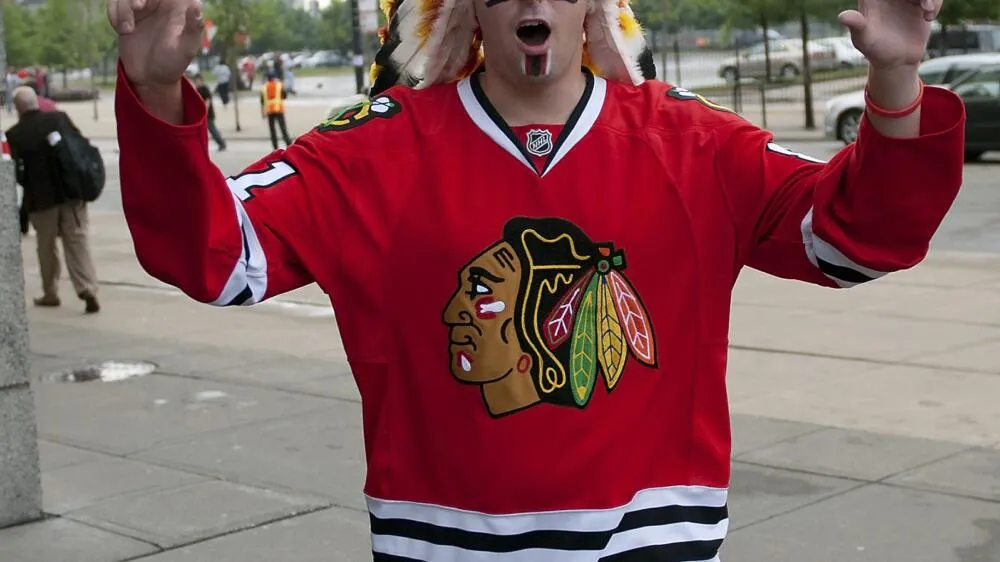
After extensive conversations with Native American partners, the Blackhawks formalized expectations for fan behavior that had previously existed informally. Headdresses are now explicitly prohibited for fans entering Blackhawks-sanctioned events or the United Center for home games.
This policy acknowledges that these symbols are sacred, traditionally reserved for leaders who have earned great respect within their tribes, and should not be generalized or used as costumes. While some franchises might avoid such policies fearing fan backlash, the Blackhawks prioritized cultural respect over potential controversy.
The organization opens all home games, public events, and other gatherings by acknowledging the traditional Native American inhabitants of the land they occupy. This Land Acknowledgement—a formal statement recognizing the unique and enduring relationship between Indigenous Peoples and their traditional territories—expresses gratitude to those whose territory the team resides on while honoring Indigenous people who have lived and worked on the land since time immemorial.
These aren’t token gestures. They represent fundamental organizational values that shape how the Blackhawks operate internally and present themselves externally. When leadership demonstrates commitment to difficult conversations and culturally sensitive policies, it signals to players, staff, and fans that the organization stands for something beyond winning games.
The Chicago Blackhawks’ approach to team culture and community building offers a roadmap for professional sports organizations seeking lasting impact. By prioritizing genuine relationships over performative gestures, supporting players as whole people rather than just athletes, engaging communities through meaningful partnerships rather than superficial outreach, and investing in youth development that removes barriers to participation, the franchise creates value that transcends any single season’s win-loss record.
As the 2025-26 season progresses, the early returns suggest this cultural foundation is translating into on-ice success. But even if the wins don’t immediately follow, the Blackhawks have positioned themselves for sustainable success by building something more enduring than any playoff run—a community of players, coaches, fans, and partners united by shared values and mutual commitment. That’s the kind of culture that weathers inevitable adversity and celebrates victories with people who genuinely care about each other’s success.

Par Mike Jonderson
Mike Jonderson is a passionate hockey analyst and expert in advanced NHL statistics. A former college player and mathematics graduate, he combines his understanding of the game with technical expertise to develop innovative predictive models and contribute to the evolution of modern hockey analytics.