











Jake Evans injury 4-6 weeks Montreal Canadiens: depth softens the blow
The Montreal Canadiens will navigate the next month without veteran forward Jake Evans, who is slated to miss 4-6 weeks with a lower-body injury sustained in a collision last weekend. The team announced the timeline on Saturday, throwing a wrench into their post-holiday break plans but providing clarity on an injury that initially sparked fears of a much longer absence.
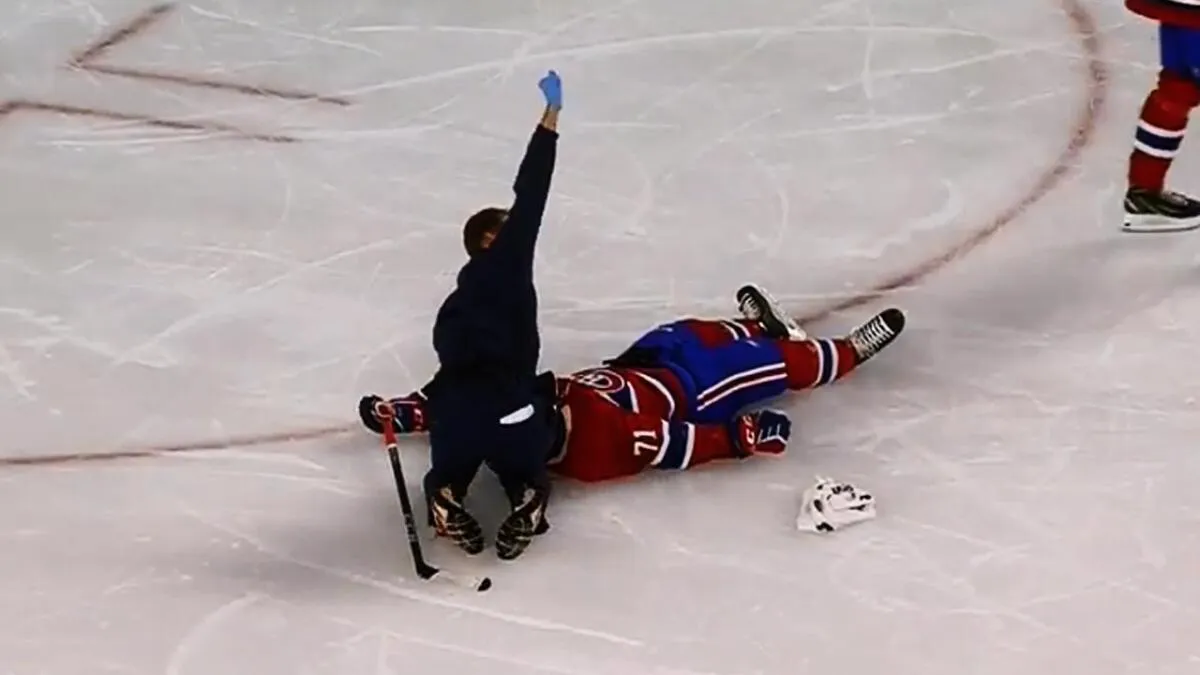
Evans, 29, exited in the first period of the Canadiens’ 4-0 victory over the Pittsburgh Penguins on December 20 after an awkward collision with Justin Brazeau. While the immediate concern centered on potential structural knee damage, medical evaluations have confirmed a less severe prognosis that should see the centre return before the Olympic break. The injury represents another setback for a Canadiens team that has battled health issues throughout the season, though the timing coincides fortuitously with recent roster moves that mitigate the impact.
How the injury occurred and initial concerns
The play that sidelined Evans appeared routine at first glance. During a first-period shift against the Penguins, Evans became entangled with Brazeau, with his left knee absorbing the brunt of the contact. He immediately left the ice and did not return, prompting speculation about the severity of the damage. In today’s game, any knee-on-knee or knee-on-thigh collision triggers immediate alarm bells about potential ACL tears, which could end a player’s season.
Canadiens medical staff conducted thorough evaluations in the days following the incident, and the 4-6 week timeline announced Saturday provided significant relief throughout the organization. Sportsnet’s Eric Engels noted that the timeline is measured from the day of injury, meaning Evans has already completed one week of his recovery. This puts his potential return somewhere between mid-January and early February, depending on his rehabilitation progress.
The veteran forward has appeared in 34 games this season, recording five goals and five assists for 10 points. While his offensive production has been modest, his value extends far beyond the scoresheet. Last season, Evans enjoyed a career year with 13 goals and 36 points while averaging 15:33 of ice time, establishing himself as a dependable two-way centre in Martin St. Louis’s system.
Evans’ critical role in Montreal’s defensive structure
The Montreal Canadiens will feel Evans’ absence most acutely on the penalty kill and in the faceoff circle. Evans had evolved into one of the team’s most reliable defensive forwards, regularly deployed against opposing top lines and serving as a mainstay on the penalty kill unit. His right-handed shot and ability to win crucial draws late in games made him an invaluable asset in tight situations.
This season, Evans’ faceoff prowess and defensive awareness allowed the Canadiens to shelter their star players from heavy defensive-zone responsibilities. Nick Suzuki, already burdened with power-play quarterback duties and top-line matchups, could rely on Evans to share the penalty-killing load. With Evans sidelined, that balance becomes more precarious.
The timing compounds the challenge, as the Canadiens return from the holiday break facing a compressed schedule with playoff positioning at stake. Every point matters in what’s shaping up to be a tightly contested Eastern Conference wild-card race. Losing a player who contributes in subtle but critical ways tests a team’s depth and forces coaching staff to adjust their trust hierarchy.
Fortunately, Evans’ injury comes at a moment when Montreal’s centre depth has never been stronger, thanks to a prescient move by general manager Kent Hughes.
Internal replacements soften the blow
The most significant factor cushioning Evans’ absence is the recent acquisition of Phillip Danault from the Los Angeles Kings, completed just 24 hours before Evans sustained his injury. Danault, who spent six seasons with the Canadiens before departing in free agency, returns as a known commodity with an established chemistry with the fanbase and familiarity with the Montreal market.
Danault’s reputation as a premier defensive centre makes him arguably an upgrade over Evans on the penalty kill. He finished fourth in Selke Trophy voting just two seasons ago and has spent years mastering the art of shutting down opposition stars. His presence allows St. Louis to maintain the same defensive structure without overextending Suzuki or asking younger players to fill roles they're not ready for.
Beyond Danault, the Canadiens can turn to rookie Owen Beck, who has shown flashes of the same two-way game that defines Evans’ style. Beck’s right-handed shot and faceoff ability mirror Evans’ skill set, and the coaching staff can now shelter him in a fourth-line role while Danault handles the heavy defensive lifting. This developmental opportunity accelerates Beck’s growth without exposing him to matchups he’s not prepared for.
Additionally, Kirby Dach continues to progress in his recovery and should return within the next two weeks, providing yet another centre option. While Dach’s game differs from Evans’ — emphasizing size and skill over pure defensive responsibility — his return adds another body to a position that recently looked thin but now appears robust.
Broader context: Canadiens navigating injury adversity
The Evans injury fits into a larger pattern of health challenges for the Canadiens this season. The team previously faced a four-month setback when Alex Newhook suffered a significant injury, forcing management to weigh internal call-ups against potential trades to maintain playoff contention. That situation tested Montreal’s organizational depth and forced difficult decisions about asset management.
Comparatively, Evans’ 4-6 week timeline seems manageable. The Canadiens have demonstrated resilience in the face of adversity, and their roster construction has been specifically designed to withstand exactly this type of medium-term absence. The fact that they can replace a top penalty killer and faceoff specialist without fundamentally altering their systems speaks to the foresight of the front office.
Another positive development emerged from Saturday’s practice in Tampa Bay: forward Alexandre Texier participated in a regular jersey after leaving Tuesday’s win against Boston with an apparent injury. His availability against the Lightning on Sunday prevents what would have been another significant loss, given Texier’s speed and underrated offensive contributions.
The injury situation also highlights the importance of the upcoming Olympic break. If Evans’ recovery extends toward the longer end of the 4-6 week projection, he could potentially return just as the league pauses for the international tournament. This would give him additional recovery time without missing more games, effectively turning a five-week injury into a more manageable setback.
What this means for Montreal’s playoff push
While losing any regular roster player creates challenges, the Canadiens find themselves in a relatively strong position to absorb Evans’ absence. The Danault acquisition transforms what could have been a crisis into a manageable situation, allowing the team to maintain their competitive level during a crucial stretch of the season.
The true test will be whether the injury bug continues to bite. Montreal’s depth can handle one medium-term absence, but additional injuries to key centres would strain even their improved roster. The team’s ability to stay healthy through January will likely determine whether they remain in the playoff conversation or fade as the season progresses.
For Evans, the focus now shifts to rehabilitation and maintaining conditioning during his time off. At 29 years old, he understands how to prepare his body for a return, and the lower-body nature of the injury should allow him to stay sharp through off-ice training. His eventual return will give St. Louis additional lineup flexibility and restore the penalty kill to full strength just in time for the stretch run.
The Montreal Canadiens have navigated treacherous injury waters before. This time, they’re better equipped to handle the storm.
Frequently Asked Questions

Par Mike Jonderson
Mike Jonderson is a passionate hockey analyst and expert in advanced NHL statistics. A former college player and mathematics graduate, he combines his understanding of the game with technical expertise to develop innovative predictive models and contribute to the evolution of modern hockey analytics.