


The 2022 NHL Draft unfolded in Montreal with uncertainty and intrigue swirling around the first overall selection. The Canadiens held court on home ice, facing one of the most debated draft classes in recent memory. While not considered the deepest talent pool, the top of the class featured three legitimate contenders for the premier position: Juraj Slafkovsky, Logan Cooley, and Shane Wright. Montreal ultimately selected Slafkovsky, leaving the Arizona Coyotes (now Utah Hockey Club) to snap up Cooley at third overall. Three years later, this Juraj Slafkovsky vs Logan Cooley 2022 NHL draft comparison has evolved into one of the league’s most fascinating player development stories.
The debate between these two players remains as vibrant today as it was on draft night. Both have carved out distinct paths to NHL success, with different timelines, playing styles, and trajectories. Understanding how these prospects were evaluated pre-draft, their professional journeys, and their current standing provides valuable insight into talent evaluation and player development.
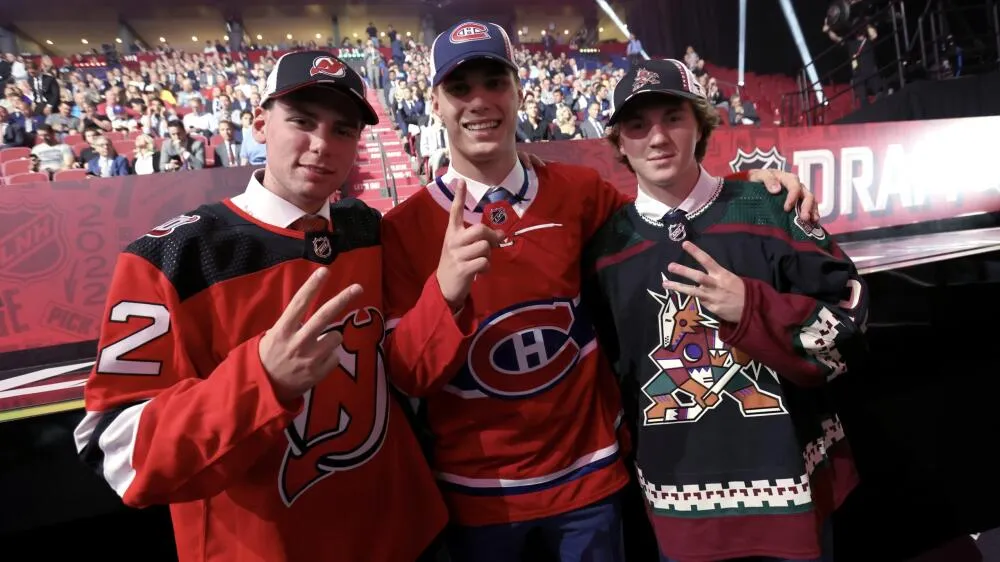
Pre-draft profiles in the Juraj Slafkovsky vs Logan Cooley 2022 NHL draft comparison
Juraj Slafkovsky’s unique path to first overall
Juraj Slafkovsky presented an unconventional profile for a first overall pick. The 6-foot-4, 218-pound Slovakian winger built his draft stock primarily through international competition rather than traditional junior hockey. He dominated at the 2022 Beijing Olympics, where he became the youngest player to win Olympic MVP after tallying seven goals in seven games for Slovakia. His performance on the world stage, combined with solid production in Finland’s Liiga with TPS (19 goals and 23 assists in 22 regular season games), elevated his stock dramatically.
Scouts praised Slafkovsky’s rare combination of size, skill, and offensive instincts. His powerful shot, particularly his one-timer, drew comparisons to elite power forwards. The scouting reports described him as an “upright skater with average speed and occasional straight-line bursts,” but his ability to protect the puck, win battles along the boards, and create scoring chances made him NHL-ready from a physical standpoint.
The concerns centered on his skating efficiency and whether his offensive production against men’s competition was sustainable. Some evaluators questioned if his Olympic performance was an outlier or a true indicator of his ceiling. Nevertheless, according to NHL.com’s draft analysis, the Canadiens selected “arguably the most NHL-ready player in the 2022 Draft class” who had “excelled against older, elite competition.”
Logan Cooley’s elite playmaking abilities
Logan Cooley represented the polar opposite profile. The 5-foot-10 center excelled with the USA Hockey National Team Development Program, showcasing exceptional skating, vision, and two-way play. He registered 20 goals and 36 assists in 41 combined games for the NTDP, displaying the dynamic playmaking that made him a consensus top-five pick.
Cooley’s skating ability stood out as genuinely elite. He possessed the kind of speed and agility that allowed him to create entries and exits, weave through coverage, and escape defensive pressure with ease. Beyond his physical tools, scouts lauded his hockey IQ, his ability to drive possession, and his commitment to playing a complete 200-foot game.
The Pittsburgh native committed to the University of Minnesota before the draft, a decision that signaled his intent to develop his game further before jumping to the NHL. Evaluators described him as a “dynamic playmaker” who was “naturally fluid with the puck” and created turnovers through active stick work in all three zones. While size remained the only question mark, his compete level and cerebral approach to the game more than compensated for any physical limitations.
Career trajectories in the Juraj Slafkovsky vs Logan Cooley 2022 NHL draft comparison
Slafkovsky’s challenging start and breakthrough
Montreal’s decision to keep Slafkovsky in the NHL for his draft-plus-one season proved controversial. The young Slovak struggled mightily, managing just five points in 39 games during the 2022-23 campaign. Critics questioned whether rushing him to the NHL had stunted his development, while supporters pointed to the value of learning at the highest level despite the statistical struggles.
The turning point came in his sophomore season. Slafkovsky transformed into a legitimate top-six contributor, posting 20 goals and 50 points in 82 games. His physical maturation, improved skating, and growing confidence created the “sophomore surge” many had predicted. The development wasn’t linear, but it validated the Canadiens’ patience and their belief in his long-term potential.
Through 200 career games entering the 2025-26 season, Slafkovsky has accumulated 42 goals and 69 assists for 111 points, with a -28 plus-minus rating. The current season has seen continued growth, with six goals and three assists in his first 15 games. His evolution into a more complete player who uses his size effectively while improving his offensive consistency has been remarkable to witness.
Cooley’s immediate impact with Utah
Logan Cooley took a different route, spending one season at the University of Minnesota before turning professional. His transition to the NHL proved smoother, recording seven goals and 37 assists for 44 points as a rookie with Arizona in 2023-24. The immediate production validated the scouting reports about his NHL-readiness and playmaking vision.
In the 2024-25 season, Cooley has continued his upward trajectory with Utah. According to StatMuse statistics, he’s compiled 45 goals and 64 assists for 109 points across 157 career games with a -12 plus-minus rating. His ability to produce consistently while maintaining his two-way commitment has made him a cornerstone for the franchise’s future.
The contrast in development curves tells an important story about player pathways. Cooley’s college year allowed him to dominate against age-appropriate competition and arrive in the NHL with refined skills and confidence. Slafkovsky’s baptism by fire required more patience but may ultimately produce a more physically dominant player with a higher ceiling.
Analyzing the statistical comparison in the Juraj Slafkovsky vs Logan Cooley 2022 NHL draft comparison
Points production and offensive impact
The raw numbers reveal fascinating insights. Slafkovsky has played 43 more games (200 vs. 157) but trails Cooley slightly in total points (111 vs. 109). However, their scoring rates tell different stories. Cooley averages 0.69 points per game compared to Slafkovsky’s 0.56, reflecting his more immediate offensive impact and consistent production.
Cooley’s playmaking dominates his profile with 64 assists compared to 45 goals, a clear 1.42 assists-per-goal ratio. Slafkovsky’s numbers skew more balanced at 69 assists to 42 goals (1.64 ratio), though he’s shown more goal-scoring improvement recently. The difference reflects their roles—Cooley as a distributor and facilitator, Slafkovsky as a power forward who creates space and finishes.
When examining plus-minus ratings, both players show negative numbers (-28 for Slafkovsky, -12 for Cooley), which speaks more to their teams’ competitive situations than individual defensive deficiencies. Montreal and Utah/Arizona have undergone rebuilding phases, placing young players in challenging circumstances where defensive metrics naturally suffer.
Style of play and team impact
The eye test reveals what statistics cannot fully capture. Slafkovsky brings a physical dimension that few in his draft class can match. His ability to protect the puck along the boards, create havoc in front of the net, and use his frame to generate scoring chances makes him invaluable in playoff-style hockey. He’s become the type of player who makes linemates better through space creation and net-front presence.
Cooley’s impact manifests differently. His exceptional skating creates transition opportunities and offensive zone entries that drive possession. He’s the type of center who controls tempo, makes quick decisions, and finds passing lanes others don’t see. His defensive responsibility and faceoff competence add dimensions beyond pure scoring, making him a complete pivot who can play in all situations.
Expert perspectives on the Juraj Slafkovsky vs Logan Cooley 2022 NHL draft comparison
Re-draft rankings and evaluations
The Athletic’s September 2025 re-draft exercise, as reported in their comprehensive analysis, ranked Slafkovsky first overall in Tier 1 as an “NHL All-Star” while placing Cooley second in Tier 2 as a “Bubble star and top of lineup” player. This evaluation suggests Slafkovsky’s unique combination of size and skill still gives him a slight edge in long-term projection.
However, other evaluators see it differently. A November 2025 Bleacher Report re-draft article suggested swapping Cooley into the first spot based on his more consistent production and immediate impact. The debate mirrors the pre-draft discussion—size and potential versus polish and production.
The divergent opinions highlight what makes this comparison so compelling. Both players have fulfilled their draft promise in different ways, creating legitimate arguments for either side. Those who value physical dominance and goal-scoring ceiling lean toward Slafkovsky, while those prioritizing playmaking, skating, and consistent point production favor Cooley.
Development philosophy and patience
The contrasting development approaches offer lessons for NHL organizations. Montreal’s decision to keep Slafkovsky in the NHL despite early struggles required organizational courage and long-term vision. The payoff came in year two when he blossomed, suggesting that sometimes the difficult path yields better results.
Arizona/Utah’s approach with Cooley—allowing college development before NHL integration—created a smoother transition with less public scrutiny. Cooley arrived more prepared mentally and physically, avoiding the confidence-crushing struggles that could have derailed a less resilient player.
Both strategies have merit, and the success of each player validates their respective development paths. As one Reddit user noted in discussions about the 2022 draft grades, “Slafkovsky was always a guy who’d take 3-4 years to really shine. He’s already a very solid player and hits 50 points and seems like he has more in the tank.” The patience required for different player types remains a critical consideration in talent development.
Future outlook for the Juraj Slafkovsky vs Logan Cooley 2022 NHL draft comparison
Ceiling and long-term projections
Slafkovsky’s ceiling remains tantalizing. If he continues improving his skating efficiency and offensive consistency while maintaining his physical edge, he projects as a potential 70-point power forward who impacts games in multiple ways. His ability to score goals in traffic, his improving playmaking, and his physical maturity suggest he hasn’t hit his peak yet.
Cooley’s trajectory points toward becoming a first-line center on a contending team. His skating, vision, and two-way commitment provide a foundation for sustained excellence. If he adds more finishing touch to complement his elite playmaking, a consistent 75-80 point season seems well within reach. His style ages well, relying on skill and intelligence rather than purely physical attributes.
The comparison will likely continue evolving over the next several seasons. Both players are still years away from their prime, with room for growth in their games. Slafkovsky needs to prove he can sustain 50-plus point seasons and become more defensively reliable. Cooley must demonstrate he can be “the guy” on a playoff team and add more goal-scoring to his resume.
Impact on team building
For Montreal, Slafkovsky represents the type of unique asset that’s difficult to acquire through free agency or trades. Players with his combination of size, skill, and offensive upside rarely become available. His development alongside Cole Caufield and Nick Suzuki creates an exciting foundation for the Canadiens’ rebuild.
Utah’s possession of Cooley gives them a foundational center to build around for the next decade. Elite centers drive franchise success, and Cooley’s two-way capabilities and offensive creativity make him the kind of player championship teams need down the middle. His contract efficiency during these early seasons provides roster flexibility that smart organizations exploit.
The Juraj Slafkovsky vs Logan Cooley 2022 NHL draft comparison ultimately transcends individual statistics. Both players have validated their high draft positions, contributed meaningfully to their teams, and demonstrated the upside that made them top-three selections. The debate about who should have gone first overall will persist, but the reality is both franchises secured franchise cornerstones who will shape their futures for years to come.
As the 2025-26 season progresses, watching these two players continue their development provides one of hockey’s most compelling ongoing storylines. Whether measured by points, impact, or potential, both Slafkovsky and Cooley have proven worthy of their draft pedigree, just along different timelines and through contrasting styles. The 2022 draft class may not have been the deepest, but its top tier has delivered exactly what scouts projected—legitimate difference-makers who will define their franchises’ trajectories for the next decade.

Par Mike Jonderson
Mike Jonderson is a passionate hockey analyst and expert in advanced NHL statistics. A former college player and mathematics graduate, he combines his understanding of the game with technical expertise to develop innovative predictive models and contribute to the evolution of modern hockey analytics.