












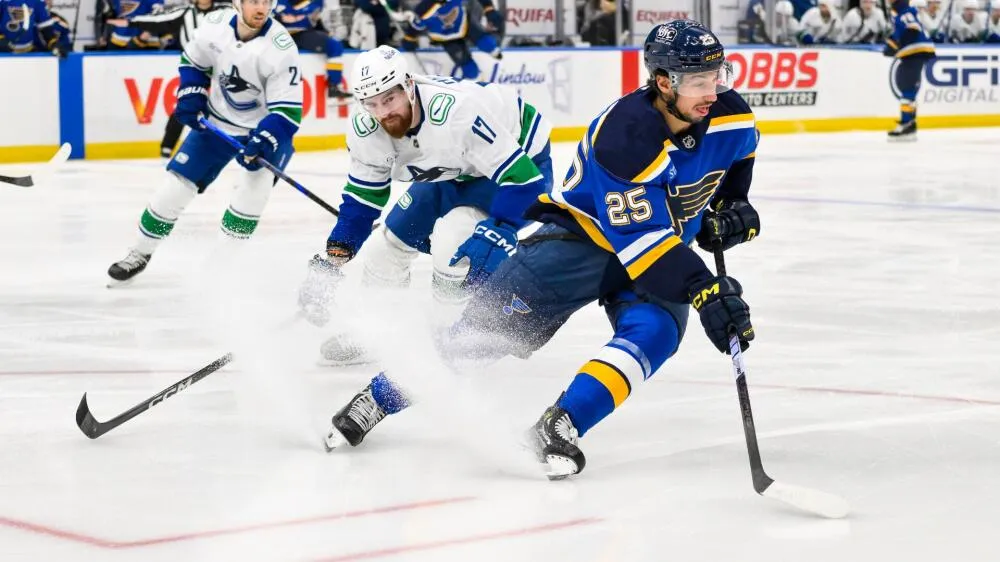
The St. Louis Blues find themselves in a familiar position—struggling to find consistency and looking for answers amid a disappointing start to the season. At the center of the conversation is Jordan Kyrou, the talented winger whose future with the organization has become one of the most intriguing storylines in the NHL. With the Blues sitting near the bottom of the standings and Kyrou being made a healthy scratch in early November, speculation about his availability has reached a fever pitch. The question on everyone’s mind: will the Blues actually pull the trigger on a trade that seemed inevitable just months ago?
The situation is complex, layered with contract complications, performance evaluations, and the harsh reality of a team that expected much more. Kyrou’s benching sent shockwaves through the hockey world, not because he’s been particularly poor, but because it highlights just how desperate St. Louis has become to find solutions to their early-season woes. With a full no-trade clause now in effect and multiple teams reportedly monitoring the situation, the Jordan Kyrou trade saga represents one of the more compelling narratives in what promises to be an active trade market.
Why the Blues are considering moving Jordan Kyrou
The Blues’ decision to scratch Kyrou for their game against Buffalo raised eyebrows across the league, particularly given his production relative to the rest of the team. With eight points in 14 games, he was tied for second on the roster at the time—hardly the statistics of a player deserving healthy scratch status. Yet head coach Drew Bannister made the call, sending a message that appeared directed at the entire roster rather than Kyrou specifically.
St. Louis entered the season with playoff aspirations, but a 5-8-2 record through their first 15 games shattered those expectations. The team’s offensive output has been middling at best, ranking 24th in the league at 2.71 goals per game. However, the real culprit has been goaltending, where Jordan Binnington and Joel Hofer have combined for one of the worst starts by a tandem in recent memory. According to Pro Hockey Rumors, Binnington posted an .859 save percentage while Hofer languished at .836 through the first month of the season.
Despite this, Kyrou has become something of a scapegoat for the Blues’ struggles. His defensive metrics have actually been strong this season, and his linemates Dylan Holloway and Brayden Schenn have controlled play at an impressive rate. The line ranks 13th out of 54 forward combinations with at least 60 minutes together in expected goals percentage. The issue isn’t production or possession—it’s the optics of a high-priced player on a struggling team.
The timing of these struggles couldn’t be worse for trade discussions. Last summer, Kyrou was frequently mentioned in trade speculation before his full no-trade clause kicked in on July 1. The Blues had a window to move him without his input, and they chose not to do so. Now, any trade would require Kyrou’s approval, adding another layer of complexity to an already challenging situation. The franchise appears to be at a crossroads: commit to building around their current core or acknowledge that significant changes are necessary.
Teams reportedly interested in acquiring Kyrou
Multiple organizations have expressed interest in Kyrou’s services over the past several months, creating a robust potential market should the Blues decide to make him available. The New York Islanders emerged as one of the most frequently mentioned suitors, their interest dating back to before Kyrou’s no-trade clause took effect. The Islanders’ need for offensive firepower and their history of acquiring established players make them a logical fit.
The Montreal Canadiens have also been linked to Kyrou on multiple occasions. Montreal’s aggressive retool has them seeking offensive talent to complement their young core, and Kyrou’s age—he’s only 26—fits their timeline perfectly. The Canadiens have the cap space and prospect capital to make a deal work, though convincing Kyrou to waive his no-trade protection for a rebuilding team could prove challenging.
According to reports from The Hockey Writers, the Ottawa Senators and Vancouver Canucks have also inquired about Kyrou’s availability, though with less intensity than New York and Montreal. The Senators would offer Kyrou a chance to play in a Canadian market with a young, emerging core, while Vancouver could position him alongside elite talent in a playoff-caliber lineup.
What makes Kyrou attractive to contending teams is his consistency. He’s topped 30 goals for three consecutive seasons and has posted between 67 and 75 points in each of the last four years. That kind of predictable, high-end production is rare in today’s NHL. He’s a player who can slot into a top-six role immediately and provide offense while not being a liability defensively—exactly what playoff-bound teams covet at the trade deadline.
The challenge for any acquiring team will be the contract. Kyrou carries an $8.125 million cap hit through the 2032 season, still having six years remaining after this campaign. While the rising salary cap has made that number more palatable than it appeared last summer, it’s still a significant commitment. Any team trading for Kyrou would need to be confident he can return to his 75-point form rather than the reduced pace he’s currently on.
The contract complications and no-trade clause factor
Kyrou’s eight-year, $65 million contract extension was signed with the expectation that he would continue his upward trajectory as a premier offensive weapon for St. Louis. The deal, which began in the 2023-24 season, looked reasonable at the time given Kyrou’s production. However, the full no-trade clause that activated on July 1, 2025, has fundamentally altered the trade landscape.
No-trade clauses shift power dramatically from teams to players, and Kyrou now holds all the cards. If the Blues approach him about waiving his protection, he can demand to go only to contending teams in desirable markets. This limitation could significantly reduce the return St. Louis might receive, as teams with less leverage can afford to offer less knowing they face limited competition.
The financial commitment also complicates matters for potential suitors. While $8.125 million no longer seems exorbitant in an era where top-six forwards routinely command north of $9 million annually, it’s still a substantial figure for a player who isn’t quite elite. The salary cap is expected to continue rising, which works in Kyrou’s favor from a trade value perspective. What seemed like a potentially unmovable contract six months ago has become increasingly palatable as market dynamics shift and other comparable players sign for similar or greater amounts.
For St. Louis, the question becomes whether moving Kyrou’s contract is worth the potential return. If they’re committed to a rebuild or retool, freeing up $8.125 million in cap space could allow them to redirect resources toward younger players or future assets. However, if they believe they’re still a playoff-caliber team with better goaltending, trading a consistent 30-goal scorer makes little sense. The organization appears torn between these competing visions, leading to the uncertainty that now defines Kyrou’s status.
Similar trade situations around the league provide context for how this might unfold. Teams increasingly prioritize cap flexibility, and moving on from productive players with significant term has become more common. The key will be whether the Blues can extract fair value given their limited leverage, or whether they’ll need to retain salary or accept a lesser return to facilitate a move.
What Kyrou’s performance says about his trade value
Despite the scratching and swirling trade rumors, Kyrou’s underlying numbers tell a story of a player who remains valuable. His eight points in 14 games works out to a 47-point pace over 82 games, well below his career standards but not disastrous considering team context. More importantly, his shot attempt differential and expected goals metrics show that he’s driving play effectively when on the ice.
The challenge for Kyrou has been shot generation. He’s registering 21% fewer shots on goal compared to last season, suggesting either reduced ice time in offensive situations or less aggressive shot selection. His shooting percentage of 12.5% remains consistent with his career average, indicating that when he does shoot, he’s finishing at his expected rate. The issue isn’t finishing—it’s opportunity.
Analytically, Kyrou’s linemates have performed well. His combination with Schenn and Holloway ranks among the league’s better possession lines, controlling 58.7% of expected goals when on the ice together. They’ve been adept at generating quality chances and limiting them defensively. Yet individual plus-minus ratings tell a different story, with Kyrou sitting at minus-8 and Schenn at minus-13. These numbers are misleading, however, as they’re heavily influenced by the atrocious goaltending behind them rather than the play in front of the net.
Teams evaluating Kyrou will look beyond surface-level statistics to these deeper metrics. They’ll see a player who, in a better situation with competent goaltending, would likely be producing at or near his career pace. The Blues’ organizational struggles aren’t Kyrou’s fault, and savvy general managers understand that context matters when evaluating trade targets. His defensive responsibility has improved, his offensive instincts remain sharp, and he’s entering his prime years.
The scratching itself, while dramatic, likely won’t impact his trade value significantly. Most around the league recognize it as a team-wide message rather than an indictment of Kyrou specifically. If anything, it may have accelerated trade discussions by forcing everyone involved to confront the reality that change is necessary. Teams that have been monitoring the situation are now picking up the phone, sensing that St. Louis might finally be ready to make a move they’ve been contemplating for months.
How this situation compares to recent NHL trade patterns
The Kyrou situation mirrors several recent NHL trade scenarios where talented players found themselves on struggling teams with hefty contracts. The NHL trade market has become increasingly active in recent seasons, with teams less hesitant to move core pieces when the fit no longer makes sense. The key difference is that most of those trades involved players without no-trade protection, giving teams more flexibility in facilitating deals.
Consider the parallel to Pierre-Luc Dubois, who was moved multiple times despite significant contracts because teams recognized his talent exceeded his circumstances. Similarly, Artemi Panarin’s trade from Columbus before his contract expired showed that teams are willing to capitalize on assets before losing them for nothing. The Blues find themselves in a different position—they have Kyrou locked up long-term, but his no-trade clause creates complications that didn’t exist in those other situations.
What’s evolved is the market’s tolerance for large contracts. Teams that once balked at taking on $8 million commitments now view them as necessary costs of acquiring top-tier talent. The rising salary cap has fundamentally changed how franchises approach contract evaluation, and deals that seemed immovable two years ago now appear manageable. This shift benefits both the Blues and Kyrou, as it expands the pool of potential trade partners.
The timing of trade discussions has also changed. Where teams once waited until the trade deadline to make moves, there’s now a recognition that early-season trades can be beneficial. Trade speculation and rumors begin earlier each year, with teams less willing to let situations fester if they believe change is necessary. The Blues’ decision to scratch Kyrou in November rather than waiting until after the new year suggests they may be willing to act sooner rather than later if the right deal materializes.
The path forward for both player and team
The Blues face a pivotal decision that will shape their trajectory for years to come. If they trade Kyrou, they’re acknowledging that their current core isn’t good enough and committing to some form of retool. The return would need to include either young, NHL-ready talent or premium draft picks—anything less would represent a failure to maximize his value. Given his production history and age, the Blues should be able to command a significant package even with the contract considerations.
For Kyrou, being traded could represent a fresh start and an opportunity to showcase his abilities in a better situation. A move to a contending team would put him in a position to contribute to playoff success while playing alongside better linemates. However, waiving his no-trade clause means giving up leverage and control over his future. He’ll need to weigh the benefits of a new situation against the security and familiarity of remaining in St. Louis.
If no trade materializes, both sides will need to repair their relationship and commit to making things work. The scratching incident could serve as a turning point if it leads to improved communication and clearer expectations. Kyrou has proven he can be a productive player when given the opportunity, and the Blues’ struggles have more to do with goaltending than forward performance. Better results from Binnington and Hofer could completely change the narrative around the team and Kyrou’s place within it.
The coming weeks will be telling. Teams around the league are watching closely, ready to pounce if the Blues indicate serious willingness to move Kyrou. General manager Doug Armstrong has never been afraid to make bold moves, and this situation may require exactly that kind of decisiveness. Whether Kyrou remains a Blue or finds himself in a new uniform before the trade deadline, the resolution of this saga will have far-reaching implications for both player and franchise.

Par Mike Jonderson
Mike Jonderson is a passionate hockey analyst and expert in advanced NHL statistics. A former college player and mathematics graduate, he combines his understanding of the game with technical expertise to develop innovative predictive models and contribute to the evolution of modern hockey analytics.