







Craig Leipold declared the Wild will re-sign Quinn Hughes, with the contract length likely settling at five years instead of the three-year term Hughes might prefer.
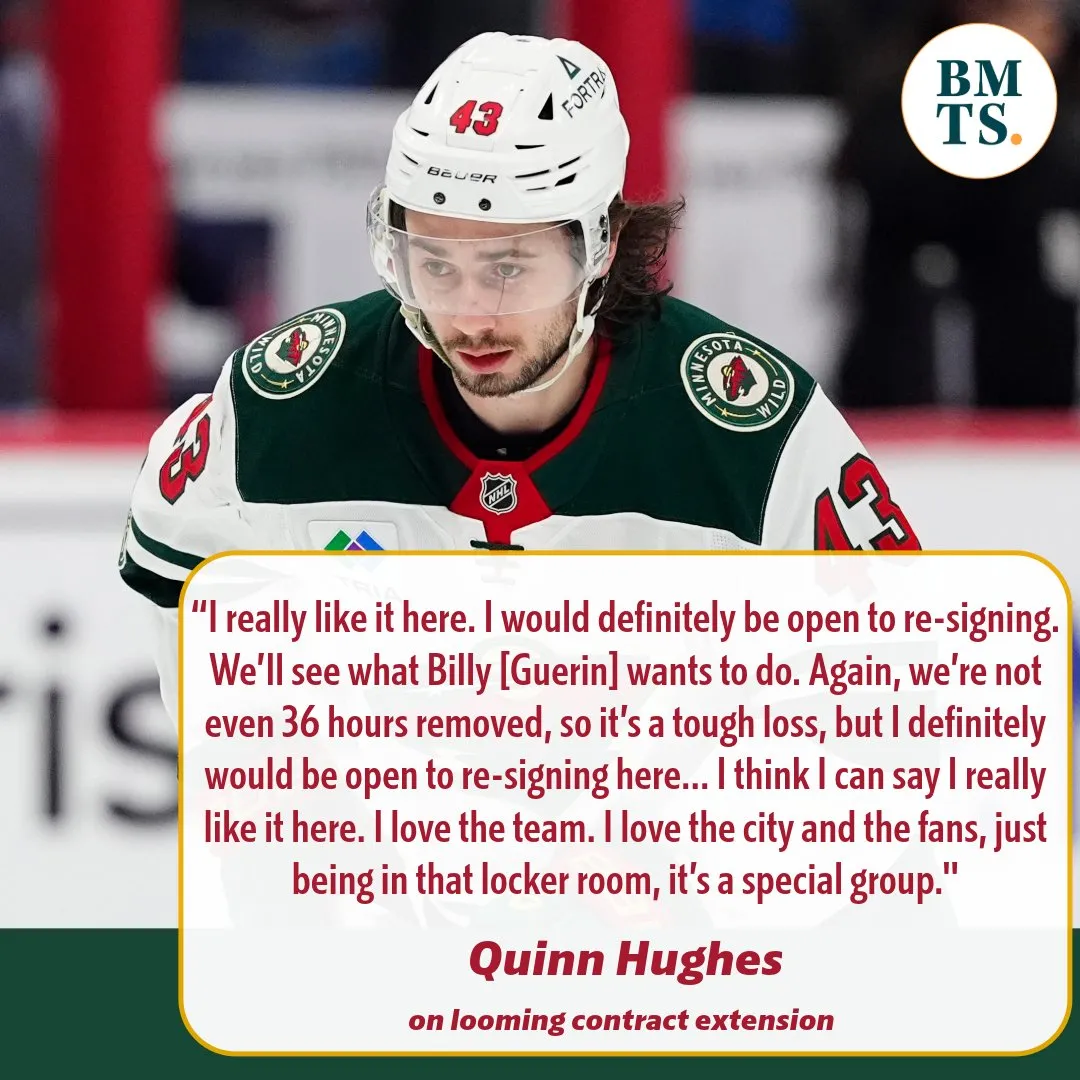
Leipold’s statements reveal prior discussions
Leipold told Minnesota Public Radio that the organization plans to secure Hughes on an extension starting July 1. He contrasted the team’s preference for maximum length against Hughes’ likely desire for a shorter commitment of three years, projecting a compromise at five.
This language differs from standard owner optimism because Leipold referenced specific numbers without qualification. The meeting between general manager Bill Guerin and Hughes on the Jersey Shore supplied the factual basis for such precision.
Hughes, acquired from Vancouver on December 12, has already evaluated the Wild roster in person. The presence of Kirill Kaprizov, Matt Boldy, Joel Eriksson Ek, Brock Faber, Jared Spurgeon and Jonas Brodin forms a ready-made contender that reduces incentive to explore 2027 free agency.
Term length determines contention window
A three-year pact would function as a prove-it bridge ending in 2029, forcing the Wild to re-enter the market while several core pieces remain in their late twenties. Leipold instead prioritizes stability through 2030, aligning contract expirations with the primes of Kaprizov and Boldy.
The addition of a second-line center such as Vincent Trocheck or Dylan Larkin, still under discussion, would complete the forward group and further validate the longer commitment. Hughes’ Norris Trophy pedigree places him in the same market tier as Cale Makar and Zach Werenski, ensuring compensation matches any competing offer.
Agent Pat Brisson has not yet exchanged term sheets, yet the absence of reported friction after the in-person meeting indicates alignment on framework. The July 1 extension eligibility window therefore becomes the operative deadline rather than the 2027 unrestricted free agency date.
Roster construction supports long-term retention
Minnesota’s goaltending tandem of Jesper Wallstedt and Filip Gustavsson provides cost-controlled depth that complements the blueline investment. This infrastructure reduces the variables that typically prompt stars to test the open market.
Trade speculation linking Hughes to his brothers in New Jersey loses momentum once the December 12 acquisition and subsequent Leipold comments are weighed together. The Wild view Hughes as already integrated rather than transitional.
Five years of cap certainty also allows Guerin to allocate remaining resources toward the missing top-two center without risking a July 2027 bidding war. The resulting contract structure therefore serves both player security and organizational planning.
Frequently Asked Questions
Sources

Par Mike Jonderson
Mike Jonderson is a passionate hockey analyst and expert in advanced NHL statistics. A former college player and mathematics graduate, he combines his understanding of the game with technical expertise to develop innovative predictive models and contribute to the evolution of modern hockey analytics.