
















Now I have enough information to write a comprehensive blog post about Linus Ullmark silencing his critics with his improved play for the Ottawa Senators. Let me create the article.
When the Ottawa Senators acquired Linus Ullmark from the Boston Bruins in the summer of 2024, expectations were sky-high. The 2023 Vezina Trophy winner was supposed to be the missing piece that would finally transform Ottawa’s goaltending woes into a strength. However, as the 2025-26 season began, those expectations turned into mounting pressure, and pressure quickly morphed into pointed criticism. Ullmark struggled badly out of the gate, posting numbers that would make even a backup blush—a .861 save percentage and a 3.41 goals-against average through his first 11 appearances.
The criticism reached a fever pitch in early November, prompting Ullmark to fire back at his detractors in a now-infamous press conference. “I don’t give two s—s about it,” he told reporters, referencing the doubters and so-called experts questioning his performance. While his words sparked debate about whether players should speak their minds or let their play do the talking, Ullmark seems to have chosen the latter route in recent weeks. His improved performances are beginning to silence the noise that surrounded him, proving that saves speak louder than words.
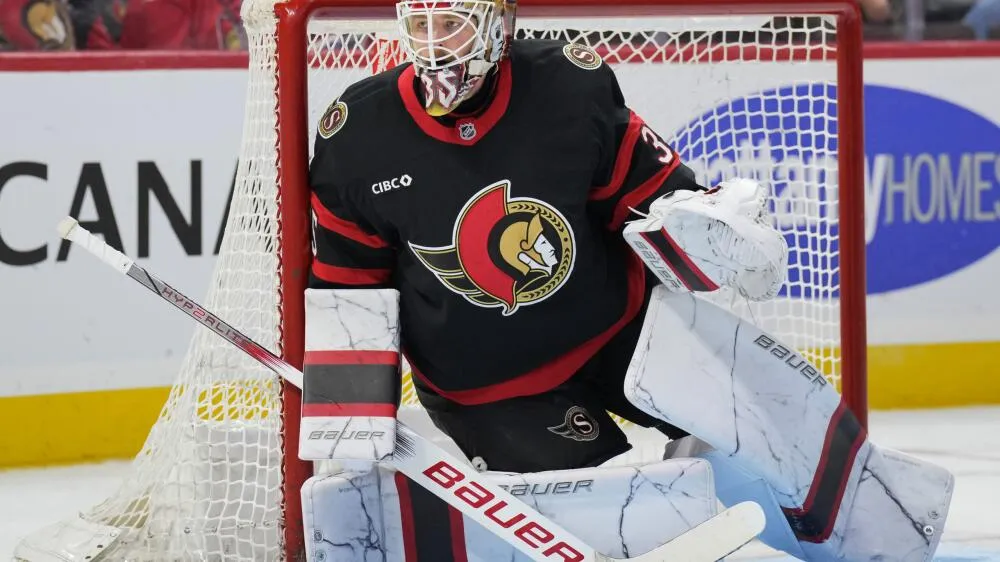
How Linus Ullmark criticism silenced by saves Ottawa Senators gained momentum through November
November has historically been a challenging month for the Ottawa Senators, but the 2025-26 season is painting a different picture. The team started the month with a 2-0-3 record despite facing a grueling schedule that includes only four home games out of 13 contests. At the center of this resurgence stands Ullmark, who has shown marked improvement from his disastrous October performances.
Against the Dallas Stars on November 11, Ullmark delivered what many observers called one of his best performances of the season. Making 30 saves in a 3-2 overtime loss, he kept the Senators competitive against one of the Western Conference’s elite teams. “We were on it,” Ullmark said after the game. “We were skating, doing a lot of good things, putting them on their heels, get two really good goals and keeping them on the outside in our own zone. So, there was a lot of good things. Might be one of the best periods that we played this season so far.”
The performance marked a turning point not just in Ullmark’s season but in how the team was executing in front of him. Coach Travis Green noted that the first 37 minutes against Dallas “might have been our best hockey of the year.” When a goaltender and his team click simultaneously, magic can happen. For Ullmark, these types of games represent the foundation upon which he can rebuild his confidence and his reputation.
His improved play has helped the Senators extend their point streak to six games, going 3-0-3 during that stretch. While the team has benefited from secondary scoring contributions—Michael Amadio has four goals in five games, and defenseman Nick Jensen found the scoresheet after struggling through hip surgery recovery—Ullmark’s steadier presence in net has provided the backbone the team desperately needed. As demonstrated in his 2025-26 season turnaround, consistency between the pipes changes everything for a young team trying to establish itself as a playoff contender.
The mental side of the game: Linus Ullmark criticism silenced by saves Ottawa Senators through mindset shifts
One of the most revealing aspects of Ullmark’s recent turnaround involves what he and goaltending coach Justin Peters have been working on behind closed doors. According to Ullmark, much of their focus has centered on the mental side of the game rather than technical adjustments. “It’s a very peculiar thing that we’re doing out on the ice. It’s a lot of mental strength, a lot of mental things,” Ullmark explained. “Some days, things aren’t going the way that you want them to. Then, you’ve got to stay level-headed, not get too ahead of it, and not get too frustrated.”
This mental approach mirrors that of other elite goaltenders who have navigated rough patches. Winnipeg Jets netminder Connor Hellebuyck, a three-time Vezina Trophy winner, has often spoken about blocking out external noise. “I kind of was always the underdog,” Hellebuyck once said in an interview. “I don’t even want to be recognized; I don’t need the fame or any of that. I figure it’s going to come if it comes. I just want to do the best; I want to be the best at what I do. I don’t care if other people think it or not.”
The difference between Hellebuyck’s approach and Ullmark’s initial reaction to criticism lies in execution. While both maintain that external opinions don’t matter, Hellebuyck has consistently backed up that mindset with elite-level performance. Ullmark, conversely, made his defiant statements while ranking 65th in save percentage among NHL goaltenders—a position that invited rather than silenced criticism.
What changed for Ullmark was his ability to channel that defiance into performance rather than press conferences. Working with Peters, he found ways to simplify his game, trust his positioning, and not overcompensate for the goals he’d allowed earlier in the season. The mental reset allowed his natural talent to resurface. When you’ve won a Vezina Trophy, the ability is never truly lost—it just sometimes gets buried under layers of overthinking and pressure.
The goaltending fraternity has long been considered hockey’s most mentally demanding position, and Ullmark’s journey this season exemplifies why. Florida Panthers goaltending coach Ron Tallas once explained, “To be an elite goalie in this league, you really have to believe in yourself and not just say to yourself that you are good. Sometimes you have great years, sometimes you can have years where the team might be offensive and it affects the way you play, but no matter what goes on in front of you, if you don’t really believe in yourself and what you are doing, it’s going to be difficult.”
Historical context: Linus Ullmark criticism silenced by saves Ottawa Senators follows goalie tradition
Ullmark isn’t the first Senators goaltender to express frustration with critics using colorful language. The franchise has a peculiar history of netminders who’ve linked opinions about their play to excrement. Tom Barrasso, during Ottawa’s 2000 playoff run against the Toronto Maple Leafs, famously told a Hockey Night in Canada broadcast, “I really couldn’t give a s—t what you people have to say.” The difference? Barrasso made that statement after helping even a first-round series the Senators had been losing 2-0.
The lesson Barrasso taught—and one Ullmark appears to be learning—is that defiant words only resonate when backed by defiant saves. Barrasso’s story also serves as a cautionary tale: despite his bravado, the Senators lost the next two games and the series, and Barrasso left Ottawa shortly after without making another meaningful contribution to the franchise.
Vegas Golden Knights goaltender Robin Lehner provides another recent example of a goalie speaking candidly about external criticism. Following a playoff victory against the Montreal Canadiens in June 2021, Lehner told journalists at a postgame press conference that he’d spent two hours watching critics “talk s—t” about him on Twitter. “I don’t care what people think,” he declared. Years earlier, while with the Buffalo Sabres, he’d remarked, “The biggest part is not caring at all about what other people think.”
What these historical parallels illustrate is that goaltenders often need to create a psychological barrier between themselves and external judgment to perform at their best. The position’s unforgiving nature—where a single mistake can cost your team a game—requires a thick skin and selective hearing. However, as recent analysis of Ottawa’s goaltending depth shows, the organization understands that even elite goaltenders need support systems both on the ice and psychologically.
The key distinction between effective and ineffective defiance lies in timing and performance. When you’re stopping pucks at an elite level, declaring independence from critics’ opinions demonstrates confidence. When you’re struggling, it can appear tone-deaf or arrogant. Ullmark’s early-season comments fell into the latter category, but his recent play is beginning to shift the narrative toward the former.
Team defense and the path forward for Linus Ullmark criticism silenced by saves Ottawa Senators
While Ullmark’s individual improvement deserves recognition, the Senators’ defensive structure has also tightened considerably. Coach Travis Green has emphasized playing a more responsible 200-foot game, and the results are becoming evident in the team’s extended point streak. The Senators are keeping opponents to the outside more consistently, limiting high-danger scoring chances, and providing Ullmark with cleaner looks at pucks.
Against Dallas, this improved team defense was on full display. The Stars’ first goal came on a deflection, their second on a power play, and the overtime winner after sustained pressure. None resulted from egregious defensive breakdowns that left Ullmark exposed. This marks a significant departure from earlier games where odd-man rushes and slot shots came with alarming frequency.
Defenseman Nick Jensen, playing on the third pairing with Tyler Kleven after recovering from invasive hip surgery, exemplifies the team’s improved defensive mindset. “I don’t really want to dwell on what has gone on in the past, whether surgery or whatever, it’s a day-by-day, game-by-game, shift-by-shift mentality that I’ve always taken,” Jensen explained after scoring against Dallas. “Chips are going to fall where they fall, and I think if you take that approach a lot of times you’re going to get good results.”
Jensen’s philosophy mirrors what Ullmark needs to embrace. Rather than dwelling on October’s struggles or November’s criticism, focusing on the next shot, the next period, the next game allows performance to speak for itself. The goaltender who won a Vezina Trophy with Boston didn’t suddenly forget how to stop pucks—he just needed time to adjust to a new team, new systems, and new expectations.
The Senators face a crucial stretch ahead, with a six-game road trip looming that includes stops in California, St. Louis, and Dallas. Road trips can make or break a team’s season, and consistent goaltending becomes even more critical when you’re sleeping in hotels and adjusting to different time zones. If Ullmark can maintain his improved form through this challenging stretch, the Senators will position themselves firmly in the playoff conversation.
Secondary scoring has emerged as another factor supporting Ullmark’s resurgence. With captain Brady Tkachuk sidelined, players like Michael Amadio and Nick Cousins have stepped up offensively. This goal support takes pressure off the goaltender, allowing him to play with more freedom rather than feeling he needs to be perfect on every shot.
Statistical realities and expectations for Linus Ullmark criticism silenced by saves Ottawa Senators
Despite recent improvements, Ullmark still faces statistical deficits that require sustained excellence to overcome. Through 14 games, his save percentage hovered around .870 and his goals-against average near 3.21—both numbers that fall well short of his Boston standards and his own expectations. Among goaltenders with at least 10 appearances this season, only St. Louis’s Jordan Binnington posted a worse save percentage.
These numbers tell a story of October struggles and November recovery. The question moving forward centers on which version of Linus Ullmark the Senators will get for the remainder of the season: the Vezina Trophy winner who posted a .938 save percentage in 2022-23 with Boston, or the goaltender who looked lost during his first month in Ottawa.
Comparing Ullmark’s situation to other elite goaltenders experiencing down years provides perspective. The 2023 Vezina winner and runner-up—Ullmark and Ilya Sorokin, respectively—have both struggled in 2025-26, suggesting that even proven elite goaltenders can experience regression. Whether this represents a temporary blip, an adjustment period to new circumstances, or signs of decline will only become clear as the season progresses.
According to The Hockey Writers, Ullmark needs to focus on consistent excellence rather than verbal defiance to truly silence critics. The article points out that goaltenders ranking 65th in the league simply aren’t in a position to proclaim indifference to public opinion. In Ottawa, effort and humility remain admired qualities in athletes, and the fanbase responds positively to players who let their performance speak first and loudest.
Last season’s numbers provide a more encouraging baseline. In 2024-25, Ullmark posted a .910 save percentage with a 2.70 goals-against average across 48 games, going 25-14-3 despite missing 18 games with a back injury. Those numbers, while not Vezina-caliber, represent solid starting goaltending that can anchor a playoff team. If Ullmark can return to that level—or ideally, surpass it—the Senators will have the goaltending they envisioned when they acquired him.
The four-year, $33 million contract extension Ullmark signed carries an $8.25 million annual cap hit. That investment demands consistent performance, not just occasional flashes of brilliance. General manager Steve Staios bet heavily on Ullmark being the answer between the pipes, and early-season struggles put that decision under scrutiny. As TSN reported, the pressure of that contract and those expectations contributed to Ullmark’s November outburst against critics.
The path forward requires Ullmark to string together strong performances rather than isolated good games. One solid outing against Dallas, while encouraging, doesn’t erase October’s struggles or guarantee future success. Consistency separates good goaltenders from elite ones, and right now, Ullmark is fighting to prove he still belongs in the latter category.
Linus Ullmark’s journey from October struggles to November improvement illustrates the precarious nature of NHL goaltending. The position demands technical excellence, mental fortitude, and the ability to block out noise while remaining accountable to teammates and coaches. Ullmark’s defiant press conference comments sparked debate, but his recent performances are beginning to author a different narrative—one written in saves rather than words.
As the Senators navigate a challenging November schedule and look ahead to December’s critical games, Ullmark’s continued development will determine whether Ottawa emerges as a legitimate playoff contender or another team that falls short of expectations. The criticism that followed his poor start has quieted in recent games, replaced by cautious optimism that the Vezina Trophy winner is rediscovering his form. Whether this represents a genuine turnaround or merely a temporary uptick remains to be seen, but for now, Ullmark is letting his glove hand do the talking—exactly as his critics demanded.

Par Mike Jonderson
Mike Jonderson is a passionate hockey analyst and expert in advanced NHL statistics. A former college player and mathematics graduate, he combines his understanding of the game with technical expertise to develop innovative predictive models and contribute to the evolution of modern hockey analytics.