The Los Angeles Kings enter the 2026 offseason grappling with significant challenges on the blue line following Anze Kopitar’s retirement. The longtime captain and No. 1 center provided structure and leadership, but his departure leaves gaps in defensive reliability and puck movement. While the acquisition and extension of Artemi Panarin at the trade deadline bolsters the wing, he cannot replicate Kopitar’s two-way play down the middle.[1][2]
Quinton Byfield figures to pair with Panarin, but the Kings must build depth around him while addressing a defense that lacks dynamism. Brandt Clarke stands as the lone consistent puck-mover, forcing general manager Rob Blake to prioritize at least one more offensive-minded defenseman to compete in today’s NHL.[1]
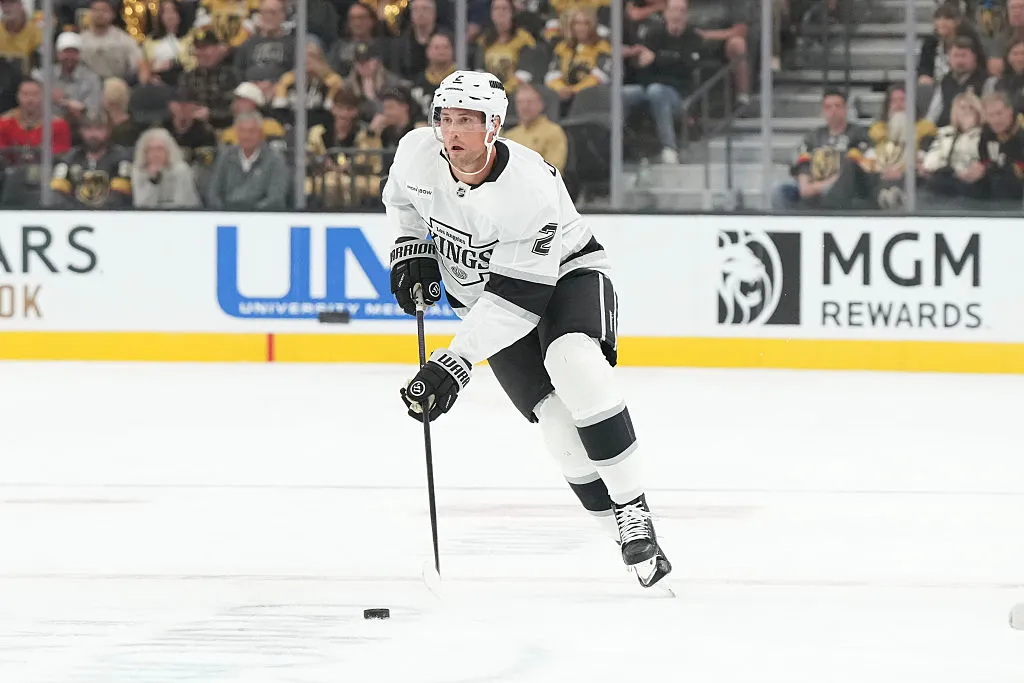
Current shortcomings on the Kings’ blue line
The Kings’ defense functioned adequately in survival mode last season but failed to generate offense or extend plays effectively. Veterans like Cody Ceci and Brian Dumoulin, added in the prior offseason, regressed and contributed to a drop in standings and special teams performance. Dennis Bernstein of The Fourth Period emphasized this in his analysis, stating, “With only one puck-moving threat on defense in Brandt Clarke, at least one more offensive-minded defender has to be added to the mix.”[1]
Drew Doughty remains a cornerstone, but at 36, he cannot shoulder the full load. The group lacks second-wave pressure and point-shot threats, making it vulnerable to fast transitions. Blake must shift from a conservative structure to a more aggressive identity under potential new coach influence.
Cap space projections show the Kings with 12 forwards, five defensemen, and two goalies under contract heading into free agency. This leaves room for maneuvers, but decisions loom on restricted free agent Brandt Clarke and others. As LA Kings Insider outlines in their offseason table setter, targeted additions are essential.[3]
Internal evaluations reveal over-reliance on retrieval rather than activation. Bernstein noted, “The Kings need to take a hard look at their defensive depth chart and ask whether it is built to win in today’s league – not just survive it.” Without upgrades, pairing Byfield with Panarin risks containment by opponents.
Prospects like Henry Brzustewicz offer promise, but NHL readiness is uncertain. The blue line’s stagnation mirrors broader regression, demanding urgency this summer.
Free agency targets for puck-moving help
The 2026 unrestricted free agent class features several right- and left-shot defensemen who could fit the Kings’ needs. Brett Kulak of Colorado, a steady two-way player with puck-moving ability, headlines options at age 32 with a $2.75 million cap hit last season. His experience stabilizing transitions aligns with LA’s tempo shift.
Luke Schenn provides veteran leadership from Buffalo, though his age (36) limits long-term appeal. Younger targets like Darren Raddysh, ranked highly on early big boards, bring offensive upside from the right side. Raddysh’s mobility and point production could complement Clarke immediately.[4][5]
College free agents represent low-cost gems. Discussions around Michigan’s Josh Eernisse or other NCAA standouts highlight potential depth adds. For a full list, check Spotrac’s 2026 defensemen free agents tracker.
- Top UFA fits: Darren Raddysh (offense, mobility), Brett Kulak (two-way reliability), Jamie Drysdale (if RFA qualifies via offer sheet).
- Budget options: Luke Schenn (leadership), college invites for camp battles.
Blake’s win-now mode post-Panarin favors short-term impact over youth gambles. However, cap constraints may force creative bridging deals.
Trade possibilities to bolster the defense
Trades offer the quickest path to blue line transformation. Early post-playoff buzz points to win-now targets, with the Kings linked to mobile defenders amid Doughty’s aging curve.[6] New York Islanders’ surplus creates intrigue; Adam Pelech’s name has surfaced as a trade asset despite defensive risks.
Alexander Romanov enters year two of his eight-year, $6.25 million deal, with full no-trade protection delayed until July 2027. Matthew Schaefer’s rookie emergence on the left opens flexibility, while Ryan Pulock and Scott Mayfield shift to 16-team lists in 2027. Pelech could provide shutdown presence if Islanders prioritize youth.[7]
Prospects like Brzustewicz or picks could entice sellers. As nhlinsight.com explores in navigating the 2026 NHL offseason for Kings, Metro Division assets like Pelech fit LA’s needs.
Other rumors swirl around restricted free agents or underutilized talents. Blake traded for Panarin aggressively; expect similar boldness on D.
Prospect pipeline and internal development
Internal growth remains key amid external pursuits. Brandt Clarke must expand his role as the primary puck-mover, with prospects like Maxence Guenette or Artur Kirsanov pushing for spots. Reddit mockups highlight Brzustewicz’s offensive right-shot potential alongside lefties like Booth and Dvorak.[8]
Development camp invites from college free agents add competition. Clarke’s RFA status underscores retention priority.
nhlinsight.com’s piece on Blue Jackets and Kings’ uncertain paths notes blue line evaluations as pivotal. Byfield’s evolution ties into defensive support.
Success hinges on blending youth with vets. Without it, Panarin’s brilliance may not suffice.
The Kings’ 2026 offseason demands decisive action on defense to honor Kopitar’s legacy and contend. Prioritizing puck-movers via free agency, trades, or promotion positions Byfield and Panarin for impact. As Bernstein warns, “As critical as the center position is, the more transformational area of need is on defense.”[1]
A revamped blue line could propel LA deep into playoffs; inaction risks further regression. Fans await Blake’s blueprint for this pivotal summer.[9]
Frequently Asked Questions

Par Mike Jonderson
Mike Jonderson is a passionate hockey analyst and expert in advanced NHL statistics. A former college player and mathematics graduate, he combines his understanding of the game with technical expertise to develop innovative predictive models and contribute to the evolution of modern hockey analytics.