














The Toronto Maple Leafs find themselves at a familiar crossroads. After exhausting internal options and watching coach Craig Berube’s frustration mount, the franchise’s search for the perfect linemate to complement Auston Matthews and Matthew Knies has reached a critical juncture. Since Mitch Marner’s departure to Vegas, the revolving door on Matthews’ wing has spun through Max Domi, Nick Robertson, Calle Jarnkrok, Easton Cowan, and even William Nylander—all without establishing the chemistry necessary for sustained offensive success.
Berube’s blunt assessment following a 5-2 loss to New Jersey said it all: “It could take some time, but I’m getting tired of it, to be honest with you.” When a head coach publicly admits exhaustion with lineup experimentation barely a month into the season, it’s a clear signal that general manager Brad Treliving needs to explore external solutions. With the Leafs facing a softer stretch of schedule ahead, now might be the perfect time to evaluate whether an internal fix exists—or if acquiring proven talent from outside the organization is the only viable path forward.
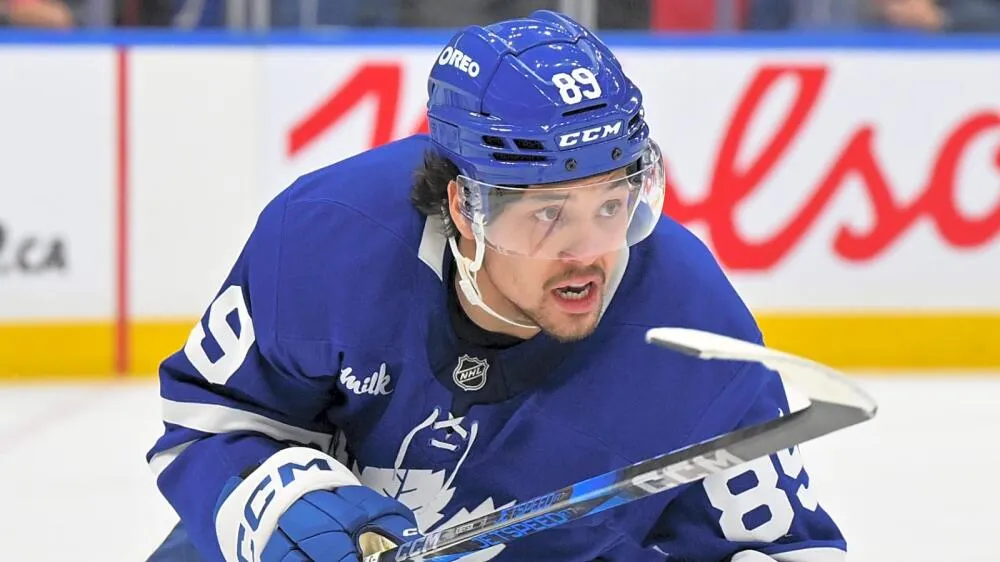
Why the Maple Leafs need external forward help for Matthews’ line
The departure of Marner has created a void that goes beyond simple point production. Matthews needs a winger who can match his elite hockey IQ, create space through speed or physicality, and capitalize on the opportunities that playing alongside a generational talent provides. The internal candidates have each brought different elements to the table, but none have delivered the complete package required to unlock Matthews’ full potential.
Berube’s system demands sustained offensive zone pressure, something he noted has been completely absent from the top line. “I don’t feel like they have any sustained pressure in the offensive zone at all. It’s one-and-done or out,” he explained. This isn’t just about finding someone who can finish Matthews’ passes—it’s about discovering a player who can help maintain possession, win puck battles, and create the cycle game that makes elite lines dominant rather than merely dangerous.
The current roster construction presents additional challenges. Promoting Nylander to the top line full-time would weaken the second unit significantly, creating a depth problem rather than solving a chemistry issue. The Maple Leafs need balance throughout their lineup, and robbing Peter to pay Paul isn’t sustainable over an 82-game season. Meanwhile, younger players like Cowan have shown flashes but may not yet possess the consistency or defensive responsibility required for top-line minutes in Berube’s system.
Toronto’s window for contention remains open but continues to narrow. Matthews is in his prime, core players are aging, and cap constraints limit flexibility. Waiting for internal development or hoping chemistry magically appears wastes precious time. The organization’s aggressive offseason additions on defense demonstrated Treliving’s willingness to be proactive—that same mentality needs to extend to solving the top-line winger problem before it derails the season.
Nazem Kadri could provide a nostalgic solution to the Maple Leafs’ top line challenges
Bringing Nazem Kadri back to Toronto would represent more than just filling a roster spot—it would be a homecoming for a player who has matured significantly since his sometimes-controversial departure. Now 35 years old and playing for the struggling Calgary Flames, Kadri offers a unique blend of skill, grit, and championship experience that could complement Matthews and Knies perfectly. His Stanley Cup victory with Colorado in 2022 proved his ability to perform when the stakes are highest, something Toronto desperately needs.
Kadri’s recent production remains impressive despite Calgary’s organizational struggles. Coming off a 35-goal, 67-point campaign, he demonstrated that age hasn’t significantly diminished his offensive capabilities. While his four assists through the early part of this season might seem underwhelming, context matters—the Flames have been dreadful, and Kadri’s individual metrics suggest he’s creating opportunities that aren’t being finished. Placed alongside Matthews and Knies, those same plays could result in significantly more production.
The fit makes sense from multiple angles. Technically a center, Kadri’s versatility allows him to play wing while bringing an element the top line currently lacks: net-front presence. His willingness to absorb punishment in the dirty areas would free Matthews to operate from his preferred shooting positions while giving Knies a partner who understands physical play. Kadri’s speed has remained adequate, and his hockey sense would allow him to anticipate Matthews’ plays rather than simply react to them.
The obstacles, however, are substantial. Kadri carries a $7 million cap hit through four more seasons—a commitment that would require significant cap gymnastics and potentially salary retention from Calgary. At 35, he’s an aging asset whose production could decline, making that term risky. Yet Treliving knows Kadri well from their time together, and if the Flames continue their downward spiral, they might be motivated to move contracts. The familiarity between player, GM, and city could overcome logistical challenges if everyone sees mutual benefit. For a team searching for identity and toughness in its top six, Kadri checks boxes that few other realistic options can match.
Rickard Rakell’s two-way excellence fits perfectly with the Maple Leafs’ Matthews-Knies duo
Pittsburgh’s struggles have put several assets on the trade market, and Rickard Rakell represents perhaps the most intriguing fit for Toronto’s needs. The 32-year-old Swedish winger has evolved from pure goal scorer into a complete two-way forward capable of matching Matthews’ offensive skill while adding the physical element that makes top lines difficult to play against. His 35-goal, 70-point performance last season demonstrates continued elite production, while his 116 hits show a willingness to engage physically that many skill players avoid.
Rakell’s game has transformed since joining Pittsburgh. While Anaheim fans remember him primarily as a sniper, he’s developed into a power forward who can win puck battles, protect possession along the boards, and create space through physicality rather than just skating. This evolution makes him ideally suited to complement Knies’ similar style while giving Matthews the space and time he needs to operate. A top line featuring Knies-Matthews-Rakell would be nightmarish for opposing defenders—skilled enough to beat you clean, physical enough to wear you down, and smart enough to exploit whatever defensive strategy opponents employ.
The financial fit makes Rakell particularly attractive. His $5 million cap hit for three more seasons represents fair value for consistent 60-70 point production, and that term provides medium-term security rather than the longer commitments that often become problematic. At 32, Rakell should maintain his current level for at least two more seasons, covering Toronto’s prime contention window. His six points through seven games this season suggest he’s picking up where last year left off, and playing with Matthews could push him toward 80 points.
Acquisition costs present the main challenge. Pittsburgh’s front office has shown little urgency to dismantle their core, even as the team’s competitive window appears closed. Rakell’s reasonable contract and consistent production make him valuable enough that the Penguins would demand significant assets in return—likely a first-round pick plus prospects or young players. Treliving would need to weigh whether that cost is worth paying for a player who won’t fundamentally alter Toronto’s championship odds, but merely improve them incrementally. Still, if the goal is finding a proven top-line winger who can contribute immediately while fitting the system and budget, few options check as many boxes as Rakell.
Alex Tuch represents the most logical Maple Leafs external forward target for Auston Matthews’ line
If Brad Treliving picks up the phone to discuss external forward options, Buffalo’s Alex Tuch should be the first name on his list. The 29-year-old right winger embodies everything the Maple Leafs need: size, speed, scoring ability, and the physical presence to win board battles and create space for Matthews. His 36-goal, 67-point performance last season demonstrated elite offensive production, while his style of play—using his 6-foot-4 frame to dominate the forecheck—perfectly complements both Matthews’ playmaking and Knies’ grinding game.
Tuch’s pending unrestricted free agency status makes him the rare combination of impact player and realistic trade target. Buffalo’s season has started poorly, continuing a playoff drought that has defined the franchise’s recent history. If the Sabres don’t turn things around quickly—and their roster construction suggests they won’t—management may finally accept that selling assets makes more sense than another failed attempt at immediate contention. Tuch’s expiring $4.75 million contract makes him attractive to contenders who need help now without long-term commitment, and his production ensures Buffalo could command significant assets in return.
The stylistic fit borders on perfect. Toronto has lacked physicality and sustained forecheck pressure on their top line, exactly what Tuch excels at providing. He doesn’t just crash and bang randomly—he uses his frame intelligently to separate defenders from pucks, protect possession along the walls, and create second chances around the net. Matthews would benefit enormously from playing with someone who can consistently win puck battles and extend offensive zone time, while Tuch would finally get the elite center who can convert his hard work into consistent scoring chances.
According to reports from The Hockey Writers, Tuch has emerged as a realistic option given Buffalo’s struggles and his contract situation. His one goal and three assists through four games show he’s maintaining his offensive involvement, and the Sabres’ upcoming games against Toronto provide perfect scouting opportunities. If Buffalo continues losing and Treliving decides external help is necessary, Tuch represents the sweet spot of impact, availability, and affordability. The acquisition cost would be substantial—likely a first-round pick and a prospect—but for a player in his prime who addresses multiple needs, that price might be worth paying. The main risk is that other contenders recognize the same opportunity, creating a bidding war that drives up the cost beyond reasonable value.
Adrian Kempe and other potential external additions worth considering
Beyond the three primary targets, several other forwards could address Toronto’s top-line needs if circumstances align properly. Adrian Kempe of the Los Angeles Kings presents an intriguing possibility. The Swedish power forward remains locked in contract extension negotiations with Los Angeles, and if those talks break down, the Kings might make him available rather than risk losing him for nothing in free agency. Kempe’s blend of speed, size, and 30-goal scoring ability would fit naturally beside Matthews, though his inconsistency and the Kings’ reluctance to trade within their competitive window make acquisition unlikely.
Owen Tippett’s name has circulated in trade rumors, though insider Elliotte Friedman recently suggested those reports may be overblown. The Philadelphia Flyers winger possesses the youth and offensive upside that could make him a longer-term solution rather than a rental, but Philadelphia’s asking price would likely exceed what Treliving considers reasonable. Tippett’s 27-goal campaign last season showed legitimate top-six scoring ability, yet his defensive limitations and streaky play might not satisfy Berube’s demands for consistent two-way play.
The struggling Calgary Flames present multiple potential targets beyond Kadri. If the organization commits to rebuilding, players like Yegor Sharangovich or Jonathan Huberdeau could theoretically become available, though Huberdeau’s massive contract makes him virtually untradeable. Sharangovich’s emergence as a consistent scorer over the past two seasons makes him an intriguing middle-ground option—cheaper to acquire than Kempe or Rakell, younger than Kadri, but less proven than any of them. His speed and shooting ability could complement Matthews well, though questions about his playmaking and physicality remain.
High-end stars like Artemi Panarin or Martin Necas would transform Toronto’s offense but remain unrealistic targets given cap constraints and acquisition costs. The New York Rangers won’t trade Panarin while they remain competitive, and even if Carolina made Necas available, the cost in assets and cap space would be prohibitive. Treliving must balance ambition with reality, targeting players who meaningfully improve the roster without mortgaging the future or destroying depth. The sweet spot likely exists in the Tuch-Rakell range: established veterans on struggling teams who provide immediate impact without requiring the king’s ransom that true superstars demand.
The timeline for acquiring Maple Leafs external forward options for the top line
Patience and urgency exist in uncomfortable tension for Toronto’s management. The upcoming schedule—featuring games against Buffalo, Calgary, Columbus, Philadelphia, and Pittsburgh—provides what The Hockey Writers describes as a “litmus test” for the current roster. If the top line continues struggling against these traditionally non-playoff teams, it signals a fundamental problem that internal solutions cannot solve. Conversely, if chemistry suddenly develops and production increases, Treliving can afford to wait and see whether the improvement proves sustainable.
The trade deadline looms in early March, but waiting that long carries significant risks. Teams that struggle early often fall too far behind in the standings to recover, even with deadline additions. Furthermore, the market becomes more competitive as the deadline approaches, with multiple contenders bidding on limited assets and driving up prices. Teams like Buffalo or Calgary that might consider trading impact players in October or November could see their situations stabilize by March, removing trade chips from availability entirely.
Berube’s public frustration suggests the internal timeline may be shorter than the league’s trade calendar would typically dictate. When coaches stop protecting players and start openly expressing dissatisfaction, pressure mounts on management to act decisively. Treliving built his reputation on aggressive roster management, making bold moves when opportunities arise rather than waiting for perfect circumstances that may never materialize. His deadline history includes both blockbuster trades and smart value acquisitions, suggesting he won’t hesitate if convinced the right deal exists.
The next month will determine Toronto’s approach. If the soft schedule produces wins but the top line remains ineffective, that creates a dilemma—does the team’s success allow Treliving to be patient, or does the top line’s continued struggle demand action despite winning results? If both the team and top line struggle, the decision becomes clearer: external help isn’t just preferable, it’s necessary. The Maple Leafs entered this season with championship aspirations, and championship windows don’t stay open indefinitely. Matthews’ prime years are too valuable to waste hoping chemistry eventually develops organically when proven solutions exist on the trade market.
Finding the right winger for Auston Matthews has become Toronto’s most pressing concern. Internal options have been exhausted, Berube’s patience has worn thin, and the clock on the franchise’s contention window continues ticking. Whether the solution proves to be Nazem Kadri’s veteran savvy, Rickard Rakell’s two-way excellence, Alex Tuch’s physical dominance, or an unexpected name that emerges as teams fall out of contention, action appears inevitable. The question isn’t whether Treliving will pursue external options, but when—and at what cost. For a franchise defined by unfulfilled potential, the stakes couldn’t be higher. The right addition could catalyze a championship run; the wrong one could waste another precious season of Matthews’ prime while the organization’s window slowly closes.

Par Mike Jonderson
Mike Jonderson is a passionate hockey analyst and expert in advanced NHL statistics. A former college player and mathematics graduate, he combines his understanding of the game with technical expertise to develop innovative predictive models and contribute to the evolution of modern hockey analytics.