





Mikko rantanen lessons learned from double-trade season: navigating unprecedented NHL chaos
The 2024-25 NHL season will forever be remembered as the year Mikko Rantanen became a human trade chip, moved twice in a span of 42 days from championship contender to rebuilding project and finally to long-term stability. For a player who spent 11 seasons building a legacy with the Colorado Avalanche, winning a Stanley Cup in 2022, the experience served as a harsh reminder that loyalty in professional sports flows in one direction. Rantanen’s journey from Denver to Raleigh to Dallas transformed him from a franchise cornerstone into a cautionary tale, and ultimately into a wiser, more resilient superstar who learned to value security over sentiment.
What made this double-trade season particularly jarring wasn’t just the frequency of movement, but the stark contrasts between each destination. Colorado represented familiarity and success. Carolina offered uncertainty and a failed courtship. Dallas provided the stability of an eight-year, $96 million contract with a full no-movement clause. Through it all, Rantanen discovered that adaptability isn’t just about learning new systems—it’s about maintaining your identity when everything around you changes.
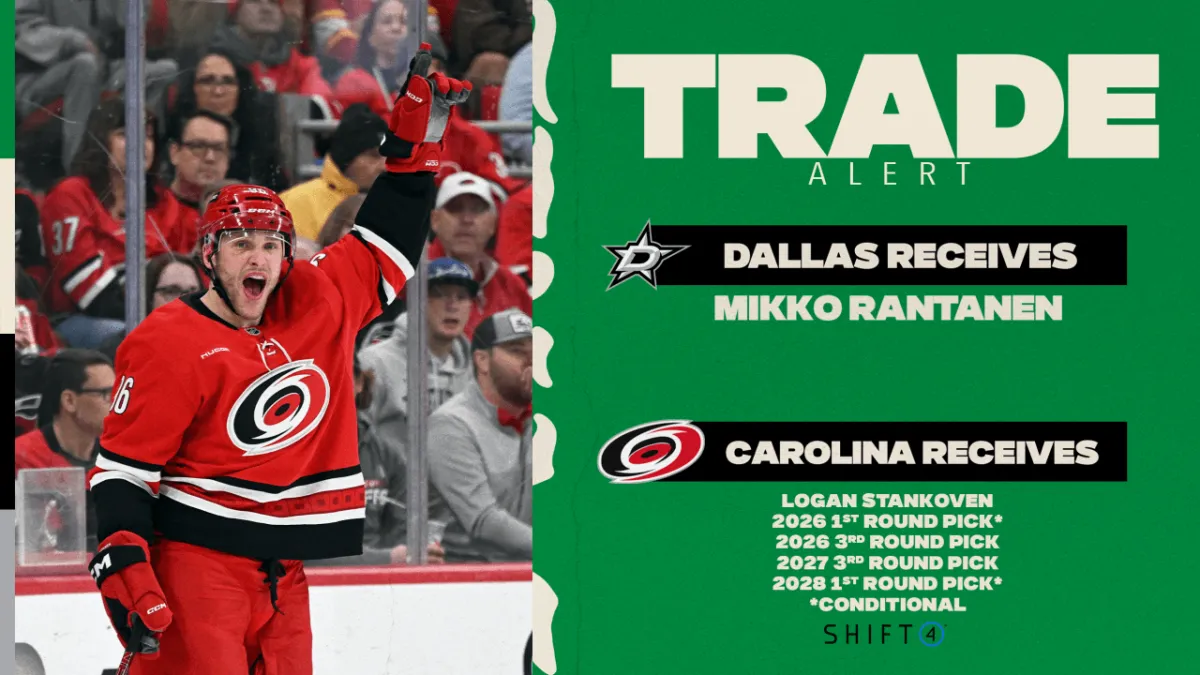
The double-trade saga that defined mikko rantanen’s 2024-25 season
From Colorado stability to Carolina uncertainty
On January 24, 2025, Avalanche general manager Chris MacFarland shocked the hockey world by trading Mikko Rantanen to the Carolina Hurricanes in a blockbuster three-team deal. The move sent Martin Necas back to Colorado and brought Taylor Hall to Raleigh, fundamentally altering the landscape of the Western Conference. For Rantanen, the trade felt like a betrayal after more than a decade of service and a championship ring. “Everything happened so quick,” he later reflected, still processing the emotional whiplash.
The decision made cold business sense from Colorado’s perspective. Rantanen, as an unrestricted free agent, held all the negotiating leverage and was rumored to be seeking $14 million annually on his next contract. MacFarland framed it as a “business decision” involving a player who “had the unrestricted free agent card,” but privately lamented losing “a superstar human being.” The Avalanche couldn’t risk losing their star winger for nothing, yet the timing—midseason, during a contract year—left Rantanen reeling.
Carolina GM Eric Tulsky gambled that his organization could convince Rantanen to commit long-term. The Hurricanes made their pitch during the 4 Nations Face-Off break, reportedly offering a nine-figure contract extension. But something never clicked. Rantanen scored just two goals and six points in 13 games, looking like a player whose mind remained in the Rocky Mountains while his body skated in the Research Triangle. The disconnect wasn’t about talent; it was about feeling at home.
The quick exit to Dallas
Just 42 days after arriving in Raleigh, Rantanen found himself packing his bags again. On March 7, 2025, hours before the trade deadline, the Hurricanes flipped him to the Dallas Stars for Logan Stankoven, two first-round picks (2026 and 2028, top-10 protected), and two third-round selections (2026 and 2027). The deal contained a critical condition: Dallas had to secure Rantanen’s signature on an eight-year, $96 million extension with a full no-movement clause.
For Carolina, the move represented pragmatic asset management. They’d rather recoup substantial value than risk losing a disengaged star for nothing. Tulsky later explained, “My sense of it was that this just didn’t feel like home for him, as far as I can tell. And that’s OK. He’s making an eight-year commitment.” The Hurricanes essentially turned a disappointing rental into a treasure chest of futures, including the promising 22-year-old Stankoven.
Rantanen admitted the second trade didn’t catch him off guard like the first. Two weeks of speculation had prepared him for another move. “Last year was nothing like I’ve experienced before,” he told ESPN. “Hopefully it never happens again. But if it does, I’m ready.” That readiness stemmed from hard-won wisdom about the business of hockey and the importance of controlling what you can control.
The emotional toll of relocation
Moving once during a season is difficult enough. Moving twice in six weeks while learning new systems, finding housing, and maintaining elite performance borders on impossible. Rantanen had to quickly adapt from Colorado’s high-altitude, speed-based system to Carolina’s structured, forechecking-heavy approach, only to pivot again to Dallas’s offensive-minded strategy. Each transition required mental and physical recalibration while his personal life remained in flux.
The instability affected more than just his stat line. Players develop routines, relationships with teammates, and familiarity with cities that become crucial to their well-being. Rantanen lost all of that in an instant. His girlfriend, Susanna Ranta, remained his anchor through the chaos, and their engagement in the offseason provided the personal stability his professional life lacked. The experience taught him that off-ice peace directly impacts on-ice performance.
Key lessons mikko rantanen learned from his double-trade experience
Adaptability becomes essential
Rantanen discovered that adaptability isn’t a luxury in today’s NHL—it’s a survival skill. Each team presented different expectations: Colorado wanted him to maintain championship standard, Carolina needed him to embrace a new culture, and Dallas required him to elevate an already-contending roster. He learned to compartmentalize emotion and focus on immediate tasks rather than dwelling on what he couldn’t change.
The Finnish winger’s approach involved finding constants in chaos. Whether in Denver, Raleigh, or Dallas, his pre-game routine remained sacred. His preparation methods stayed consistent. He leaned into his physical style—his nickname “Moose” preceded him everywhere—and refused to let uncertainty alter his identity. This mental framework allowed him to contribute meaningfully even when his surroundings felt alien.
Teammates noticed his resilience. Dallas forward Tyler Seguin, who previously knew Rantanen only as an opponent, observed, “Getting him here as a teammate, I’ve learned what a good person he is. How much he can affect our locker room with his leadership. Sometimes, guys come in and won’t feel comfortable talking. He does.” That comfort level didn’t happen by accident—it was a skill Rantanen consciously developed through his double-trade trial.
The business side of hockey hits hard
The most painful lesson involved understanding that loyalty rarely trumps economics. Rantanen gave Colorado his prime years, helped deliver a Stanley Cup, and established himself as one of the NHL’s premier power forwards. Yet when contract negotiations stalled, the organization chose certainty over continuity. “You learn always from those tough moments, whether it’s on the ice or wherever in life,” Rantanen reflected. “You always learn from those moments when you’re going through tough times.”
His experience illuminates a growing trend: teams increasingly trade star players in their walk years rather than risk losing them for nothing. The Kevin Durant model has arrived in hockey. Rantanen became the face of this new reality, a superstar treated as a depreciating asset. The lesson? Build your own security because teams will always protect their interests first.
Finding home matters more than money
Perhaps surprisingly, Rantanen learned that environment trumps compensation. He rejected Carolina’s lucrative offer not because of dollars, but because of fit. The connection with Dallas happened quickly—the Stars’ roster featured fellow Finns Roope Hintz, Miro Heiskanen, and Esa Lindell, creating an immediate support system. The organization’s championship aspirations aligned with his own. The city felt right.
His eight-year commitment to Dallas came with a full no-movement clause, giving him complete control over his future for the first time. “We’re settled and know where we’re going to be,” he said. “You don’t have to think about off-ice stuff as much. You can just focus on hockey. It’s been more comfortable.” That comfort, earned through disorienting change, became his non-negotiable priority.
On-ice challenges and controversies during the double-trade season
The suspension and boarding incidents
Rantanen’s double-trade season included on-ice turmoil that tested his reputation. On November 18, 2025, he shoved Islanders defenseman Alexander Romanov from behind, causing a violent collision with the boards. Romanov required shoulder surgery and faced a five-to-six-month recovery. Islanders coach Patrick Roy’s furious reaction went viral—screaming at Rantanen from the bench, his face red with rage, appearing to warn the Stars forward about their rematch.
Four days later, Rantanen received a game misconduct for boarding Calgary’s Matt Coronato. The second ejection triggered an automatic one-game suspension, as NHL rules require 41 games between misconducts to avoid ban. Suddenly, the skilled scorer was gaining infamy as a reckless hitter. Rantanen accepted responsibility but noted, “Usually if something happens, if somebody gets pissed off, the media picks it up. So I’m not really surprised it got so big.”
The incidents raised questions about whether frustration from his unsettled situation was manifesting in dangerous play. Dallas coach Glen Gulutzan dismissed the connection, focusing instead on Rantanen’s competitive fire: “The most interesting thing that I’ve found coaching Mikko… The similarity is their fire. Their competitiveness. And that’s what you need, right? They’re very hard on themselves, just to be great every night.” The lesson? Even when life feels chaotic, professionalism demands emotional discipline.
Maintaining performance amid chaos
Despite everything, Rantanen produced. His 13-game Carolina stint disappointed statistically (two goals, six points), but context matters—he was a square peg in a round hole, learning a new system while processing his first trade. Once in Dallas, he exploded for 33 points in 25 games, including 10 goals and 18 power-play points. The Stars’ man-advantage unit ranked second in the league, with Rantanen as its catalyst.
His playoff performance silenced doubters. In 18 postseason games, he amassed 22 points, including a stretch of nine goals and eight assists in six games. Most satisfyingly, Dallas eliminated Colorado in a seven-game first-round series, with Rantanen contributing against his former team. “There’s been a lot written about him. There’s been a lot said about him,” then-coach Peter DeBoer noted. “There’s been a lot of doubters out there, based on the situations he’s been in and how it’s looked at different points.” Rantanen’s postseason answered every question about his ability to perform under pressure.
Building a new foundation in Dallas after the double-trade lessons
Chemistry with new linemates
Dallas presented Rantanen with an ideal situation: talented linemates, a supportive organization, and long-term security. He found immediate chemistry with center Wyatt Johnston, a right-shot playmaker reminiscent of his Colorado running mate Nathan MacKinnon. “Playing a lot with Nate in the past as a righty, it’s more common for me to make plays and stuff,” Rantanen explained. “Johnston is a really good player. He can score goals. We find each other pretty well.”
Winger Jason Robertson noted that a full training camp made a significant difference. “You really didn’t have time to develop that look, that chemistry after the trade deadline last year,” he said. That extended preparation showed—Rantanen’s comfort allowed him to be a vocal leader, a departure from the quieter Finnish stereotype. “Normally, most of our Finnish guys are relatively quiet,” Robertson observed. “Mikko comes in here and he’s this big, loud and happy guy. Just a different dynamic.”
The Finnish connection
Dallas already housed what teammates jokingly called the “Finnish Mafia”—Hintz, Heiskanen, Lindell, and former Star Mikael Granlund. Rantanen’s arrival strengthened that bond. After practices, the Finns would run Suomi-only shooting drills, speaking their native language and maintaining cultural connections that eased his transition. Yet Rantanen didn’t isolate himself; he integrated with the entire roster while preserving his cultural ties.
That balance proved crucial. While the Finnish contingent provided immediate friendship and familiarity, Rantanen consciously built relationships across the locker room. His charisma and willingness to communicate made him a bridge between cliques rather than a member of an exclusive group. Teammate Tyler Seguin appreciated this duality: “I used to know him as a skilled big forward that put up a lot of offense. Getting him here as a teammate, I’ve learned what a good person he is. How much he can affect our locker room with his leadership.”
Long-term security and no-movement clause
The eight-year contract with a full no-movement clause represents more than financial reward—it’s a statement of trust and mutual commitment. After being traded twice against his will, Rantanen now controls his destiny completely. Dallas GM Jim Nill called him “one of the elite power forwards in the game,” and backed up that assessment with the organization’s most significant investment since the Tyler Seguin extension.
Rantanen’s relief is palpable. No more trade rumors. No more learning new cities mid-season. No more proving his worth to skeptical new teammates. “We’re settled and know where we’re going to be,” he said. “You don’t have to think about off-ice stuff as much. You can just focus on hockey.” That focus has translated into production and leadership, turning a chaotic year into a foundation for the rest of his career.
What mikko rantanen’s double-trade journey means for the NHL
The rise of contract-year trades
Rantanen’s saga signals a shift in how teams handle superstar contracts. The old model—keep your star through their walk year and hope to re-sign them—has become too risky. Colorado chose certainty, acquiring Martin Necas and avoiding the possibility of losing Rantanen for nothing. Carolina took a calculated gamble, then pivoted to asset accumulation when the fit proved wrong.
This trend will accelerate. General managers increasingly view in-season trades of pending free agents as prudent asset management rather than organizational failure. The stigma is fading. Players like Rantanen become pawns in a chess match where teams prioritize flexibility over loyalty. The lesson for stars? Secure your no-movement clause early, because business decisions can upend lives overnight.
Player empowerment vs. team control
Paradoxically, Rantanen’s journey highlights both player power and its limits. His UFA status gave him leverage over his next contract, but couldn’t prevent the trades themselves. He rejected Carolina’s massive offer, exercising his right to choose his destination. Yet he had no say when Colorado shipped him out, proving that team control remains paramount until you reach free agency.
This tension defines modern NHL economics. Teams want cost certainty and asset protection. Players want security and input into their careers. Rantanen’s solution—signing a long-term deal with a no-movement clause—represents the ultimate player empowerment tool. For more insights into how players navigate these complex decisions, check out this deep dive into Rantanen’s decision-making process.
The ripple effects will influence negotiations for years. As explored in analysis of player mobility trends, the balance of power continues shifting, with stars increasingly demanding trade protection as non-negotiable contract terms. For more insights into how players navigate these complex decisions, check out this analysis of NHL player movement trends.
Rantanen’s story serves as both warning and blueprint for the next generation of stars entering their walk years. The double-trade season taught him lessons he hopes to never need again, but those lessons have made him a more complete player and person. As he skates toward a Stanley Cup in Dallas, the chaos of 2024-25 feels like a crucible that forged his future rather than a crisis that defined it.
Frequently Asked Questions

Par Mike Jonderson
Mike Jonderson is a passionate hockey analyst and expert in advanced NHL statistics. A former college player and mathematics graduate, he combines his understanding of the game with technical expertise to develop innovative predictive models and contribute to the evolution of modern hockey analytics.