






The Minnesota Wild entered the 2024-25 season with high expectations, but as the campaign unfolded, it became increasingly clear that certain key forwards were underperforming. Joel Eriksson Ek, Ryan Hartman, and Marcus Foligno—three players who form the backbone of the team’s middle-six forward group—have struggled to provide the consistent offensive production the Wild desperately need. With the team fighting for playoff positioning and depth scoring remaining a persistent issue, these veterans must elevate their games if Minnesota hopes to make a meaningful postseason run.
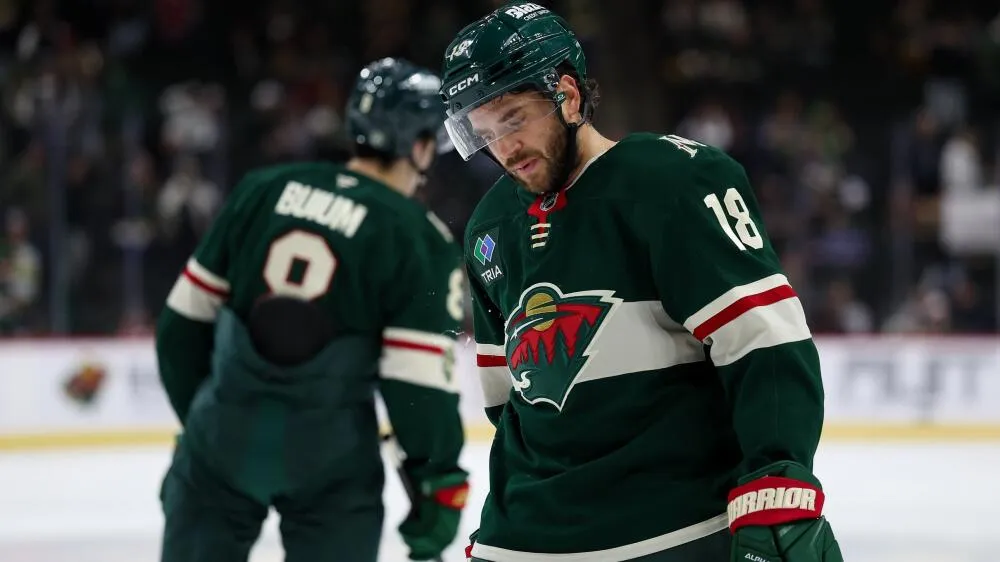
Joel Eriksson Ek’s injury-plagued season demands more consistency
Joel Eriksson Ek’s 2024-25 campaign was marred by injuries that limited him to just 46 games during the regular season. The Swedish center, who signed an eight-year contract extension worth $8.4 million annually, missed significant time due to two separate injuries. His first absence came in December after a collision with another player, sidelining him for 11 games. Just when he appeared to be finding his rhythm again, a second injury struck, keeping him out for an additional 21 games.
Through his 46 appearances, Eriksson Ek managed 14 goals and 15 assists for 29 points—a 0.63 points-per-game pace. While respectable given the circumstances, this production falls short of the expectations that come with his contract and the responsibility of being Minnesota’s second-line center. According to The Hockey Writers’ season report card, he earned an A- grade for battling through adversity, but the team needed more from him when healthy.
His defensive contributions remained solid with 82 hits and 36 blocked shots, demonstrating his commitment to the two-way game. However, the Wild’s depth scoring crisis means Eriksson Ek must provide more offensive punch when he’s on the ice. His previous career-high of 30 goals in the 2023-24 season showed he’s capable of being a legitimate scoring threat, making his injury-shortened campaign all the more frustrating.
The concern extends beyond just this season. With Eriksson Ek now entering the prime years of his career, durability becomes paramount. The Wild cannot afford to have their second-highest-paid forward missing half the season on a regular basis. His ability to stay healthy and maintain a 60-70 point pace will be crucial to Minnesota’s success moving forward.
In the playoffs, Eriksson Ek appeared in all six games against Vegas but managed just three assists without a single goal. His calm leadership presence was valuable, but the Wild needed more offensive production from a player of his caliber in crucial moments. The lack of goal-scoring from their top defensive forward exposed Minnesota’s depth issues when it mattered most.
Ryan Hartman’s declining production raises serious concerns
Ryan Hartman’s 2024-25 season represented a significant step backward for the veteran forward. After recording 34 goals during his breakout 2021-22 campaign alongside Kaprizov and Mats Zuccarello, Hartman has steadily regressed. This season, he managed just 11 goals and 15 assists for 26 points across 69 games—a concerning 0.38 points-per-game average that ranks him far below the production expected from a top-six forward.
The American winger’s struggles stem partly from inconsistent linemate pairings. Hartman bounced between all four lines throughout the season as coaching staff searched desperately for offensive chemistry. His most productive seasons came when deployed alongside elite playmakers, but injuries to Kaprizov and Eriksson Ek disrupted any chance of establishing sustained line combinations. Despite these challenges, Hartman’s individual performance simply wasn’t good enough.
Beyond the scoring drought, Hartman’s discipline issues continued to plague his game. He accumulated 75 penalty minutes, frequently putting his team in difficult situations with untimely infractions. While playing with an edge can be valuable, Hartman’s inability to control his emotions often hurt the Wild when they needed him most on the ice. This has been a recurring theme throughout his Minnesota tenure, and at age 30, significant improvement seems unlikely.
The data from Elite Prospects reveals Hartman’s struggles in stark detail. His minus-seven rating indicates he was on the ice for more goals against than for, a troubling statistic for someone who spent considerable time in top-six minutes. His shooting percentage also declined, suggesting either poor shot selection or a simple lack of finishing ability.
For Hartman to justify his roster spot and $4 million salary in future seasons, he must rediscover the offensive instincts that made him valuable. Whether that means simplified play, better linemate chemistry, or a shift in his approach remains to be seen. What’s certain is that the Wild cannot continue to receive bottom-six production from a player earning middle-six money.
The pressure on Hartman heading into the 2025-26 season will be immense. With younger players like Marco Rossi and potential call-ups from the AHL nipping at his heels, Hartman’s roster security is no longer guaranteed. He needs to prove he can still be a reliable 20-25 goal scorer, or the Wild may look elsewhere to fill that role.
Marcus Foligno’s physical style needs an offensive complement
Marcus Foligno has built his reputation as one of the NHL’s premier power forwards, delivering bone-crushing hits and providing a physical presence that few can match. However, the 2024-25 season highlighted a troubling trend: Foligno’s offensive production has plateaued at levels below his capabilities. Through 77 games, he recorded 14 goals and 15 assists for 29 points—identical to Eriksson Ek’s totals despite playing 31 more games.
The Buffalo native’s physical contributions remain undeniable. He led the Wild in hits with 75 penalty minutes worth of aggressive play that set the tone for Minnesota’s forecheck. At 6-foot-3 and 223 pounds, Foligno uses his frame effectively to create space and protect teammates. Yet as he ages, this style becomes increasingly difficult to sustain without significant injury risk.
Foligno’s career trajectory shows he’s capable of more offensively. During the 2021-22 season, he scored 23 goals, proving he could be a legitimate 20-goal power forward. That production level would significantly benefit the Wild’s depth scoring issues, but replicating it requires a shift in approach. Instead of relying primarily on physicality, Foligno needs to prioritize getting to scoring areas and finishing opportunities.
The analytics paint a picture of a player who contributes beyond the scoresheet. His plus-seven rating demonstrates strong defensive play and reliable two-way performance. He also spent time on the top line alongside Matt Boldy and Marco Rossi when injuries decimated the forward group, showing his versatility. However, Hockey Wilderness noted that while Foligno elevated his game in that role, sustained top-line production remained elusive.
Health represents another concern for Foligno, who has dealt with various injuries throughout his Minnesota tenure. His physical style inevitably leads to wear and tear, and at 33 years old, recovery becomes more challenging. The Wild need Foligno to remain in the lineup consistently while also providing 15-20 goals annually to justify his $4 million cap hit through 2025-26.
As Foligno enters the twilight of his career, finding the right balance between physicality and offensive contribution becomes crucial. The Wild value his leadership and toughness, but they also need him to convert on scoring chances when given prime opportunities. His willingness to adapt his game could extend his effectiveness for several more seasons.
The reality is that Foligno’s body can’t sustain his current level of physical punishment indefinitely. Transitioning toward a more offensively focused role while maintaining his intimidating presence would benefit both his longevity and the team’s depth scoring. Whether he can make that adjustment will significantly impact his remaining years in Minnesota.
The collective impact on Minnesota’s playoff aspirations
The combined underperformance of Eriksson Ek, Hartman, and Foligno created a ripple effect throughout the Wild’s lineup. With these three players combining for just 84 points across 192 games played, Minnesota’s depth scoring evaporated at crucial moments. This placed an unsustainable burden on Kaprizov, Boldy, and Rossi to generate nearly all of the team’s offense.
According to statistics tracked throughout the season, the Wild’s top three scorers—Boldy (73 points), Rossi (60 points), and Kaprizov (56 points in 41 games)—accounted for a disproportionate percentage of the team’s offensive production. When the playoffs arrived and opposition defenses keyed on these players, Minnesota had no secondary scoring to turn to.
The first-round playoff exit to Vegas exposed these deficiencies brutally. Despite holding a 2-1 series lead, the Wild couldn’t generate enough depth scoring to close out the Golden Knights. Eriksson Ek’s three assists were respectable, but his lack of goals proved costly. Hartman and Foligno contributed minimally, with the team desperate for anyone beyond their top line to break through.
Comparing Minnesota’s situation to other playoff teams reveals the severity of the problem. Successful postseason teams typically receive contributions from three or even four lines, with depth players stepping up when stars are neutralized. The Wild’s inability to generate secondary offense from their veteran forwards cost them numerous games and ultimately their season.
Looking ahead, the organization faces difficult decisions. Can they afford to wait for Eriksson Ek to return to full health and previous production levels? Will Hartman justify his roster spot, or should younger players get opportunities? Does Foligno have another 20-goal season in him, or has age caught up to his physical style? These questions will define Minnesota’s offseason planning.
The franchise’s championship window remains open, but it’s narrowing. Kaprizov is in his prime, and the defense has solidified with young talent like Brock Faber emerging. However, without reliable secondary scoring from veterans like Eriksson Ek, Hartman, and Foligno, the Wild will continue to face first-round exits. The time for these players to step up isn’t next season—it should have been this year.
What the Minnesota Wild forwards Eriksson Ek, Hartman, and Foligno need to step up means going forward
As Minnesota enters another critical offseason, the pressure on these three forwards will only intensify. The Wild’s front office has invested significant resources in building a competitive roster, but investments only pay off when players perform to expectations. General manager Bill Guerin faces tough choices about whether to remain patient with underperforming veterans or inject youth and energy into the lineup.
For Eriksson Ek, the path forward is clear: stay healthy and produce at the level his contract demands. His two-way abilities are valuable, but at $8.4 million per season, he must be a 60-70 point player who can anchor the second line. If injuries continue to plague him, the Wild may need to explore moving him before his value diminishes further, though his contract makes such a move extremely difficult.
Hartman’s situation is more precarious. At 30 years old with declining production and mounting discipline issues, he’s running out of chances to prove he belongs in a top-six role. The emergence of younger forwards means competition for roster spots will be fierce in training camp. Hartman needs to approach the 2025-26 season with renewed focus and determination, or he may find himself on the trade block or accepting a reduced role.
Foligno faces the natural challenges that come with aging as a power forward. His leadership and physical presence remain valuable, but the Wild need more offensive production to justify his ice time. A return to 20-goal form seems unlikely given his age and style, but even 15-18 goals with his physical contributions would represent significant improvement. The key is finding sustainable ways to generate offense without sacrificing the toughness that defines his game.
Collectively, these three players hold the key to Minnesota’s depth scoring renaissance. If even two of them can return to career-average production levels, the Wild instantly become more dangerous and difficult to defend. The talent exists within the roster—it’s a matter of execution, health, and mental resilience. As the 2025-26 season approaches, all eyes will be on Eriksson Ek, Hartman, and Foligno to deliver the performances Minnesota desperately needs to compete for a Stanley Cup.
Frequently Asked Questions

Par Mike Jonderson
Mike Jonderson is a passionate hockey analyst and expert in advanced NHL statistics. A former college player and mathematics graduate, he combines his understanding of the game with technical expertise to develop innovative predictive models and contribute to the evolution of modern hockey analytics.