





The Nashville Predators enter the 2025-26 season carrying the weight of one of the most disappointing campaigns in franchise history. Following an embarrassing and disastrous 2024-25 season that saw the team struggle despite high expectations, general manager Barry Trotz faces the monumental task of engineering a rapid turnaround. The Predators organization has made it clear they’re ready to make significant changes, with Trotz reportedly telling insiders that “the Predators have made it known they’re open for business” regarding trades.
This season represents a critical inflection point for a franchise that went all-in during the previous offseason, signing high-profile players like Steven Stamkos and Jonathan Marchessault to complement core pieces like captain Roman Josi and goaltender Juuse Saros. The gamble backfired spectacularly, leaving Nashville with expensive contracts, aging stars, and a roster that failed to produce results on the ice.
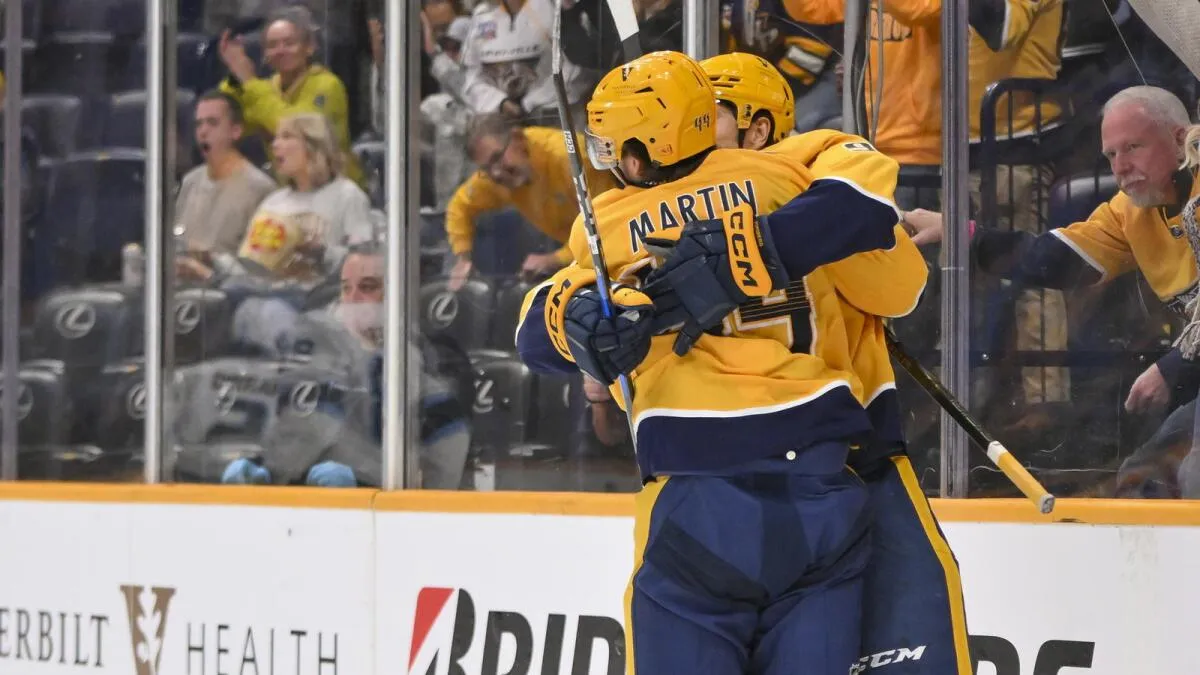
Nashville Predators season turnaround 2025-26 analysis: Roster reconstruction begins
The Predators have already started their rebuild by trading Gustav Nyquist to the Minnesota Wild for a second-round pick during the previous season, signaling their intentions to accumulate future assets. As the team navigates the early months of 2025-26, several veteran players remain in trade discussions, including Stamkos, Ryan O’Reilly, Marchessault, Filip Forsberg, and even star goaltender Juuse Saros.
The opening night roster for 2025-26 reflects a mix of established veterans and emerging youth. The 22-player active roster includes 13 forwards, seven defensemen, and two goaltenders, with notable prospects like Fedor Svechkov and Joakim Kemell earning spots alongside proven performers like Forsberg and O’Reilly. However, the team began the season with Matthew Wood and Nicolas Hague on injured reserve, while Luke Evangelista awaited immigration clearance.
Youth movement takes center stage
One of the clearest paths to Nashville Predators season turnaround 2025-26 analysis involves accelerating the development of young talent. Players like Matthew Wood, Fedor Svechkov, Luke Evangelista, Zachary L’Heureux, Joakim Kemell, Reid Schaefer, Ozzy Weisblatt, and Tanner Molendyk should receive increased roles in the NHL this season.
The coaching staff’s willingness to trust younger players could determine the team’s competitiveness. Svechkov, the Predators’ first-round pick from the 2021 NHL draft, has shown flashes of lethal shooting ability and offensive creativity. Despite averaging just over 12 minutes of ice time, his potential as a future goal scorer excites the organization. With more opportunities arising from potential veteran departures, his playing time should increase significantly.
Zachary L’Heureux, another 2021 first-rounder, brings grit and offensive upside when healthy. His week-to-week upper-body injury status complicates matters, but the 21-year-old forward represents an important piece of Nashville’s future. These prospects offer hope that the suffering of the previous season won’t be in vain, potentially forming the foundation for a brighter future in Smashville.
Nashville Predators season turnaround 2025-26 analysis: Defensive restructuring
The blue line presents both the team’s greatest strength and its most pressing challenge. Captain Roman Josi remains the anchor, but at 34 years old, he needs a consistent defensive partner who can complement his offensive-minded style. The Swiss-born defenseman has played with nine different partners for 30 minutes or more during five-on-five play, highlighting the instability that plagued the previous season.
Finding the right partner for Josi is paramount. Historically, successful pairings featured defensive stalwarts like Shea Weber and Ryan Ellis, who allowed Josi to freelance offensively while covering defensively. Current options include Justin Barron, who has one year remaining on his contract, and Andreas Englund, an unrestricted free agent after this season.
Barron has demonstrated an ability to shoot from the blue line, creating space for Josi’s one-timer opportunities. Englund brings physicality and stability with his large frame, relying on smart positioning and initial outlet passes rather than puck-carrying. While neither matches the pedigree of Weber or Ellis in their prime, they could provide the necessary balance to Josi’s game.
The Predators also feature Brady Skjei as a mainstay defenseman, though the pairing with Josi hasn’t yielded the desired results. Nick Perbix and Nick Blankenburg offer depth options, while the injured Nicolas Hague could factor into the equation upon his return from upper-body injury.
Nashville Predators season turnaround 2025-26 analysis: Goaltending workload management
Juuse Saros has been Nashville’s workhorse since the 2021-22 season, leading the league in starts and facing massive shot volumes. However, this heavy workload may have contributed to his “down year” during the disastrous previous season. In 2024-25, Saros started 46 of the team’s 61 games, facing the fourth-most shots in the league despite the team’s struggles.
The acquisition of Justus Annunen from the Colorado Avalanche provides a legitimate backup option with starter potential. The 24-year-old has performed admirably in relief appearances, bailing out the team when defensive play broke down. Splitting starts evenly between Saros and Annunen serves multiple purposes: it rests the veteran starter, provides valuable experience for the backup, and potentially boosts Annunen’s trade value or solidifies his role as the long-term backup.
This season offers a perfect opportunity to manage Saros’ workload carefully. With the team potentially rebuilding, there’s no need to risk injury or exhaustion on a goaltender who represents a critical piece for future success. The Predators can afford to give Annunen extended looks, gathering more tape to evaluate whether he can be the serviceable backup Saros needs heading into the final year of his current deal.
Nashville Predators season turnaround 2025-26 analysis: Trade deadline strategy
The upcoming trade deadline will prove crucial for Nashville’s long-term plans. With the team likely out of playoff contention again, Trotz must maximize returns for veteran assets while avoiding complete demolition of the roster.
Top trade candidates
Several big pieces have surfaced in trade rumors, including Steven Stamkos, Ryan O’Reilly, Jonathan Marchessault, and Filip Forsberg. The decision on whether to move these players involves complex calculations about salary cap implications, return value, and the message sent to fans.
Stamkos, signed to a lucrative contract, hasn’t produced at expected levels. Moving him could free significant cap space, though finding a willing trade partner might prove challenging. O’Reilly and Marchessault bring championship experience and could interest contenders seeking depth additions.
The Forsberg situation presents the most intrigue. As a homegrown star and fan favorite, trading him would signal a full rebuild. However, his value might never be higher, and contenders would pay premium prices for his scoring touch.
The Saros question looms largest. Trading an elite goaltender in his prime typically yields substantial returns, but doing so while selling other veterans would leave the team with massive holes to fill. The return for Saros could jumpstart a turnaround, yet his presence also helps the Predators win games they might otherwise lose, potentially hurting draft lottery odds.
Secondary market opportunities
Beyond the marquee names, Nashville can market several affordable options. Michael Bunting, Nick Perbix, Nick Blankenburg, and Nic Hague (at a reduced cap hit) could attract interest from teams seeking depth pieces without breaking the bank. These moves might not yield first-round picks but can accumulate valuable mid-round selections and organizational depth.
Nashville Predators season turnaround 2025-26 analysis: Building for competitive future
The organization’s stated goal involves making the previous season an anomaly and returning to contention quickly. This approach differs from traditional tank-and-rebuild models, instead focusing on retooling while remaining competitive.
The draft lottery equation
Nashville’s performance this season directly impacts their chances at franchise-altering prospects like Gavin McKenna or Keaton Verhoeff. The front office must balance the desire to develop young players and establish a winning culture against the strategic benefit of securing a top draft pick.
Every win versus loss carries dual implications. While fans and players naturally compete to win, the organization must consider whether each victory helps or hurts the long-term vision. This delicate balancing act requires transparent communication from management to maintain fan support during difficult stretches.
Culture reset
Creating a winning culture while losing games presents perhaps the greatest challenge. Head Coach Andrew Brunette must instill competitive habits, accountability, and systems play even as the roster experiences turnover. Young players need to learn what it takes to win at the NHL level, even if the scoreboard doesn’t immediately reflect those lessons.
The Predators’ leadership core, centered around Josi, must model professional standards daily. How the captain approaches this transitional period will influence the development of prospects and the team’s identity moving forward. Josi’s willingness to take accountability for poor performances sets the tone for the entire organization.
The 2025-26 season will test the Predators’ ability to execute a rapid turnaround. Success depends on hitting on multiple fronts: developing youth, managing veterans, maximizing trade returns, and maintaining competitive standards. While the pain of the previous campaign remains fresh, the foundation for a brighter future could emerge from these strategic decisions. The question isn’t whether Nashville will be active at the trade deadline, but rather which moves will best position them for sustainable success in 2026-27 and beyond.
Barry Trotz faces pressure to deliver results quickly, but patience and strategic thinking will ultimately determine whether this season serves as a successful bridge to contention or merely extends the franchise’s recent misery. The Predators’ faithful deserve a winning team, and the organizational moves this season will reveal how committed management is to making that happen sooner rather than later.
Frequently Asked Questions

Par Mike Jonderson
Mike Jonderson is a passionate hockey analyst and expert in advanced NHL statistics. A former college player and mathematics graduate, he combines his understanding of the game with technical expertise to develop innovative predictive models and contribute to the evolution of modern hockey analytics.