












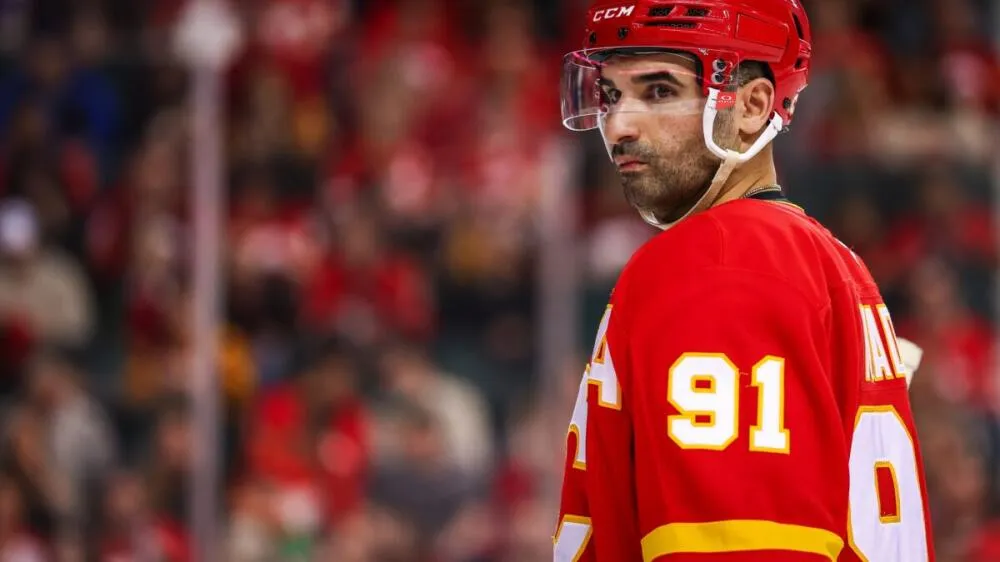
Nazem Kadri’s name has been swirling in trade conversations as the Calgary Flames struggle through the early portion of the 2025-26 season. The veteran center, now in his fourth year of a seven-year contract worth $7 million annually, finds himself at the center of speculation as teams across the NHL search for offensive upgrades and experienced playoff performers. With two goals and eight points through 11 games, the 35-year-old remains productive despite his team’s struggles, making him an intriguing target for contenders looking to bolster their depth down the middle.
As Kadri approaches his 1,000th NHL game—a milestone he’s expected to reach soon—the trade chatter has intensified. However, there’s a significant wrinkle that potential suitors must navigate: Kadri holds a 13-team no-trade list, creating an extra layer of complexity for any franchise interested in acquiring his services. According to reports, teams are scrambling to determine whether they’re on that list and, if so, how they might convince the veteran to waive his protection. The combination of his contract, age, and trade protection makes any potential deal far more intricate than a simple asset swap.
Top Nazem Kadri trade destinations for the 2025-26 season
Florida Panthers emerge as ideal landing spot
ESPN’s Kevin Weekes stated emphatically during Frozen Frenzy coverage that “there isn’t a better fit for Nazem Kadri than Florida.” The Panthers are navigating a difficult period without captain Aleksander Barkov, who suffered a major knee injury that could sideline him for the remainder of the regular season and potentially into the playoffs. The situation has prompted discussions about potential trade options as Florida looks to maintain its status as a Stanley Cup contender.
From a stylistic perspective, Kadri would slot seamlessly into Florida’s aggressive, physical system. The former Stanley Cup champion plays with the edge and intensity that defines Panthers hockey. His two-way capabilities would allow head coach Paul Maurice to deploy him in critical situations, providing flexibility across the forward lines. With Barkov’s $10-million cap hit available if he remains on long-term injured reserve through the playoffs, Florida has the financial flexibility to absorb Kadri’s $7-million salary.
The challenge with a Panthers acquisition lies in the long-term implications. Kadri still has three years remaining after this season, and when Barkov returns, the center depth chart becomes crowded. Anton Lundell and Sam Bennett are both signed long-term as the team’s second and third-line centers. If Florida were to acquire Kadri, they would likely need to flip him during the offseason to recoup assets or address other roster needs, making this more of a complex, multi-phase transaction.
Despite these complications, Kadri’s history of performing in high-pressure playoff situations—culminating in his Stanley Cup victory with Colorado in 2022—makes him an attractive option for a Panthers team looking to defend its championship aspirations. His grit, skill, and experience would provide immediate value, even if the long-term fit requires creative roster management.
Carolina Hurricanes pursue center depth
The Carolina Hurricanes have emerged as another potential destination in the Nazem Kadri sweepstakes. The Hurricanes have consistently been among the NHL’s top regular-season teams but have fallen short in the playoffs, and general manager Eric Tulsky may view Kadri as the type of veteran presence that could push them over the hump. Carolina’s need for additional center depth, particularly behind Sebastian Aho, makes Kadri an intriguing fit.
Kadri’s physical style and willingness to engage in the dirty areas of the ice aligns well with Carolina’s fast, relentless forechecking system. His experience in playoff battles could prove invaluable for a team that’s faced criticism for coming up short when the stakes are highest. The Hurricanes have cap space to work with and a deep prospect pool that could entice Calgary in trade negotiations, making a deal financially and logistically feasible.
One potential concern for Carolina is whether they appear on Kadri’s 13-team no-trade list. If they do, the Hurricanes would need to convince the veteran that Raleigh offers the best opportunity for postseason success. The team’s consistent competitiveness and strong organizational culture could work in their favor during those discussions. Additionally, Kadri’s relationship with potential linemates and his desire to compete for another Stanley Cup might override any initial hesitation.
The Hurricanes have been aggressive in recent years when pursuing playoff upgrades, and Kadri fits the profile of a player who could make a tangible difference in their quest for championship glory. His versatility allows him to play up and down the lineup, providing head coach Rod Brind’Amour with options depending on matchups and game situations.
Colorado Avalanche reunion possibility for the 2025-26 season
A reunion with the Colorado Avalanche represents one of the more romantic potential trade destinations for Nazem Kadri. The center won his Stanley Cup with the Avalanche in 2022, posting eight goals and 15 points in 16 playoff games during that magical run. Colorado’s center depth has been tested throughout the 2025-26 season, and bringing back a familiar face who knows the system and culture could provide both on-ice and intangible benefits.
General manager Chris MacFarland has shown a willingness to make bold moves when the team needs reinforcement, and Kadri’s familiarity with coach Jared Bednar’s system would allow for a seamless transition. The Avalanche’s window remains open with Nathan MacKinnon, Cale Makar, and Mikko Rantanen leading the charge, and adding a proven playoff performer like Kadri could address their need for secondary scoring and center depth.
The financial aspect of a Colorado reunion presents challenges. The Avalanche are typically tight against the salary cap, meaning Calgary would likely need to retain a portion of Kadri’s salary or take back salary in return. However, if both teams are motivated—Calgary looking to recoup assets and Colorado seeking a playoff boost—creative cap management could make the numbers work. The emotional appeal of returning to the team where he won his championship might also persuade Kadri to facilitate the deal if Colorado appears on his no-trade list.
Beyond the X’s and O’s, Kadri’s leadership and playoff pedigree would provide invaluable mentorship for Colorado’s younger players. His ability to elevate his game when it matters most is precisely what championship-contending teams seek as they prepare for the postseason grind. A second stint in Denver could offer Kadri another legitimate chance at raising the Stanley Cup.
Vancouver Canucks capitalize on Western Conference positioning
The Vancouver Canucks have generated significant interest as a potential landing spot, particularly after insider Rick Dhaliwal confirmed that Vancouver is not on Kadri’s 13-team no-trade list. This revelation immediately elevated the Canucks as a realistic destination, eliminating one of the primary obstacles that could derail trade negotiations. Vancouver’s need for center depth and veteran leadership makes Kadri an appealing target as they look to build on their competitive foundation.
Playing in Vancouver would bring Kadri to a Canadian market with passionate fans and intense media scrutiny—an environment he’s familiar with from his years in Toronto. The Canucks have established themselves as a playoff-caliber team, and adding a player of Kadri’s caliber could push them into legitimate contention in the Western Conference. His ability to contribute offensively while maintaining defensive responsibility would complement Vancouver’s top-six forwards and provide insurance against injuries.
The Canucks have been aggressive in their pursuit of playoff success, and general manager Patrik Allvin has demonstrated a willingness to make impactful trades when opportunities arise. Vancouver possesses the assets and cap flexibility to construct a competitive offer for Calgary, potentially including prospects, draft picks, or young roster players. The provincial rivalry between British Columbia and Alberta could add an extra layer of intrigue to such a transaction.
From Kadri’s perspective, joining a team trending upward with emerging stars and a passionate fanbase could be appealing. The opportunity to play meaningful games in front of sold-out crowds while competing for a playoff spot would align with his competitive nature. Vancouver represents both a geographical and competitive fit that could satisfy all parties involved in trade discussions.
Understanding the complexities of Nazem Kadri trade destinations in 2025-26
The no-trade list complication
According to Sportsnet’s Elliotte Friedman, the discovery that Kadri holds a 13-team no-trade list rather than a full no-movement clause has sent ripples through front offices across the NHL. Teams are actively investigating whether they appear on that list, with some executives expressing surprise at finding themselves included. The partial no-trade protection gives Kadri significant control over his destination while still leaving options available for Calgary to explore.
Friedman noted on the 32 Thoughts podcast that teams are asking themselves, “Am I on that list? Am I not on that list? I’m on that list. How did I end up on that list? And how do I change that?” This uncertainty creates a dynamic negotiation environment where teams must not only satisfy Calgary’s asking price but also ensure they’re not among the 13 franchises Kadri has designated as unacceptable destinations. For teams that do appear on the list, convincing Kadri to waive his protection becomes a secondary negotiation requiring its own strategy.
The psychological element cannot be understated. Teams that discover they’re on Kadri’s no-trade list may feel slighted and work harder to change his mind, potentially offering additional incentives or painting a compelling picture of their championship potential. Conversely, teams not on the list gain a competitive advantage in trade talks, knowing they can proceed without the added complication of convincing the player to accept the deal.
This complexity means that the most obvious fits from a hockey perspective might not be the most realistic from a contractual standpoint. Calgary must balance maximizing their return with finding destinations Kadri will accept, creating a three-dimensional puzzle that goes beyond simple asset valuation.
The 1,000-game milestone timing
One factor that has temporarily cooled Kadri trade discussions is his approaching 1,000th NHL game. Friedman emphasized that the Flames won’t move Kadri before he reaches this significant career milestone, respecting both the player’s achievement and the celebration his family has planned. This creates a natural timeline for when trade talks might intensify—immediately after Kadri plays his 1,000th game, the Flames will be free to listen to offers without the ethical complication of denying him this moment.
“This is huge for Kadri and his family, and I’ve heard that they’ve got like, big celebration planned. You don’t let that get touched,” Friedman stated. The mutual respect between player and organization, even amid trade speculation, speaks to the professionalism on both sides. Calgary recognizes Kadri’s contributions and character, while Kadri continues to compete at a high level for a struggling team rather than sulking or demanding an immediate trade.
The milestone timing also serves Kadri’s interests. By continuing to perform well while approaching 1,000 games, he maintains his trade value and demonstrates to potential suitors that he remains a productive player worth acquiring. His personal pride and competitive nature drive him to prove doubters wrong, a quality that has defined his career from his days as a seventh overall pick in 2009 through his Stanley Cup triumph in 2022.
Once the 1,000-game celebration concludes, expect trade discussions to accelerate rapidly. Teams that have been monitoring the situation will submit serious offers, and Calgary will have the flexibility to make a deal without the added complication of disrupting Kadri’s personal milestone. The timing could align perfectly with teams assessing their needs as the season approaches the midway point and the trade deadline comes into clearer focus.
Contract considerations for Nazem Kadri trade destinations in 2025-26
Long-term commitment versus rental status
One of the primary complications in potential Kadri trade scenarios is his contract status. Unlike typical trade deadline acquisitions who are pending unrestricted free agents, Kadri has three years remaining on his deal after this season at a $7-million cap hit. This makes him far more than a rental, requiring acquiring teams to commit significant cap space not just for the current season but for multiple years into the future.
For rebuilding or budget-conscious teams, this long-term obligation makes Kadri an unrealistic target regardless of his on-ice value. However, for win-now contenders with stable ownership and cap flexibility, the extended term could actually be viewed as an advantage. Rather than losing Kadri to free agency after a few months, teams would secure his services through the prime of their competitive window, providing continuity and avoiding the need to replace him in the offseason.
Calgary may need to retain salary to facilitate a trade, potentially keeping 25-50% of Kadri’s cap hit on their books for the duration of his contract. While this isn’t ideal for a rebuilding team, it could be the difference between securing quality assets in return versus settling for a lesser package. Some scenarios might involve a three-team trade where a third party retains additional salary, though these arrangements add complexity and require finding a willing partner with available retention slots.
The long-term nature of Kadri’s contract also means that acquiring teams must project his performance trajectory. At 35 years old, will Kadri maintain his current production level through age 38? Teams with strong analytics departments will model various aging curves and production scenarios, weighing the risk against the potential playoff impact he could provide in the near term.
Salary cap gymnastics and creative solutions
Fitting Kadri’s $7-million cap hit into a contender’s salary structure requires creative financial maneuvering. Most playoff-bound teams operate with minimal cap space, necessitating salary movements to accommodate a player of Kadri’s contract value. This could involve Calgary retaining salary, prospects or picks being redirected to third teams who take on bad contracts, or the inclusion of salary dumps going back to the Flames.
One potential structure involves Calgary retaining 50% of Kadri’s salary ($3.5 million) while also taking back an overpaid player from the acquiring team. This simultaneously reduces the cap hit for the contender while providing Calgary with additional assets as compensation for absorbing a less desirable contract. Teams like the Panthers, Hurricanes, or Avalanche each have contracts they might consider moving to create the necessary cap flexibility.
Another consideration is performance bonuses and salary structure within Kadri’s contract. Understanding the timing of salary payments and potential bonus clauses can impact how teams approach the acquisition. Some organizations with ownership groups willing to spend actual dollars beyond the cap hit have advantages in these negotiations, particularly if Kadri’s contract includes front-loaded salary payments that reduce the real-money cost in future years.
The trade deadline’s proximity also affects cap calculations. Teams acquiring players at the deadline pay a prorated portion of the annual cap hit based on remaining games, creating opportunities to fit larger contracts into tight cap situations. However, with three years remaining beyond this season, acquiring teams must plan for the full $7-million impact (or whatever retained percentage is negotiated) in subsequent years, making this a decision with lasting implications for roster construction.
The 2025-26 season has thrust Nazem Kadri into the trade spotlight as Calgary’s struggles have intensified speculation about veteran departures. For Kadri, the situation represents both an opportunity and a challenge—an opportunity to join a contender and chase another Stanley Cup, but a challenge in navigating his no-trade protection and ensuring any move serves his family and career interests. Teams pursuing Kadri must balance hockey fit, financial feasibility, and the diplomatic work of convincing him to waive his no-trade clause if they appear on his restricted list.
As Kadri approaches his 1,000th game and Calgary continues evaluating its future direction, the coming weeks will provide clarity on whether a trade materializes before the deadline. Whether he lands in Florida, Carolina, Colorado, Vancouver, or elsewhere, Kadri’s next destination will significantly impact both his legacy and his new team’s championship aspirations. For now, all parties continue their behind-the-scenes work, with Kadri maintaining his professionalism and focus while the hockey world watches this compelling trade saga unfold.

Par Mike Jonderson
Mike Jonderson is a passionate hockey analyst and expert in advanced NHL statistics. A former college player and mathematics graduate, he combines his understanding of the game with technical expertise to develop innovative predictive models and contribute to the evolution of modern hockey analytics.