




NHL concerns over Olympic ice quality in Milan Italy hockey tournament overshadow Olympic hockey return
NHL players are set to return to Olympic competition in February 2026 for the first time since 2014, but serious concerns about ice quality and rink dimensions in Milan threaten to cast a shadow over hockey’s biggest international stage. As construction at the Santagiulia Ice Hockey Arena enters its final weeks, NHL deputy commissioner Bill Daly has issued a stark warning: if the ice surface is deemed unsafe, the league will not allow its players to participate, regardless of the years of negotiation that brought them back to the Winter Games.
The issues surrounding the Milan Olympic hockey tournament have caught many by surprise. While the return of NHL stars like Connor McDavid, Auston Matthews, and Sidney Crosby was supposed to be a celebration of hockey’s best talent on the world stage, infrastructure challenges and design compromises have created tension between the NHL, the International Ice Hockey Federation (IIHF), and Olympic organizers. With the women’s tournament scheduled to begin February 5 and the men’s competition starting February 11, time is running short to address these critical problems.
Bill Daly’s stark warning about player safety
NHL deputy commissioner Bill Daly pulled no punches when addressing league governors in Colorado Springs earlier this week, stating clearly that player safety would be the non-negotiable factor in determining whether NHL players compete in Milan. “If the players feel that the ice is unsafe to play, then we’re not going to play,” Daly told reporters. “It’s as simple as that.”
Daly’s comments reflect the league’s primary concern that construction delays have created an impossibly tight timeline for proper ice installation and testing. The main Santagiulia Arena is scheduled for completion on February 2, just three days before the women’s tournament begins and nine days before the men take the ice. This narrow window leaves virtually no margin for error, equipment malfunctions, or weather-related complications that could affect ice quality.
The compressed schedule means the ice surface will face extraordinary stress during the Games. With three games per day planned for nearly three weeks straight, the rink’s ability to maintain consistent, safe playing conditions will be severely tested. NHL officials worry that inadequate curing time and insufficient test events could result in dangerous ice conditions that increase injury risk for the world’s elite players.
The dimension dilemma: shorter rinks raise competitive concerns
Adding to the quality concerns, the IIHF confirmed this week that Olympic hockey rinks in Milan will measure 196.85 feet by 85.3 feet—more than three feet shorter than the standard 200-foot by 85-foot NHL dimensions. This deviation from the specifications outlined in the July agreement between the NHL, NHLPA, and IIHF has sparked debate about competitive fairness and player safety.
The federation defended its decision by stating that the dimensions comply with IIHF regulations and match the rink size used at the Beijing 2022 Olympics. However, that argument rings hollow to many NHL officials, who point out that Beijing’s Games occurred without NHL participation due to COVID-19 scheduling conflicts. The current agreement explicitly called for NHL-standard ice to accommodate the league’s players, making this change a significant departure from the negotiated terms.
The Pittsburgh Penguins and Nashville Predators played two Global Series games in Stockholm last month on a similar-sized rink, and Daly noted the league received no player complaints. However, critics argue that a regular-season showcase differs dramatically from the intensity of Olympic medal competition, where players push their bodies to the absolute limit. The slightly wider but notably shorter surface could compress playing space in ways that affect skating lanes, defensive systems, and the high-speed collisions that define elite hockey.
How rink dimensions impact Olympic hockey strategy
International ice dimensions have varied throughout Olympic history, creating different tactical approaches:
- 1998, 2006, 2014: Traditional international size (196.85 by 98.4 feet) emphasized speed and wide puck movement
- 2002: Slight variation in Salt Lake City tested adaptation skills
- 2010: NHL dimensions in Vancouver provided familiar conditions
- 2018, 2022: NHL dimensions were agreed upon but COVID prevented NHL participation
- 2026: Hybrid size creates uncertainty about optimal strategies
Finland men’s hockey general manager Jere Lehtinen downplayed concerns, telling the Associated Press, “It’s the same for every team, and I think that’s the bottom line.” While true, this perspective overlooks how the compressed space might fundamentally alter the style of play fans expect to see from the world’s best talent.
Santagiulia arena: construction delays create crisis atmosphere
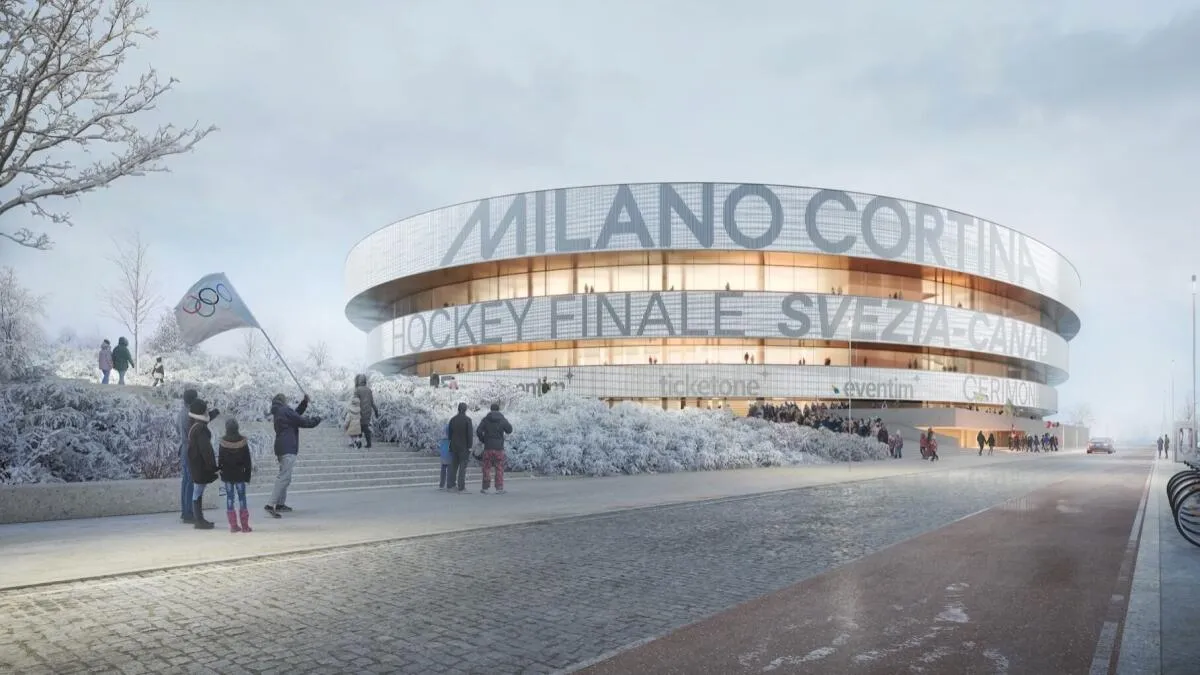
The Santagiulia Ice Hockey Arena, a new 16,000-seat venue on Milan’s outskirts, remains a construction zone just weeks before it must host the world’s best hockey players. Photographs from the site show workers still installing seats, dasher boards, and refrigeration systems, while organizers scramble to complete the facility in time for scheduled test events January 9-11.
Olympic organizers confirmed there is “no plan B” for the hockey tournament, meaning the Games rely entirely on Santagiulia’s completion despite the delays. This lack of contingency planning has alarmed NHL officials who have witnessed similar infrastructure challenges derail major sporting events. The absence of a backup venue means any significant construction setback or, worse, a cancellation of hockey at the Olympics.
Compounding the concerns, reports suggest locker room facilities may be housed in temporary trailers adjacent to the arena rather than the permanent, climate-controlled spaces NHL players expect. While Olympic athletes traditionally stay in village dorms, the quality of competition facilities remains paramount for a sport requiring such precise ice conditions.
The Rho Ice Hockey Arena, another Milan-area venue, recently hosted the IIHF Group B Under-20 World Championship as a test event, but workers were still putting finishing touches on that facility just days before puck drop. This eleventh-hour completion pattern has become the norm rather than the exception for Milan’s Olympic hockey preparations.
NHL deploys experts to salvage Olympic participation
In response to growing concerns, the NHL has mobilized its top ice technicians and refrigeration experts to assist Italian organizers with the Santagiulia project. “We have offered and they’re utilizing our ice experts and technicians and outside providers,” Daly explained. “We’re basically moving everybody there to try to help get this done in a way that’s acceptable for NHL athletes.”
This unprecedented intervention demonstrates the league’s commitment to making Olympic participation work while protecting its most valuable asset—its players. NHL ice experts, who maintain playing surfaces in some of the world’s most demanding arenas, bring specialized knowledge about creating and maintaining NHL-quality ice in challenging conditions.
The league will maintain on-site presence throughout the test events in early January, allowing officials to evaluate ice quality firsthand and provide real-time feedback to construction crews. This collaborative approach represents a significant commitment of resources, with NHL personnel potentially stationed in Milan for several weeks leading up to the Games.
Timeline pressure creates high-stakes race
Critical dates in the Milan Olympic hockey timeline:
- January 9-11: Test events at Santagiulia Arena
- February 2: Scheduled arena completion
- February 5: Women’s tournament begins
- February 11: Men’s tournament begins
- February 22: Men’s gold medal game
This compressed schedule leaves virtually no time for major corrections if the test events reveal significant problems. NHL officials privately express concern that surface-level fixes might mask deeper issues that only become apparent during the intensity of Olympic competition.
Player association perspective and tournament integrity
The NHL Players’ Association has taken a measured approach to the controversy, canvassing members about their concerns. According to Daly, players did not view the dimension discrepancy as a significant health, safety, or competitive issue, which has helped prevent a full-scale crisis.
However, the union shares the league’s concerns about ice quality and construction delays. Assistant executive director Ron Hainsey has been in regular contact with IIHF and Olympic officials, emphasizing that players expect NHL-standard conditions for their first Olympic appearance in 12 years. The union’s primary focus remains ensuring the facility is safe and suitable for elite competition, regardless of the specific measurements.
Team Canada general manager Doug Armstrong first raised the ice dimension issue publicly in September, and assistant coach Peter DeBoer recently discussed the challenges on a radio show, highlighting how national federations have been aware of the situation for months. Yet some federations reportedly knew about the dimension change earlier but failed to escalate it to NHL officials during site visits—an oversight Daly attributed to the subtlety of the difference. “It’s not like people bring tape measures there,” he noted dryly.
What this means for the future of Olympic hockey
The Milan ice quality controversy raises fundamental questions about the relationship between professional leagues and the Olympic movement. When NHL commissioner Gary Bettman negotiated the league’s return to the Games, the agreement included specific requirements for playing conditions that reflected the NHL’s standards. The current situation tests whether the Olympic organizing model can accommodate these professional expectations.
For hockey fans worldwide, the ice concerns represent a potential threat to what should be a showcase event. After waiting 12 years to see the world’s best players compete for their countries, the prospect of substandard conditions or, worse, NHL withdrawal would be devastating for the sport’s Olympic profile.
Looking ahead: solutions and compromises
The immediate focus remains ensuring Santagiulia Arena delivers safe, playable ice by February. If successful, the NHL’s intervention could become a model for future Olympic collaborations, where league expertise helps elevate venue quality. However, if problems persist, the 2026 Games might force a reevaluation of whether the current Olympic delivery model can meet professional sports standards.
The IIHF has reportedly assured the NHL that the 2030 Olympics in France will feature rinks built to full NHL specifications, suggesting lessons are already being learned from the Milan experience. For now, all parties maintain optimistic public postures while working furiously behind the scenes to ensure hockey’s Olympic return isn’t remembered for the wrong reasons.
The stakes couldn’t be higher. With rosters due December 31 and the hockey world eagerly anticipating matchups between superstars who’ve never faced each other in Olympic competition, the pressure is mounting on Italian organizers to deliver a facility worthy of the talent it will host. Whether they succeed remains the most pressing question facing the Milan Winter Games.
Frequently Asked Questions

Par Mike Jonderson
Mike Jonderson is a passionate hockey analyst and expert in advanced NHL statistics. A former college player and mathematics graduate, he combines his understanding of the game with technical expertise to develop innovative predictive models and contribute to the evolution of modern hockey analytics.