The NHL salary cap has crossed the $100 million threshold for the first time, set at exactly $104 million for the 2026–27 season.
AAV calculation and individual limits
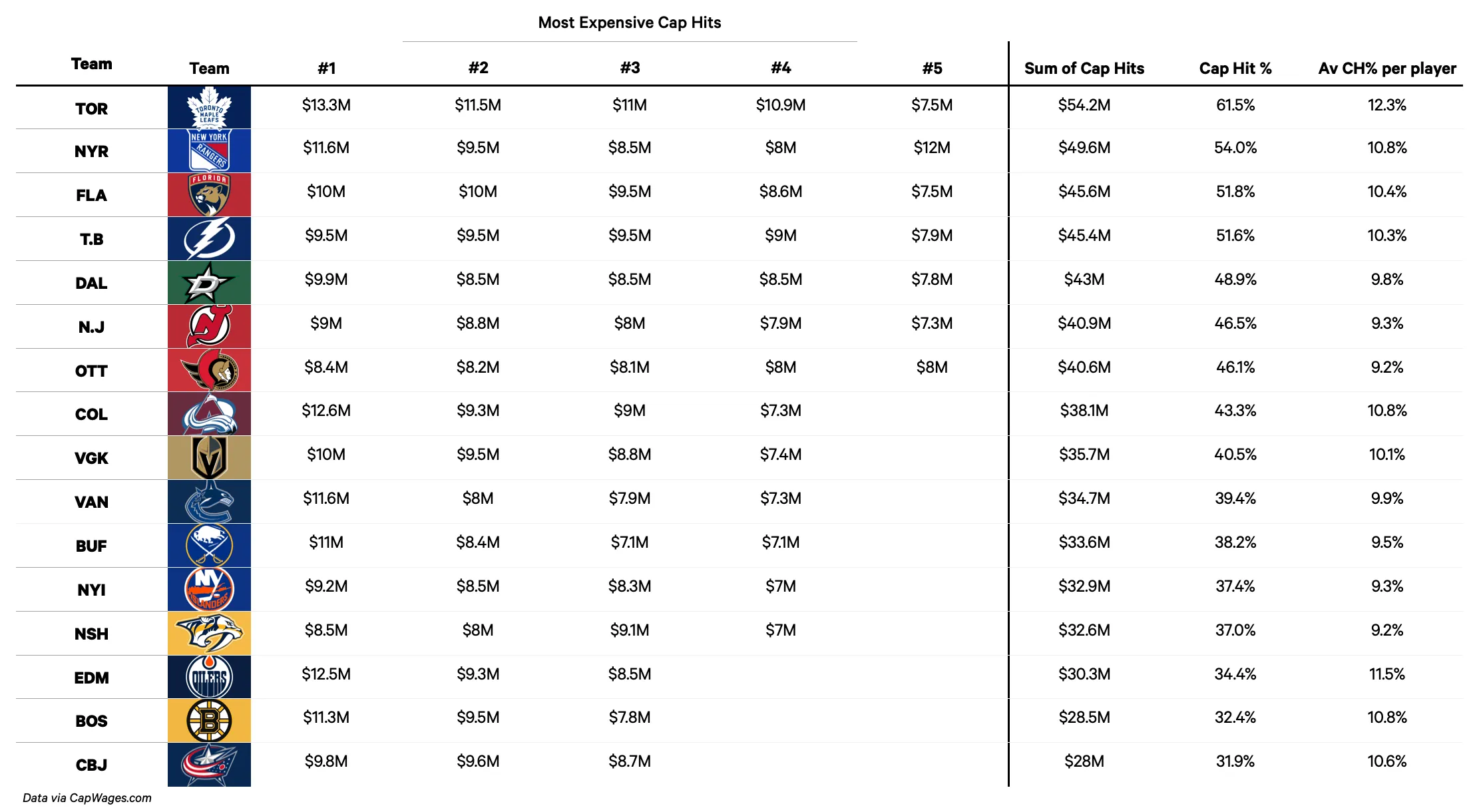
The cap hit equals total contract value divided by length regardless of yearly salary distribution. An eight-year $80 million deal therefore produces a constant $10 million annual charge.
This AAV method contrasts with front-loaded structures that benefit players early while holding cap impact steady across seasons. The league caps individual earnings at 20 percent of the ceiling, fixing the 2026-27 maximum at $20.8 million.
Puckpedia and Spotrac both confirm the $104 million upper limit and $76.9 million floor for the coming season. Entry-level contracts remain strictly controlled, allowing young talent to outperform modest cap charges during early windows.
LTIR restrictions and playoff compliance
LTIR relief previously permitted teams to exceed the cap by replacing long-term injured players and then restore full rosters for playoffs. Updated rules limit that relief when return is expected in the same season.
Playoff compliance now requires every active roster to stay inside the cap structure. The change removes the prior advantage where playoff lineups exceeded the regular-season limit by significant margins.
General managers must therefore construct balanced 23-man groups rather than relying on seasonal manipulation, according to the mechanics outlined in the NHL-NHLPA agreement.
Revenue tie and future projections
The cap ceiling derives directly from projected hockey-related revenue split near 50-50 between players and owners. New media rights, digital advertising, and international events drive the $8.5 million jump from the prior $95.5 million limit.
The same framework projects a further rise to $113.5 million in 2027-28 with a floor of $83.9 million. Teams that lock in long-term deals now gain breathing room only if AAV precision keeps total commitments under the escalating ceiling.
Salary retention up to 50 percent and daily cap-space accrual remain tools for deadline flexibility, yet buyout penalties spread over double the remaining term continue to punish inefficient contracts.
Frequently Asked Questions
Sources

Par Mike Jonderson
Mike Jonderson is a passionate hockey analyst and expert in advanced NHL statistics. A former college player and mathematics graduate, he combines his understanding of the game with technical expertise to develop innovative predictive models and contribute to the evolution of modern hockey analytics.