The early morning hours of November 10, 1985, forever altered the trajectory of the Philadelphia Flyers franchise and left an indelible mark on the hockey world. Pelle Lindbergh, the 26-year-old Swedish goaltender who had just captured the Vezina Trophy and led his team to the Stanley Cup Finals, lost control of his modified cherry-red Porsche 930 on a New Jersey road, crashing into a wall at speeds estimated between 80 and 90 miles per hour. The next day, after his family arrived from Sweden, Lindbergh was removed from life support. Four decades later, as the anniversary of his death approaches, the Flyers organization and hockey community continue to honor a goaltender whose promise was cut tragically short.
The significance of this 40th anniversary carries additional weight in 2025, as it follows the September passing of Bernie Parent, the legendary Flyers goaltender who served as Lindbergh’s mentor and childhood hero. With Rick Tocchet, Lindbergh’s former teammate, now behind the bench as head coach, and a new documentary examining his life and legacy, the Pelle Lindbergh Flyers goalie remembrance resonates more profoundly than ever. Understanding Lindbergh’s impact requires looking beyond the tragedy to appreciate the remarkable talent and connection he forged with Philadelphia in such a short time.
The rise of the Flyers’ Swedish sensation
Pelle Lindbergh arrived in North America following the 1980 Winter Olympics as a young goaltender with something to prove. While the world celebrated the U.S. team’s “Miracle on Ice,” Lindbergh held the distinction of being the only goaltender who didn’t lose to that legendary American squad, earning a 2-2 tie in the tournament opener. His North American journey began with the AHL Maine Mariners, where he quickly formed a bond with equipment manager Dave “Sudsy” Settlemyre.
Settlemyre, a former goaltender himself, instantly connected with the young Swede. Their relationship extended far beyond the professional realm, as they became close friends and collaborators. It was Settlemyre who nicknamed him “Gump” after former Montreal Canadiens goalie Gump Worsley. The two would spend hours working on Lindbergh’s equipment, at one point setting up eight-foot tables in a weight room to tinker with his pads. Lindbergh had learned leather-working skills as a child in Sweden, hanging around a local shoemaker, and he used that knowledge to craft competitive advantages despite his smaller 5-foot-9 stature.
“Just his personality and being a goalie — we hit it off right away,” Settlemyre recalled. “Hung out, became buddies other than just being at the rink and being teammates.” Those early days in Maine laid the foundation for what would become a remarkable, if brief, NHL career. Lindbergh’s athleticism compensated for what he lacked in size, and his work ethic suggested a player determined to maximize every opportunity.
The Flyers brought Lindbergh up for parts of five seasons between 1981-82 and 1985-86, but his path to elite status wasn’t immediate. After posting an .890 save percentage and 2.99 goals-against average in 40 games during the 1982-83 season while splitting time with Bob Froese, Lindbergh struggled the following year. The difficulties were significant enough that he was even reassigned to the AHL Springfield Indians for four games, raising questions about whether he would ever fulfill his potential at hockey’s highest level.
Everything changed when Mike Keenan took over as head coach in the summer of 1984. Keenan called Lindbergh to lunch and delivered a message that would transform the young goaltender’s career: “No matter what, you’re our No. 1 goalie.” That vote of confidence proved catalytic. During the 1984-85 season, Lindbergh blossomed into one of the NHL’s premier netminders, leading the Flyers to the best record in the league with a 40-17-7 record. His .899 save percentage and 3.02 goals-against average earned him the Vezina Trophy as the league’s best goaltender, and he led the NHL with 65 games played.
The Bernie Parent connection and Philadelphia’s embrace
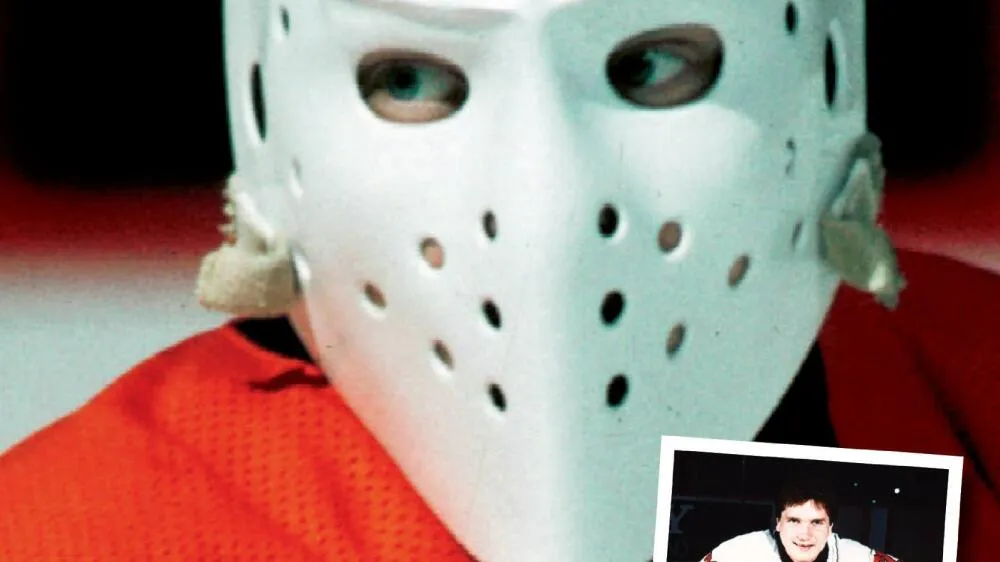
What truly endeared Lindbergh to Philadelphia fans was his unmistakable connection to Bernie Parent, the franchise’s legendary goaltender. As a child growing up in Stockholm’s working-class neighborhoods, Lindbergh had a poster of Parent on his bedroom wall. Parent wasn’t just a distant idol; he became Lindbergh’s mentor and friend when he joined the Flyers organization as goalie coach. The symmetry was remarkable—Lindbergh had worn No. 1 with Team Sweden and in the AHL because of Parent, and when he reached the NHL, he adopted No. 31 as a tribute to his hero.
On the ice, the similarities were striking. Both goaltenders shared the stand-up style that defined their era, both were undersized for the position, and both wore plain white masks. To Flyers fans who had celebrated Parent’s brilliance during the franchise’s Stanley Cup championships in 1974 and 1975, Lindbergh appeared to be a reincarnation of their beloved goaltender. The prospect of another generation of elite goaltending sparked hope for additional championship glory.
“Bernie and Pelle had a great relationship,” recalled Keenan. “Pelle adored Bernie. I do know that Pelle was emulating Bernie, that stand-up style. He was almost a duplicate style of Bernie. The fans probably saw that and fed off it because, it’s a riot — here’s young Bernie Parent in the net.” The connection wasn’t manufactured or forced; it was genuine, born from childhood admiration that evolved into professional mentorship and deep friendship.
In 1985, the Flyers were arguably Philadelphia’s most popular professional sports team. Their two Stanley Cup victories were still fresh in collective memory, and Lindbergh’s emergence as an elite goaltender positioned the franchise for what appeared to be another sustained run of excellence. According to Al Morganti, who covered the team for the Philadelphia Inquirer, “The Flyers were still a huge headline team. It was before the NFL took over the entire landscape.”
Despite his ups and downs before breaking through, including that stint in the minors, Philadelphia embraced Lindbergh completely. “The fans really loved him,” Morganti observed. “It was amazing, the connection that he had so quickly.” Lindbergh wasn’t viewed as a Swedish import; he was adopted as one of their own. Former Flyers president Jay Snider remembered him as perpetually upbeat: “He always had that smile, a great way about him. He was so likable. I believe it came through to everybody.”
The night that changed everything
The 1985-86 season began with extraordinary promise. By early November, the Flyers had compiled a 12-2-0 record, riding a nine-game winning streak. On November 7, Lindbergh made 18 saves in a 6-2 victory over the Chicago Blackhawks, with Mark Howe and Tim Kerr each scoring twice. Two nights later, with Lindbergh taking a rare night off, backup goaltender Bob Froese backstopped a 5-3 win over Boston, extending the streak to 10 games. The next scheduled game wasn’t until November 14, giving the team several days to celebrate their success.
Following the November 9 victory, the Flyers gathered at The Coliseum in Voorhees, their practice facility, for a party. In the early morning hours of November 10, Lindbergh left the gathering with two passengers—Ed Parvin Jr. and Kathy McNeal—in his heavily modified Porsche 930 Turbo. What happened next would devastate a franchise, a city, and hockey communities on both sides of the Atlantic.
Lindbergh lost control of the vehicle in Somerdale, New Jersey, crashing into a wall at high speed. The subsequent investigation revealed his blood alcohol level at 0.24 percent, far exceeding New Jersey’s legal limit of 0.10 at the time. Both passengers suffered critical injuries—Parvin with a fractured skull, McNeal in a coma for nine days with a broken pelvis, ruptured spleen, and damaged liver. Lindbergh was rushed to the hospital and placed on life support while doctors determined he was legally brain dead.
Jay Snider was in Los Angeles for NHL marketing meetings when he received the call from his father to return immediately. At the hospital, despite Lindbergh showing no outward signs of injury from the neck up, it was clear he wouldn’t survive. General manager Bobby Clarke had been on a scouting trip in Boston and went directly to the hospital from the airport. “The players were all there,” Clarke remembered. He instructed Keenan to gather the team and leave the hospital, knowing there was nothing anyone could do.
The decision was made to keep Lindbergh on life support until his parents, Sigge and Anna-Lisa Lindbergh, could fly from Sweden. On November 11, 1985, surrounded by family, Pelle Lindbergh was removed from life support. His organs were donated, providing life to others even as his own ended far too soon. The hockey world mourned, but the mourning was complicated by the circumstances—drunk driving had claimed not just Lindbergh’s life but had seriously injured two others.
Navigating grief and complicated circumstances
The revelation of Lindbergh’s blood alcohol level added layers of complexity to the tragedy. Jay Snider, anticipating that the information would eventually become public, released it to the media. The decision to be transparent didn’t ease the difficulty of processing what had happened. “We weren’t responsible for that. He was solely responsible,” Snider acknowledged. “But there were other people’s lives affected by that.”
The news resonated particularly hard in Sweden, where drunk driving carried severe social stigma. In 1985, Sweden’s legal blood alcohol limit was 0.05 percent—half of New Jersey’s limit—and has since been lowered to 0.02 percent. For Lindbergh’s parents and the Swedish public, the circumstances were especially difficult to reconcile with the person they knew. Mark Howe recalled the reaction from Sweden: “I kept hearing when they found out he had been drinking and driving, it was, he knew better than that. I remember reading about how the people were really disappointed in Pelle.”
In the documentary “The Swede of Philadelphia,” released in November 2025 on the 40th anniversary, Kathy McNeal addressed Lindbergh directly: “Pelle, I don’t blame you. I never blamed you. I wish I could take that day back. And I miss you. And so many people you touched in your life miss you.” Her words offered grace in the face of tragedy, acknowledging both the loss and the reality that one catastrophic decision doesn’t define a person’s entire life.
When asked whether Lindbergh should be remembered as a talented goaltender on the cusp of greatness or as a cautionary tale, Howe offered a nuanced perspective: “I remember him as both. You don’t give people passes, but you find me somebody that hasn’t made a mistake in their life and they didn’t get away with it. He just didn’t. That’s how I look at it. He made a mistake, and he paid dearly for it.”
Three days after Lindbergh’s death, the Flyers held an emotional ceremony at the Spectrum. The most daunting task—delivering the eulogy—fell to 26-year-old captain Dave Poulin. Bobby Clarke called Poulin to the Coliseum on Tuesday afternoon and simply said, “Hey Davey, you’re going to do the eulogy tomorrow.” Poulin, stunned, responded that he didn’t even know what a eulogy was. Despite the short notice and overwhelming emotion, Poulin delivered remarks that honored his fallen teammate with dignity and grace.
Howe reflected on Poulin’s performance: “What I remember was, boy, they certainly picked the right guy to be captain of this hockey club. Dave had to work hard to prove himself to the players that he was worthy of the captaincy, because he hadn’t been there very long. He had already done that on the ice and the way he conducted himself off the ice, but I was just so proud of what he did. He did Pelle 100 percent justice that day.”
The legacy that endures four decades later
The Flyers’ first game after Lindbergh’s death came on November 14 against the Edmonton Oilers—the same team that had defeated them in the Stanley Cup Finals just months earlier. In a display of resilience, Philadelphia won 5-3, extending their winning streak to 11 games. The streak eventually reached 13 games as the team rallied around their fallen teammate’s memory. The Flyers finished that season with a 53-23-4 record, though they fell in the Division Semi-Finals to the New York Rangers.
One season later, with rookie sensation Ron Hextall in goal, the Flyers again reached the Stanley Cup Finals, facing Edmonton once more. While they ultimately fell short, the franchise demonstrated remarkable resilience in the wake of unimaginable tragedy. The healing process, however, extended far beyond wins and losses.
Dave Settlemyre remained with the Flyers for five years after Lindbergh’s death. Most within the organization assume the practice of keeping No. 31 unavailable began with him, though the equipment manager never officially retired the number. When he left in 1990, his successor Turk Evers continued the tradition. When Derek Settlemyre—Sudsy’s son—took over as head equipment manager in 2006, he received clear guidance: the retired numbers and No. 31 were not options for new players.
When veteran goaltender Martin Jones signed with Philadelphia in 2021 and requested No. 31—which he’d worn for eight years in Los Angeles and San Jose—equipment manager Rick Bronwell provided a history lesson. Jones switched to No. 35 without hesitation. The number hasn’t been worn in four decades, a quiet but powerful tribute that speaks to Lindbergh’s enduring impact on the franchise.
Current team governor Dan Hilferty offered this statement to The Athletic: “The Philadelphia Flyers have a formal process in place to vote for both Flyers Hall of Fame members and retired numbers. Pelle Lindbergh’s No. 31 will always be considered for retirement. Over the last 40 years, our players and staff have observed and chosen not to wear Pelle’s number on a Flyers sweater as a sign of respect for what he means to the organization as well as the player and person he was.”
The organization annually presents the Pelle Lindbergh Memorial Award to the team’s most improved player. In April 2025, Bobby Brink received the trophy from captain Sean Couturier, continuing a tradition that keeps Lindbergh’s name in the conversation for each new generation of Flyers. Yet Lindbergh has never been inducted into the Flyers Hall of Fame, nor is his number among the six officially retired by the franchise—a curious dynamic that has sparked debate among fans and former players alike.
Bobby Clarke offers a provocative perspective on the number’s future: “I’d like to see somebody else wear it, to honor Pelle. Not because he was insignificant, but because he was significant.” Clarke’s view suggests that allowing the number to be worn again by a worthy player might serve as a greater tribute than keeping it permanently vacant, though the organization has shown no indication of changing course.
Remembering Pelle Lindbergh in 2025
The 40th anniversary of Lindbergh’s death carries particular resonance in 2025 for several reasons. Bernie Parent’s passing in September at age 80 severed one of the last direct connections between Lindbergh and the glory days of Flyers hockey. Parent had been more than a coach; he was the link between past championships and future hopes, and Lindbergh was meant to be the bridge to that next era of success.
Rick Tocchet’s presence behind the bench adds another layer of poignancy. At 21 years old in 1985, Tocchet was a budding young star experiencing the trauma of losing a teammate. Now, four decades later, he leads the franchise as head coach, carrying memories and lessons from that devastating loss. The coincidence that the Flyers hosted Edmonton on November 14, 1985—their first game after Lindbergh’s death—and face the Oilers again on a similar date this season provides an eerie symmetry.
The release of “The Swede of Philadelphia,” Charlie Minn’s documentary featuring interviews with Tocchet, the late Parent, and others connected to Lindbergh, has brought renewed attention to his story. The film examines not just the tragedy but the person behind the mask—his personality, his dreams, his relationships, and the void his loss created. For younger Flyers fans who never saw Lindbergh play, the documentary offers insight into why his memory endures.
Dave Poulin, who delivered that difficult eulogy in 1985, still thinks about Lindbergh regularly. During his decade as head coach at Notre Dame, Poulin shared Lindbergh’s story with his players every year. When teaching his three daughters to drive, Lindbergh’s name inevitably came up. “You’re allowed to learn from other’s mistakes,” Poulin explained. “It’s a story that hopefully taught others, because of the harshness of what it was.”
Mark Howe’s balanced perspective perhaps best captures how the Pelle Lindbergh Flyers goalie remembrance should be understood four decades later. By acknowledging both the extraordinary talent and the tragic mistake, we honor the complexity of human existence. Lindbergh was a young man full of promise who made a catastrophic error in judgment. The error doesn’t erase the talent, and the talent doesn’t excuse the error. Both truths coexist.
Jay Snider remembers the smile, the enthusiasm, the joy Lindbergh brought to everyone around him. Settlemyre recalls the friend who bought a crossbow on a whim and bounced around “like having a little puppy dog behind you.” Teammates remember the dedication, the work ethic, and the stand-up goaltending style that echoed their legendary mentor. Opponents remember facing a competitor whose best years were still ahead of him.
The tragedy of Pelle Lindbergh isn’t just that he died young—it’s that we’ll never know how great he might have become. Would he have led the Flyers to another Stanley Cup? Would he have won multiple Vezina Trophies? Would his name be spoken in the same reverent tones as Parent, or Patrick Roy, or Martin Brodeur? These questions remain forever unanswered, preserved in the amber of what-might-have-been.
As the 40th anniversary arrives, the Philadelphia Flyers and hockey world remember a talented goaltender whose life ended far too soon. The circumstances demand acknowledgment—drunk driving cost Lindbergh his life and seriously injured two others, serving as a sobering reminder of choices and consequences. Yet the remembrance extends beyond tragedy to celebrate a player who captured Philadelphia’s heart, who idolized Bernie Parent and became his worthy successor, who worked tirelessly to overcome physical limitations through skill and determination.
Number 31 remains unworn, a quiet tribute in an organization known for its tough-guy mentality and refusal to dwell on the past. Perhaps that restraint—the absence of constant fanfare—makes the gesture more powerful. Every time a new goaltender joins the Flyers, equipment managers have that conversation. Every year, the Pelle Lindbergh Memorial Award reminds everyone of his legacy. The Pelle Lindbergh Flyers goalie remembrance continues not through grand gestures but through consistent, meaningful actions that ensure his memory endures for generations who never saw him play.

Par Mike Jonderson
Mike Jonderson is a passionate hockey analyst and expert in advanced NHL statistics. A former college player and mathematics graduate, he combines his understanding of the game with technical expertise to develop innovative predictive models and contribute to the evolution of modern hockey analytics.