












The Carolina Hurricanes’ dressing room has a new sound this season: the low, even rumble of Pyotr Kochetkov’s voice calmly directing traffic in front of his net.
Less than two years after he stepped on North-American ice for the first time, the 25-year-old from Nizhny Novgorod has gone from “goalie of the future” to the indisputable 1A in Rod Brind’Amour’s rotation, pushing veteran Frederik Andersen into a 1B role and making the Hurricanes’ goaltending controversy the most pleasant problem any coach could ask for.
Kochetkov’s ascension is more than a feel-good story; it is a case study in modern goalie development, European scouting patience and, above all, a reminder that the NHL’s best organizations are willing to rip up the depth chart when performance—not pedigree—demands it.
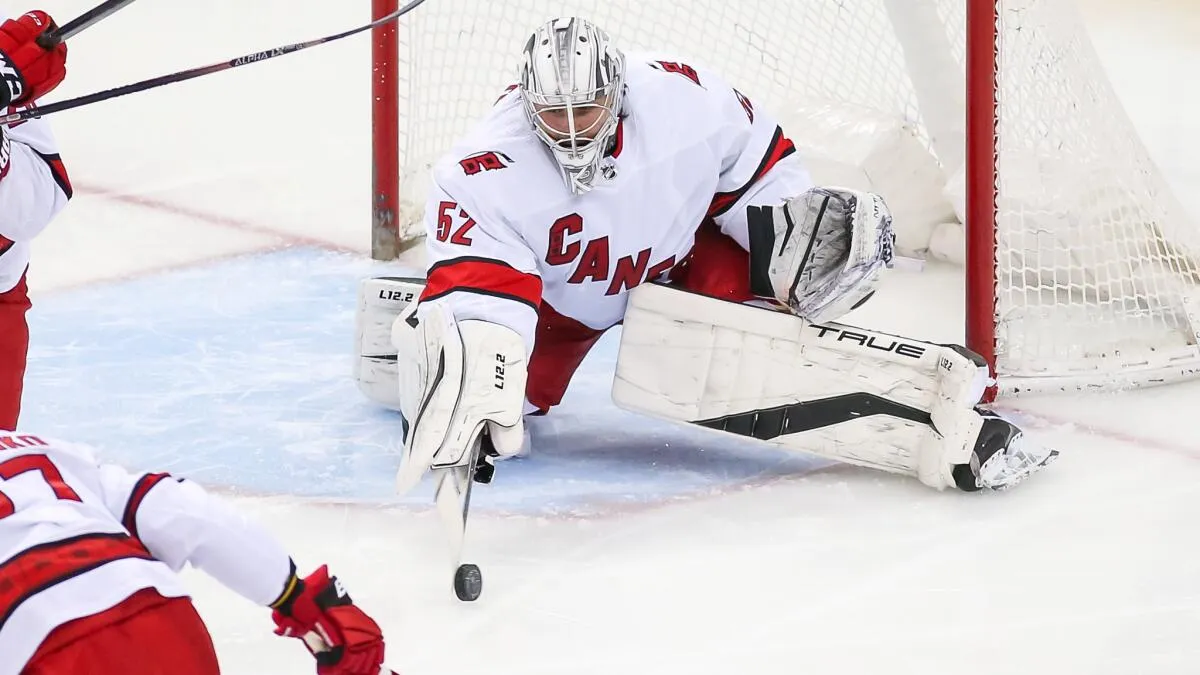
Pyotr Kochetkov 1A goaltender Hurricanes: the numbers behind the takeover
Through his first 28 appearances of 2024-25, Kochetkov owns a .923 save percentage at 5-on-5 and a league-leading 9.3 goals-saved above expected among goalies with 1,000-plus minutes, according to Natural Stat Trick.
Those figures are not merely elite; they are Vezina territory. Add a 2.12 goals-against average and six shutouts—already one shy of Carolina’s single-season franchise record—and the coaching staff’s decision becomes obvious.
- High-danger save %: .860 (3rd in NHL)
- Puck-handling assists: 4 (t-most among goalies)
- Record when facing 35+ shots: 7-2-1
The analytics echo what teammates say quietly in hallway interviews: the net feels bigger for opponents until the moment Kochetkov’s glove snaps it shut.
From KHL star to Calder dark horse: the winding road to Raleigh
Carolina’s 2019 fourth-round pick (93rd overall) stayed in Russia for two more seasons, winning the KHL’s Golden Mask as playoff MVP with Torpedo in 2021.
Instead of rushing him overseas, the Hurricanes convinced Kochetkov to sign a two-year, two-way deal in May 2022 and parked him with Chicago (AHL) to learn the smaller rink, heavier traffic and language that dominates NHL creases.
“American hockey is faster horizontally,” Kochetkov told The News & Observer last month. “In KHL, shooters try to beat you with speed through neutral. Here, they pass through you. My first month in Chicago, I was diving like a soccer goalie.”
By December 2022, injuries to Andersen and Antti Raanta catapulted him to the NHL, where he recorded a 27-save shutout in his debut against the Jets.
Still, the organization preached patience, splitting starts 50-50 with Alex Lyon during the 2023 Calder Cup playoffs and beginning 2023-24 as the clear backup. The patience paid off: Kochetkov’s save percentage has risen every quarter since, culminating in the current campaign where he has started 18 of the last 24 games.
What makes the Russian different: technique, temperament and tacos
Goalie coach Jason Muzzcati breaks Kochetkov’s style into three non-negotiables:
- Post play on his feet – Uses the “reverse-VH” only as a last resort, keeping his 6’3” frame upright to seal short-side threats.
- Pre-scouting release points – Arrives two hours early to study shooter clips; has a notebook on every opposing forward.
- Quick-reset athleticism – Recovers from scrambles with a crossover slide modeled after Henrik Lundqvist.
The intangibles are just as loud. Defenseman Jaccob Slavin laughs when recounting Kochetkov’s first U.S. grocery trip: “He bought, like, 80 corn tortillas, learned the word ‘taco’ and nothing else. Next game he stops 40 shots and the nickname stuck—Taco’s in net, we’re good.”
That levity translates to pressure moments. Down 2-1 in last spring’s second-round versus the Devils, Kochetkov shrugged off a Game 4 overtime loss by hosting the team for homemade borscht. The Hurricanes won the next two games, clinching the series on home ice.
The Frederik Andersen factor: how the 1A/1B dynamic actually works
Conventional wisdom says two starters create controversy; Carolina calls it “competitive peace.”
General manager Don Waddell structured both goalies’ contracts—Andersen two years, $6.4 M total; Kochetkov three years, $2.3 M AAV—to avoid financial jealousy, while Brind’Amour publishes the upcoming three-game starter a week in advance, eliminating day-to-day drama.
Andersen, 35, has embraced the mentor role. After Kochetkov’s 49-save masterpiece in Boston, the veteran waited in the tunnel with the game puck.
“He earned it,” Andersen said. “My job is to push him, then celebrate when he flies by me.”
The arrangement keeps both goalies fresh for what the franchise covets most: a deep run in the wide-open Eastern Conference. Carolina’s team save percentage (.913) ranks second in the NHL, and the club is on pace for the fewest back-to-back losses since relocation from Hartford.
Projecting the future: is a Vezina—or a parade—next?
History says a Russian goalie has never won the Vezina in its 93-year existence. Kochetkov, candid as ever, calls that “a boring fact to change.”
More importantly, the Hurricanes have never advanced past the conference final since the 2006 Cup. With a locked-in 1A making $2.3 million against the cap—read: bargain surplus—Carolina has flexibility at the trade deadline to add scoring depth rather than desperately search for goaltending like so many contenders.
What it means for the championship picture is simple: every playoff series will start with the Hurricanes believing they have the better goalie, a psychological edge they last held during Ron Francis’ playing days.
If Kochetkov maintains even a .915 save percentage in the postseason, the conversation shifts from whether Carolina can win the Cup to who can beat them four times before Taco closes the kitchen.
For a deeper dive into how the Hurricanes rebuilt their blue line to support their young star, check out our breakdown of Carolina’s defensive evolution.
And if you’re curious how other Russian netminders have fared in the NHL, our historical comparison of Shesterkin, Sorokin and Samsonov provides useful context.
Frequently Asked Questions

Par Mike Jonderson
Mike Jonderson is a passionate hockey analyst and expert in advanced NHL statistics. A former college player and mathematics graduate, he combines his understanding of the game with technical expertise to develop innovative predictive models and contribute to the evolution of modern hockey analytics.