





Quinn Hughes was handed the captain’s ‘C’ for the Vancouver Canucks at just 23 years old, becoming one of the youngest leaders in franchise history. The 2024 Norris Trophy winner represents the foundation upon which Vancouver hopes to build sustained success. Yet as the 2025-26 season unfolds, Hughes faces a unique set of obstacles that test not only his elite abilities on ice but also his capacity to guide a franchise through turbulent waters. His journey offers a revealing look at the modern demands placed on young NHL captains navigating team dysfunction, contract uncertainty, and the weight of franchise expectations.
The leadership challenges confronting Hughes extend far beyond typical growing pains. Between injuries that sidelined him for critical stretches, public feuding among star teammates, and mounting questions about his own long-term commitment to Vancouver, the young defenseman has been forced to mature rapidly under an unforgiving spotlight. His response to these pressures will likely define both his legacy and the trajectory of the Canucks organization for years to come.
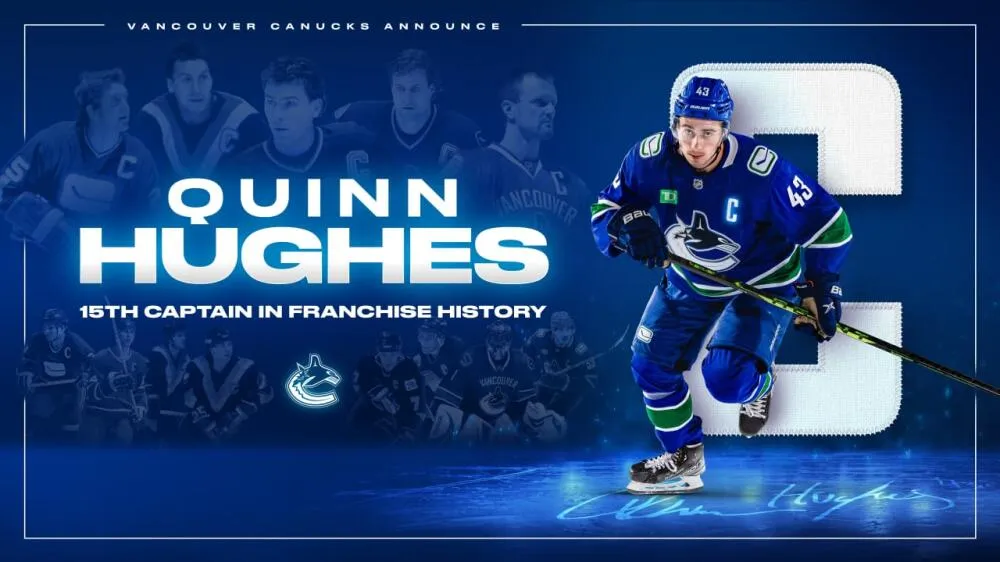
Quinn Hughes Canucks captain leadership challenges amid contract uncertainty
Hughes enters the 2025-26 season with just two years remaining before unrestricted free agency, a timeline that has intensified speculation about his future commitment to Vancouver. When pressed about his plans, Hughes has been deliberately measured in his responses, neither offering reassurances of a long-term extension nor closing the door on exploring other options. “One thing I’m really good at — or have gotten good at — is I’m very present,” Hughes told Sportsnet. “I can’t even sign (a contract extension) for another year, so there’s nothing I can do.”
This calculated ambiguity creates a challenging dynamic for a captain whose primary responsibility includes projecting confidence and stability to teammates. While Hughes insists he can “handle the noise,” the reality is that contract uncertainty inevitably filters through the locker room. Younger players watch closely to see whether their franchise cornerstone is genuinely invested or merely fulfilling obligations while positioning himself for departure. Veterans wonder if they’re building toward something sustainable or simply treading water until the next organizational reset.
The situation draws uncomfortable parallels to previous Canucks captains who departed under difficult circumstances. The Vancouver Canucks captains’ legacy includes figures like Trevor Linden and Henrik Sedin, who remained committed to the franchise through extended rebuilds. Hughes faces the inverse pressure—leading a team that made the playoffs in 2023-24 but collapsed spectacularly the following season, raising legitimate questions about whether management can assemble a true contender before his contract expires.
General Manager Patrik Allvin has acknowledged the delicate nature of Hughes’ contract situation, understanding that the team’s performance over the next 18 months will largely determine whether the captain chooses to re-sign. This creates a feedback loop where on-ice struggles fuel contract speculation, which in turn generates distractions that can contribute to further struggles. Hughes has explicitly stated that his decision to re-sign will be based on Vancouver’s competitiveness, placing enormous pressure on both management and his teammates to deliver results quickly.
The financial stakes compound these leadership challenges. Hughes will command a contract likely exceeding $10 million annually, and Vancouver’s salary cap situation makes building around him increasingly complex. If the Canucks fail to show meaningful progress, Hughes could easily point to organizational shortcomings as justification for departure, leaving teammates to wrestle with the implications of a captain who keeps his options open.
Navigating teammate conflicts and Quinn Hughes Canucks captain leadership challenges
Perhaps no aspect of Hughes’ captaincy has proven more difficult than managing the public feud between Elias Pettersson and J.T. Miller, two of Vancouver’s highest-paid forwards. The 2024-25 season was marred by reports of dysfunction between these core players, creating a rift that Hughes was expected to address as captain. The tension became so pronounced that it overshadowed on-ice performance and raised questions about whether the two could coexist long-term.
Hughes approached the situation with characteristic restraint, opting for private conversations rather than public declarations. However, this low-key approach drew criticism from observers who wanted to see more visible leadership in moments of crisis. Unlike previous Canucks captains like Bo Horvat, who excelled at maintaining public positivity even during difficult stretches, Hughes has proven less comfortable in the role of team spokesperson and morale-builder.
The challenge for Hughes lies in his naturally reserved personality. He is not a vocal presence in the manner of traditional hockey captains who rally troops with impassioned speeches or confrontational interventions. Instead, Hughes leads primarily through his play—logging massive minutes, driving offensive production from the blue line, and consistently demonstrating elite skill. This style can be highly effective when results follow, but becomes problematic when the team struggles and teammates look for verbal leadership and direction.
The Pettersson-Miller situation required exactly the type of direct intervention that doesn’t come naturally to Hughes. Multiple reports suggested that the dysfunction affected team chemistry throughout the season, yet there were few indications that Hughes successfully mediated the conflict or established clear behavioral expectations. The result was a season that spiraled into disappointment, with Vancouver missing the playoffs despite possessing significant talent.
Adam Foote’s arrival as head coach brings a defensive-minded leader who understands the pressures facing young blue-liners. His relationship with Hughes could prove pivotal in helping the captain develop the interpersonal tools necessary to manage veteran personalities and internal conflicts. “He’s trying to make us a better team,” Hughes said of Foote. “He can teach us and bring us closer.”
The physical toll of Quinn Hughes Canucks captain leadership challenges on performance
Hughes’ leadership responsibilities have coincided with concerning injury patterns that raise questions about the physical sustainability of his workload. During the 2024-25 season, lower-body injuries forced him to miss multiple games in late October, including crucial matchups against divisional rivals. While he returned to immediately resume top-pairing duties and first power-play responsibilities, the recurring nature of these ailments suggests the cumulative strain of logging 28-plus minutes nightly while carrying both on-ice and leadership burdens.
The challenge for Hughes involves managing expectations around his availability and performance. As captain, he faces pressure to play through discomfort and model toughness for younger teammates. Yet as the team’s most valuable asset—both in terms of on-ice impact and trade/contract value—there are legitimate concerns about long-term health if he consistently pushes beyond prudent limits.
Despite the injury disruptions, Hughes’ production remained elite. In his return game against Nashville, he immediately resumed top-pairing duties. Against Winnipeg shortly after, he assisted on all three Vancouver goals while adding four shots and two blocks. Over a four-game stretch following his injury return, Hughes tallied six assists, showcasing the vision and playmaking ability that earned him Norris Trophy recognition.
These performances underscore a critical dimension of Hughes’ leadership—when he’s on the ice at full capacity, he remains among the NHL’s most impactful defensemen. His skating, passing, and hockey IQ place him in elite company alongside players like Cale Makar. The question becomes whether the physical demands of captaincy, combined with heavy minutes and the stress of a struggling franchise, create an unsustainable situation that could lead to either more frequent injuries or a decision to seek a fresh start elsewhere.
The mental toll of playing through adversity while shouldering leadership expectations should not be underestimated. Hughes has acknowledged that the 2024-25 season was “really not fun” and “an exhausting year,” admitting it took him considerable time to mentally recover from the disappointment. For a player entering his prime years, the prospect of enduring multiple seasons of similar frustration could influence both his immediate performance and his long-term decision-making about where to continue his career.
Quinn Hughes Canucks captain leadership challenges in public communication and perception
One of the more striking aspects of Hughes’ captaincy has been his visible discomfort with the public-facing dimensions of leadership. Following disappointing losses, his post-game media availabilities have frequently been brief and terse, offering little in the way of narrative-shaping or inspirational messaging. This stands in marked contrast to Bo Horvat, his predecessor as captain, who consistently maintained an energetic and hopeful public presence even during Vancouver’s darkest stretches.
Hughes’ reserved communication style creates a perception problem that extends beyond media relations. Fans and teammates alike look to captains for emotional cues—signals about how to process adversity, maintain belief during slumps, and conceptualize the team’s identity. When a captain appears withdrawn or reluctant to engage, it can create a leadership vacuum that others must fill or that simply remains unfilled, leaving the team directionless.
The contrast with previous Canucks captains is instructive. Trevor Linden cultivated an image as the heart and soul of the franchise, someone whose commitment never wavered regardless of circumstances. Henrik Sedin led with quiet dignity but also demonstrated willingness to address difficult topics and represent the organization publicly. Hughes, by comparison, often seems eager to minimize his media obligations and avoid controversial topics.
This reticence may stem from Hughes’ youth and relative inexperience in leadership roles. At 25, he is still developing the tools necessary to project confidence and authority in situations that make him uncomfortable. It may also reflect a deliberate strategy of keeping his options open—by avoiding strong public declarations of commitment or vision for the franchise, he preserves flexibility for potential departure.
However, this approach carries significant risks. In an era where fan engagement and media narrative significantly influence team culture, a captain who appears disengaged or unhappy can accelerate negative momentum. Recent reports have described Hughes’ “apparent misery,” noting that he seems increasingly reserved and burdened by the team’s struggles. Whether accurate or not, these perceptions shape how players, management, and fans view both Hughes’ leadership and the franchise’s direction.
The challenge for Hughes involves finding authentic ways to fulfill the public dimensions of captaincy without compromising his natural personality. Forcing himself to become someone he’s not would likely backfire, creating performative leadership that teammates would recognize as inauthentic. Instead, he may need to embrace a quieter leadership model while ensuring that his commitment and standards are clearly communicated through other channels—leadership by example taken to its logical conclusion.
Evaluating Quinn Hughes Canucks captain leadership challenges and future outlook
As the 2025-26 season progresses, Hughes finds himself at a crossroads that will define both his career and the Canucks’ franchise trajectory. The leadership challenges he faces—contract uncertainty, teammate conflicts, injury concerns, and public communication difficulties—represent a formidable test for any captain, let alone one who assumed the role so early in his career. His response to these obstacles will determine whether he emerges as a franchise pillar comparable to Vancouver’s legendary captains or as a cautionary tale about the dangers of premature leadership appointments.
Several factors will prove decisive in the months ahead. First, Vancouver’s organizational competitiveness must improve dramatically if Hughes is to commit long-term. General Manager Patrik Allvin has acknowledged this reality, understanding that the next 18 months represent a critical evaluation period. If the Canucks demonstrate genuine playoff contention and sustainable roster construction, Hughes may choose to build his legacy in Vancouver. If dysfunction continues, his departure becomes increasingly likely regardless of financial inducements.
Second, Hughes must continue developing the interpersonal and communication skills necessary for effective captaincy. While his on-ice excellence remains unquestioned—he projects to approach 90 points this season according to The Hockey News’ Fantasy Guide—leadership demands more than individual brilliance. Adam Foote’s mentorship could prove invaluable in helping Hughes navigate these challenges, but ultimately the captain must find his authentic leadership voice.
Third, the health and sustainability of Hughes’ workload requires careful management. Averaging 28 minutes nightly while managing leadership responsibilities creates legitimate concerns about long-term viability. Vancouver’s coaching staff and medical team must balance the team’s need for Hughes’ on-ice impact against the risk of overuse injuries that could compromise both his immediate performance and future career.
The broader question surrounding Hughes’ captaincy involves whether modern NHL leadership has evolved beyond traditional vocal, confrontational models. Perhaps Hughes represents a new archetype—the elite performer who leads primarily through play rather than words, whose commitment is measured in minutes logged and plays made rather than media soundbites. If successful, he could redefine expectations for what captain leadership looks like in the contemporary NHL.
However, this model requires near-constant excellence and team success to remain viable. When results falter, the absence of strong public leadership becomes glaring, leaving teammates and fans without the emotional anchoring that traditional captains provide. Hughes’ challenge involves finding ways to provide that stability while remaining true to his personality and approach.
The coming months will reveal whether Quinn Hughes can master the full spectrum of leadership challenges confronting him. His elite skill is beyond dispute—few defensemen in hockey can match his impact when healthy and engaged. Whether he can translate that individual excellence into team-wide success while managing the unique pressures of Vancouver’s captaincy remains the defining question of his career. For Canucks fans hoping to see their franchise return to championship contention, Hughes’ development as a complete leader may prove as crucial as any personnel move or strategic decision the organization makes.

Par Mike Jonderson
Mike Jonderson is a passionate hockey analyst and expert in advanced NHL statistics. A former college player and mathematics graduate, he combines his understanding of the game with technical expertise to develop innovative predictive models and contribute to the evolution of modern hockey analytics.