







The Carolina Hurricanes entered the 2025-26 season with championship aspirations and a retooled defensive corps designed to support their high-powered offense. But through the opening weeks of the campaign, an unexpected weak link has emerged on the blue line. Sean Walker, elevated to a top-pairing role alongside Jaccob Slavin, has struggled mightily in expanded minutes, exposing vulnerabilities that have been amplified by a rash of defensive injuries. What was supposed to be a seamless transition into shutdown duty has instead become a troubling liability for a team that prides itself on defensive excellence.
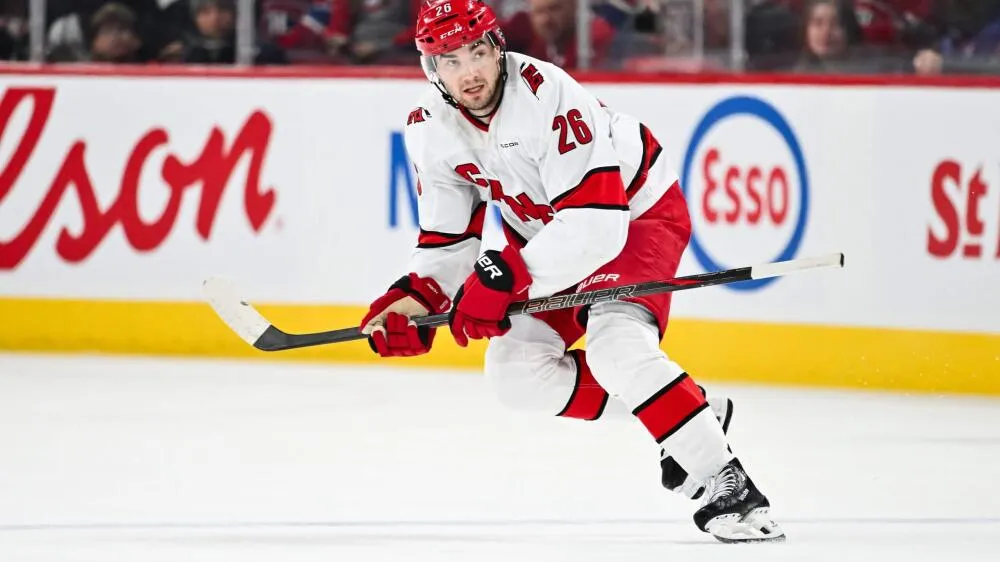
The alarming numbers behind Sean Walker’s Hurricanes defensive struggles in the 2025-26 season
The statistics paint a troubling picture of Walker’s performance through the first six games of the campaign. He has been on the ice for eight goals against at 5-on-5, the worst mark on the Hurricanes roster and among the league leaders in that dubious category. Only a handful of players across the NHL—including Sam Bennett, Mackenzie Weegar, and Brayden Point—have been on the ice for more goals against during that span.
Perhaps even more alarming is the save percentage when Walker is on the ice: a staggering .812. While goaltenders share responsibility for goals against, this figure suggests that Walker’s defensive breakdowns are creating high-quality scoring chances that are difficult for even competent netminders to stop. The Hurricanes have received decent goaltending overall this season, but the goalies simply cannot bail out their defensemen when the defensive structure collapses.
Walker’s goals against per 60 minutes of 5-on-5 play sits at 4.53, according to Natural Stat Trick. To put that in perspective, if Walker played all 60 minutes of a game, his on-ice performance would translate to four or five goals against. However, his expected goals against per 60 minutes is 2.45, indicating he’s been somewhat unlucky and that regression toward the mean should occur as the season progresses. Still, that’s cold comfort for a team dealing with the here and now of a defensive crisis.
During a particularly brutal six-game stretch, Walker posted a minus-8 rating—a remarkable achievement in the wrong direction for a player who is supposed to be shutting down opposing offenses. While plus-minus is an imperfect statistic that doesn’t account for context, that kind of bleeding in such a short timeframe cannot be ignored.
The burden of elevated responsibilities and ice time
A significant factor in Walker’s struggles has been the dramatic increase in his workload. Throughout his career, Walker averaged approximately 17 minutes of ice time per game—a reasonable load for a depth defenseman who could provide solid minutes without being overextended. That changed dramatically this season when he was thrust into a top-pairing role alongside Slavin, Carolina’s defensive anchor.
Through the early portion of the season, Walker has averaged 23:12 of ice time per game, nearly six additional minutes compared to his career average and more than five extra minutes from last season. That’s a substantial jump that would challenge any defenseman, but particularly one who has never been asked to handle such heavy minutes against elite competition night after night.
The elevated ice time has also come with increased special teams responsibilities. Last season, Walker logged just 50 seconds per night on Carolina’s league-leading penalty kill unit. This year, he’s averaging 2:15 on the penalty kill through the opening games, more than doubling his previous workload. He’s also been deployed on the second power play unit while Alexander Nikishin adapts to the NHL game, adding another dimension to his expanded role.
Assistant coach Tim Gleason acknowledged the adjustment Walker faces: “I think it’s just more the minutes and knowing that you’re playing against those top two lines every night.” That’s a significant change from the sheltered third-pairing minutes Walker enjoyed last season when he and Shayne Gostisbehere posted the best possession numbers in the league, both finishing with better than 60 percent Corsi For percentage.
Walker himself recognizes the challenge: “You’re going to be playing against those elite players every night if you’re playing with (Slavin). So you definitely feel a little more confident if you do take some risk, but you don’t want to go overboard, and then you’re putting a lot of pressure on him to save your (butt) night in, night out.” That self-awareness is admirable, but translating it into on-ice results has proven elusive thus far.
How defensive injuries have magnified the problem
The Hurricanes’ defensive struggles aren’t solely Walker’s fault—a cascade of injuries has left the blue line decimated and forced players into roles they weren’t prepared to handle. The situation has transformed what might have been a manageable adjustment period into a full-blown crisis that has exposed the team’s lack of defensive depth.
Jaccob Slavin, the defensive stalwart who has made every partner look better throughout his career, has missed time with a lower-body injury that limited him during training camp and caused him to miss the team’s road trip out west. Without Slavin’s stabilizing presence, Walker has been left without his most important security blanket, facing top lines without the benefit of playing alongside arguably the NHL’s best defensive defenseman.
Shayne Gostisbehere, who had exceptional chemistry with Walker on the third pairing last season, suffered an injury in the win over the Los Angeles Kings and was sent home for rehabilitation, further depleting the defensive depth. The departure of Dmitry Orlov and Brent Burns in free agency already left the Hurricanes with question marks on the blue line, and the injuries have amplified those concerns.
The ripple effect has been devastating. The Hurricanes have been forced to rely on call-ups, their seventh defenseman is playing on the third pairing, and the left side of the defense features a mix of newcomers still adjusting to Carolina’s system. This environment has placed exceptional weight on both Walker and Jalen Chatfield to hold the defensive structure together—a burden that neither player has been equipped to carry.
It’s worth noting that both Walker and Chatfield were knocked out of the playoffs last season with injuries before the Hurricanes’ elimination. Since returning from that postseason injury, Walker hasn’t been able to recapture the dazzling form he displayed in the first round against the New Jersey Devils, when he looked like exactly the type of versatile defenseman Carolina needed.
The Slavin partnership and unfulfilled expectations
When the Hurricanes decided to pair Walker with Slavin, there was optimism based on familiarity and previous success. During the regular season and playoffs last year, Gleason deployed Slavin and Walker together for approximately 100 minutes as a test run, and the results were promising enough to warrant expanding the partnership this season.
“With a couple D going down, people had to step up, and he was one of them,” Gleason said of Walker during last year’s playoffs. “He definitely came into that role, and from a coaching standpoint, it’s more the comfort level a little bit. So he obviously showed that.”
Slavin has a track record of elevating his partners’ games. Dougie Hamilton, Tony DeAngelo, and Brent Burns all thrived when paired with Slavin, benefiting from his exceptional positioning, hockey IQ, and ability to clean up mistakes. “I think anybody who plays with him is probably going to do fairly well,” Gleason said of Slavin’s impact.
Walker recognized the opportunity: “I would say it’s really an unbelievable opportunity. He’s definitely one of the top defensemen in our league. … I think we complement each other pretty well. But for me to get to play with a guy that caliber is very fortunate, I would say. Not many people get that opportunity every day.”
The theory behind the pairing made sense on paper. Walker is more defensively oriented than some of Slavin’s previous partners, which should create a shutdown pairing capable of neutralizing opponents’ top lines. “A little more defensive-minded, I think, all around than some of my previous partners,” Slavin said with a smile. “Nothing against the old partners, but it’ll be nice to have that.”
However, theory and practice have diverged significantly. In the season opener against New Jersey, the Walker-Slavin pairing shadowed Jack Hughes and Jesper Bratt for most of the night. Against Philadelphia, they primarily faced Trevor Zegras, Christian Dvorak, and Owen Tippett. Those are the types of matchups the Hurricanes envisioned when they assembled this pairing, but the execution has left much to be desired.
The Hurricanes entered the season 5-1-0 despite Walker’s struggles, a testament to their offensive firepower and overall roster depth. But as The Hockey Writers noted, Carolina’s iconic stalwart defensive unit has been unusually leaky early in the season, and Walker’s performance stands out as the primary culprit. For a team with championship aspirations, this vulnerability could prove costly if it persists.
What needs to change for the Hurricanes’ defensive structure
The path forward for Walker and the Hurricanes requires both short-term adjustments and long-term solutions. In the immediate future, the team desperately needs to get healthy on the blue line. The return of Slavin would provide Walker with the defensive partner who can best mask his weaknesses and maximize his strengths. When Slavin is on the ice, Walker can focus on his defensive responsibilities without feeling the pressure to carry the entire burden of shutdown duty.
Gostisbehere’s return would also help stabilize the defensive rotations, allowing the Hurricanes to potentially move Walker back down the lineup if his struggles continue. Last season’s third-pairing deployment brought out the best in Walker’s game, and there’s no shame in acknowledging that his optimal role might be in a more sheltered capacity rather than facing elite competition every shift.
Head coach Rod Brind’Amour may also need to consider reducing Walker’s ice time until he finds his footing. The jump from 17 to 23 minutes per game is substantial, and gradually increasing his workload might allow him to build confidence rather than drowning in responsibility. This would require other defensemen to step up, but it might be necessary to preserve Walker’s confidence and effectiveness.
From Walker’s perspective, simplifying his game might be the key. Rather than trying to contribute offensively or make high-risk plays, focusing exclusively on gap control, defensive zone positioning, and limiting high-quality chances could help him stem the bleeding. He scored a goal early in the season, demonstrating offensive capability, but that cannot come at the expense of defensive reliability when he’s playing top-pairing minutes.
The advanced metrics suggest that some positive regression is coming. With an expected goals against per 60 of 2.45 compared to his actual goals against per 60 of 4.53, there’s statistical evidence that Walker has been somewhat unlucky. As the sample size grows throughout the season, those numbers should converge closer to expectations, providing some natural improvement without requiring dramatic changes.
However, luck alone won’t solve the problem. Walker needs to tighten up his defensive zone coverage, improve his gap control in transition, and make smarter decisions with the puck. The Hurricanes’ coaching staff will undoubtedly work with him on these details, using video sessions and practice time to address specific breakdowns that have led to scoring chances against.
The situation facing Sean Walker and the Carolina Hurricanes is far from hopeless, but it demands attention and adjustment. The team’s strong start has masked the defensive deficiencies to some degree, but sustainable success requires all seven defensemen to perform their roles effectively. As the season progresses and healthier bodies return to the lineup, the Hurricanes will have opportunities to recalibrate their defensive pairings and find the optimal deployment for Walker—whether that’s alongside Slavin with reduced minutes or in a return to the depth role where he excelled last season. What’s clear is that the current arrangement isn’t working, and championship contenders cannot afford to let defensive vulnerabilities fester when the playoffs are built on the foundation of limiting quality chances against.

Par Mike Jonderson
Mike Jonderson is a passionate hockey analyst and expert in advanced NHL statistics. A former college player and mathematics graduate, he combines his understanding of the game with technical expertise to develop innovative predictive models and contribute to the evolution of modern hockey analytics.