Canada has advanced to the knockout rounds at the Milan Olympics as the top team in men’s hockey. Sidney Crosby and Connor McDavid each tallied a goal and two assists in a commanding 10-2 victory over France on Sunday.[1] The win capped a perfect preliminary round, with Canada outscoring opponents by 17 goals across three games.
The performance solidified Canada’s status as the tournament favorite. They now await their quarterfinal opponent on Wednesday, potentially Czechia or Germany.[2]
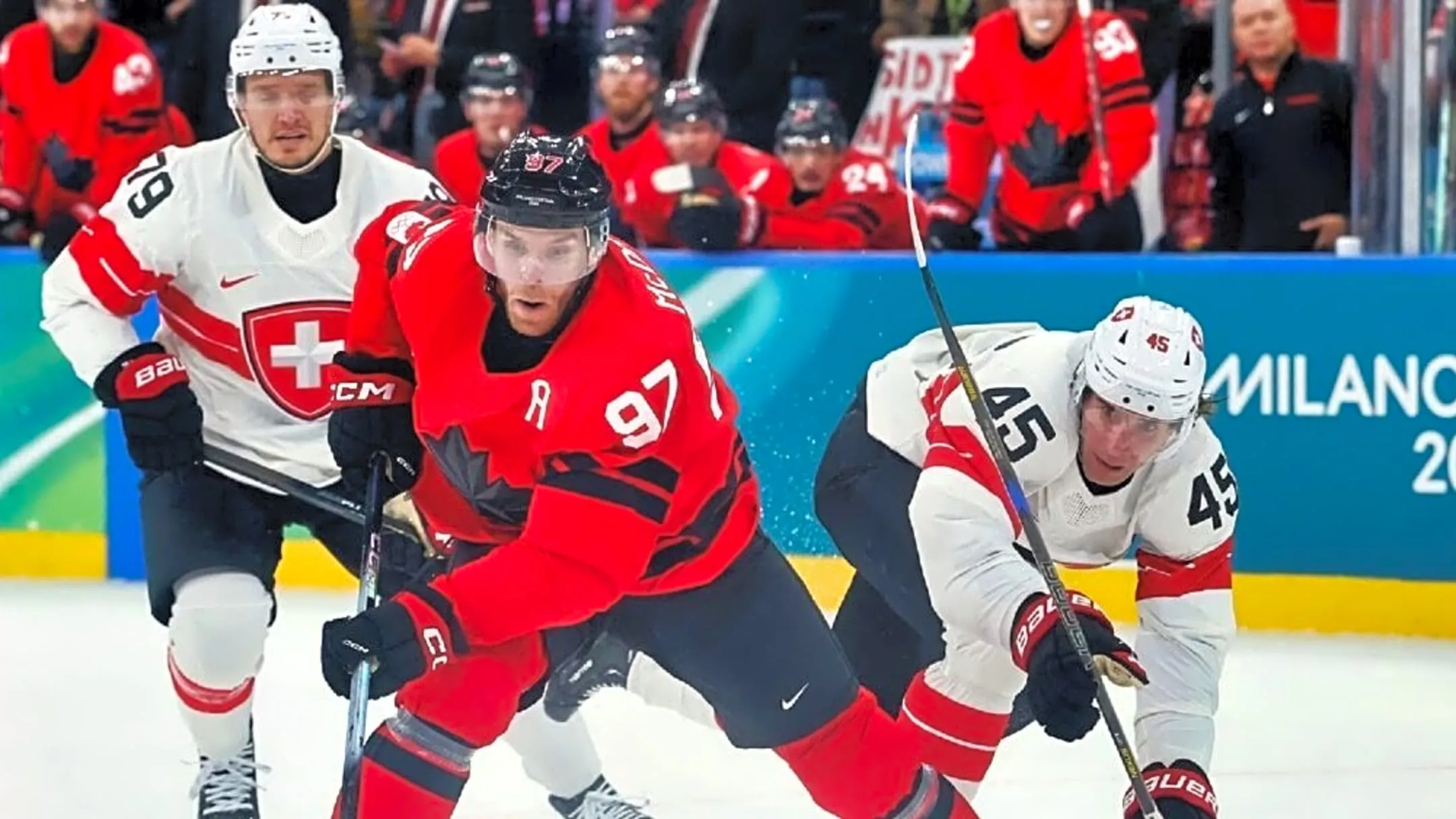
Canada’s unbeaten run in preliminary play
Canada opened the tournament strongly and never looked back. Their dominance was evident from the outset, blending skill, size, and relentless finishing.
In the game against France, shots favored Canada 46-13, easing the workload for goaltender Jordan Binnington. He made most stops routine, though one second goal slipped through.
The top line clicked perfectly. Tom Wilson, slotted on McDavid’s right wing by coach Jon Cooper, added a goal amid physical play, including a fight that led to his ejection under international rules.[3]
Mark Stone chipped in with a shorthanded goal in the first period and two assists. Brandon Hagel and Macklin Celebrini sealed the rout late.
Previous wins included a 5-1 decision over Switzerland, where McDavid and Nathan MacKinnon shone.[4] Canada remained undefeated throughout.
Crosby and McDavid’s leadership on display
At 38, Sidney Crosby showed no signs of slowing down in his third Olympics. He seeks a third straight gold, contributing masterfully in the France game.
Connor McDavid, in his Olympic debut, leads all scorers with nine points in three games. His speed and vision overwhelmed defenses.[5]
Together, they form the core of Canada’s attack. McDavid’s first Olympic goal came earlier, and both extended streaks against France.
Their chemistry hints at a generational handoff. Crosby captains with poise, while McDavid emerges as the new force. For more on Crosby passing the torch, see the official Olympics site.
The duo’s nine combined points in the opener underscored Canada’s edge.
Young guns and gritty contributors
Macklin Celebrini, at 19, impressed with four goals in three games. He scored on a penalty shot and power play against France.
Nathan MacKinnon returned after a forearm hit, adding to the depth. Tom Wilson’s physicality protected stars, even at ejection cost.
Mark Stone’s timely shorthanded tally energized the bench. Others like Hagel provided secondary scoring.
- Celebrini: 4 goals
- McDavid: 1 goal, 8 assists
- Crosby: Multiple points, record chase
This balance makes Canada formidable. ESPN’s full recap details the box score.
Quarterfinal path and U.S. implications
Canada clinched the No. 1 seed. The U.S. must thrash Germany by 10+ goals to overtake them, unlikely.
A lesser U.S. win pits them against Sweden in quarters. Canada likely faces Czechia or Germany Wednesday, with Binnington in net.
Sweden looms as a tough draw, but Canada’s prelim form suggests they can handle anyone.
Standings shook up elsewhere. Switzerland’s OT win over Czechia eased their path.
Switzerland rallies without Fiala
Switzerland beat Czechia 4-3 in overtime, honoring injured Kevin Fiala. Roman Josi opened scoring by banking off Radko Gudas.
Dean Kukan netted the winner, his top career goal. “The shot from there is always dangerous,” he said.
Timo Meier and Pius Suter scored, Leonardo Genoni stopped 29 of 32. Nico Hischier noted, “We’ll play for him.”
Fiala’s leg injury hurts, but the win sets up France or Italy next. “A huge win against a really good team,” Josi added.
Canada’s momentum positions them for gold contention. With stars aligned and depth proven, expect them to skate through quarters and chase history. The tournament’s best team rolls on.
Frequently Asked Questions

Par Mike Jonderson
Mike Jonderson is a passionate hockey analyst and expert in advanced NHL statistics. A former college player and mathematics graduate, he combines his understanding of the game with technical expertise to develop innovative predictive models and contribute to the evolution of modern hockey analytics.