

In the desert heat of Tempe, Arizona, a hockey program continues to defy expectations and reshape its narrative. Arizona State University men’s hockey has become a compelling story of growth, resilience, and championship ambition. The Sun Devils’ journey through their second season in the National Collegiate Hockey Conference (NCHC) has been filled with dramatic moments, breakout performances, and the kind of determination that defines successful programs. Sparky’s Notebook serves as your comprehensive guide to everything happening with ASU hockey, offering insider perspectives, player spotlights, and the stories that matter most to Sun Devil faithful.
The program’s evolution from a Division I independent to a competitive NCHC member has been remarkable. With head coach Greg Powers at the helm since 2010, ASU has built something special in the Valley of the Sun, attracting top talent and creating a culture that embraces the underdog mentality while harboring legitimate championship aspirations.
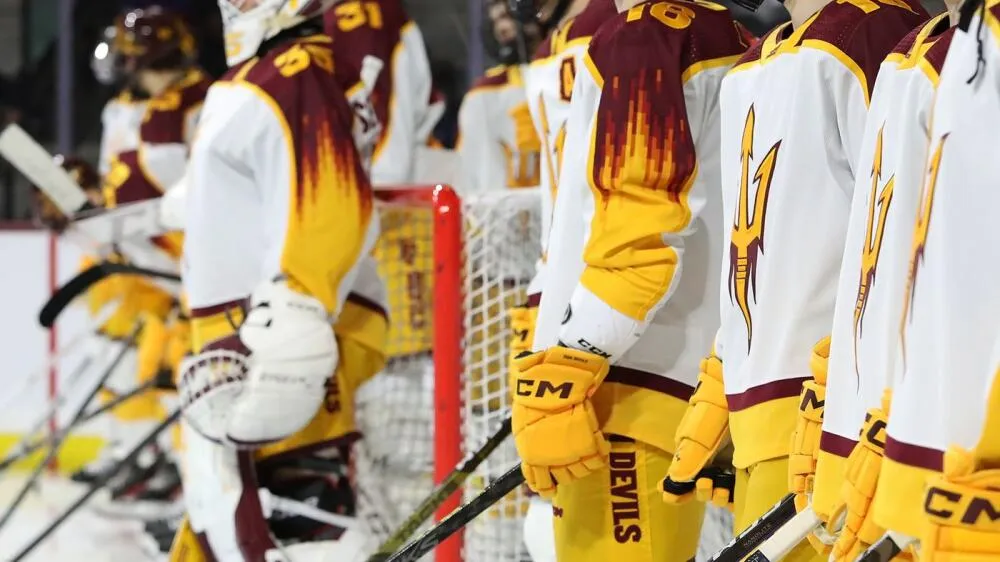
Arizona State University men’s hockey Sparky’s Notebook: breaking down the 2025-26 season start
The Sun Devils entered the 2025-26 campaign with high expectations despite last season’s controversial NCAA Tournament snub. After finishing second in the NCHC standings and falling to Denver in the conference semifinals, ASU became the first team to finish runner-up in NCHC regular-season play yet miss the NCAA Tournament—a bitter pill that has fueled this year’s hunger.
“I still don’t agree with it,” Powers stated during a preseason press conference. “Obviously, it is what it is, and we're hungrier for it, but we felt like we should have been in and been the third team in. We had a winning record against Frozen Four teams, winning record against teams in the NCAA tournament we should have been in.”
The roster transformation has been significant, with 17 new faces joining the program. This influx of talent has created both opportunities and challenges as the coaching staff works to blend veterans with newcomers. The early season schedule tested ASU immediately with a home-and-home series against No. 6 Penn State, followed by the Ice Breaker Tournament where they faced Notre Dame and Alaska Fairbanks.
After stumbling out of the gate with two losses to Penn State, the Sun Devils showed their resilience by claiming the Ice Breaker Tournament title. The victory over Alaska Fairbanks in the championship game showcased the team’s offensive firepower and ability to bounce back from adversity—traits that will prove essential in the grueling NCHC schedule ahead.
The non-conference slate represents a critical opportunity for ASU to build its NCAA Tournament resume. With games against Augustana, Ohio State, and other quality opponents, every result carries weight in the PairWise Rankings that determine postseason berths. Powers understands this reality better than anyone after last year’s disappointment.
Arizona State University men’s hockey Sparky’s Notebook: Cruz Lucius emerges as offensive catalyst
Pittsburgh Penguins prospect Cruz Lucius has transformed from injury-plagued observer to offensive dynamo in remarkable fashion. After missing much of the first half of last season with an upper-body injury that delayed his debut until January 10, the 21-year-old forward has exploded out of the gates in 2025-26 with four goals in the first four games—already doubling his two-goal output from 19 games last season.
The breakthrough came during the Ice Breaker Tournament championship game against Alaska Fairbanks, where Lucius recorded a hat trick that not only secured the tournament title but announced his arrival as a legitimate scoring threat. His confidence with the puck has been evident, particularly his willingness to shoot from distance—a weapon that has kept opposing goaltenders on their toes.
“I always feel like I can shoot the puck, and can shoot from range,” Lucius explained. “So just working on that has helped me a lot. And just like I said, four guys who I’m playing with as well as a team.”
The chemistry Lucius has developed with his linemates stems from extensive summer work and team-building activities that extended beyond the ice. The Sun Devils organized bonding opportunities, including a memorable trip to GolfLand that helped accelerate the integration of new players into the program’s culture. For Lucius, who spent much of last season watching from the stands, this offseason immersion proved invaluable.
“I think everyone being here, kind of being in and out over the summer, and being able to meet everyone, being around everyone, before school started was huge,” Lucius noted. “Just the culture thing that going into a season when you already know everyone, and you don’t really have to break that in is really, really helpful, and overall, has helped us a lot.”
His hot start has provided ASU with secondary scoring depth beyond its established stars. If Lucius can maintain even a fraction of this pace throughout the conference schedule, the Sun Devils will possess the kind of balanced offensive attack that makes them dangerous against any opponent in the NCHC.
Arizona State University men’s hockey Sparky’s Notebook: leadership takes center stage with co-captains
The Sun Devils have placed their trust in two proven leaders to guide the program through a pivotal season. Co-captains Kyle Smolen and Bennett Schimek represent the best of what ASU hockey has built—skilled, committed players who understand both the team’s potential and the work required to achieve it.
Schimek enters his final campaign after finishing last season with 37 points, just two shy of the team lead. His offensive production combined with his on-ice intelligence makes him a dual threat who can control games in multiple ways. Smolen, coming off a sixth-place finish in team scoring during his sophomore season, has established himself as a versatile forward capable of playing anywhere in the lineup and excelling in whatever role the coaching staff requires.
“I think that Shim and Smoly have done such a great job as our two captains, really bringing everyone together and making them understand what our standard is here—on and off the ice,” Powers said. “These two have set a new standard for leadership in every way. The guys are really dialed in to everything we want to do, and how we want to do it, because of them.”
The co-captains’ influence extends far beyond the locker room and practice rink. They’ve taken ownership of team culture, organizing activities and ensuring new players feel welcomed and integrated quickly. Their friendship has grown throughout the offseason, but their focus remains firmly on collective success rather than individual accomplishment.
Smolen’s willingness to embrace any role exemplifies the selflessness Powers seeks from his leaders. “I can play anywhere,” Smolen stated confidently. “I’m willing to do anything that you’re asking me. I’m going to do it at the highest level I possibly can.” That flexibility gives the coaching staff valuable lineup options and sets a tone for younger players about putting team success above personal statistics.
Schimek, meanwhile, refuses to pay much attention to preseason rankings that slotted ASU at No. 14 nationally. The underdog mentality that has defined the program since its Division I elevation remains firmly intact. “I don’t think guys put too much thought into it, just because it doesn’t really matter where we're ranked,” Schimek explained. “We believe we can win on any given night against anybody.”
Arizona State University men’s hockey Sparky’s Notebook: Cullen Potter’s sophomore surge
First-round NHL Draft picks don’t typically play college hockey in the desert, but Cullen Potter isn’t a typical player. The Calgary Flames’ selection at No. 32 overall in the 2025 NHL Draft became the highest-drafted Sun Devil in program history, cementing his status as one of college hockey’s elite young talents. Now, with one season of NCAA experience under his belt, Potter enters his sophomore campaign with elevated expectations and refined skills.
“It was unbelievable, every kid that grows up playing hockey dreams about making the NHL,” Potter reflected on draft day. “So for it to finally happen for me and my family, it was [a] speechless moment.” The moment represented validation not just for Potter but for ASU’s program—proof that elite prospects can develop in non-traditional hockey markets.
Potter’s freshman season produced 22 points while playing as a 17-year-old against competition often four or five years his senior. The physical and mental demands of college hockey tested him nightly, but he showed flashes of the elite skating and offensive instincts that attracted NHL scouts. His January birthday meant he competed as one of the youngest players in the nation, making his production all the more impressive.
Powers has noticed significant maturation in Potter’s game after one offseason of strength training and skill development. “He’s 17 when he got here, and now he acts like he’s 20, right?” Powers observed. “Lots of maturing still to do, but he’s matured a ton in every way. He’s bigger, he’s stronger, and he’s more polished.”
The physical transformation stands out most noticeably. Potter focused heavily on adding strength and improving his ability to compete in board battles and high-traffic areas. College hockey’s physicality presents challenges for younger players, particularly those with Potter’s skating style that relies on elusiveness over brute force. His improved strength should help him maintain possession under pressure and finish plays in tight spaces.
“Then, just how I play the game mentally, college hockey is faster, stronger,” Potter acknowledged. “So, continuing [to] work on all the stuff that I’m good at, and then also just my physicality and how I think the game is probably those the biggest areas I’ve improved.” The mental processing speed required at this level often separates good players from great ones, and Potter’s dedication to improving his reads and decisions could unlock another level of production.
Arizona State University men’s hockey Sparky’s Notebook: depth pieces making early impacts
While stars grab headlines, championship teams are built on depth, and ASU’s supporting cast has delivered early dividends. The so-called fourth line of Logan Morrell, Ty Nash, and Sam Alfano has arguably been the team’s most consistent unit through the opening games. Their energy, physicality, and opportunistic scoring have earned them power-play minutes—a rare distinction for bottom-six forwards that speaks to their impact.
The trio’s chemistry developed quickly, benefiting from the team’s summer bonding activities and training sessions. Their willingness to forecheck aggressively and create turnovers has generated offensive chances while providing reliable defensive zone coverage. Powers has rewarded their play with increased ice time, trusting them in critical situations.
New Jersey Devils’ 2025 second-round pick Ben Kevan wasted no time announcing his arrival, scoring his first two NCAA goals against Alaska Fairbanks during the Ice Breaker Tournament. The freshman forward brings a scoring touch that gives ASU another weapon in its offensive arsenal. His ability to find space in the offensive zone and convert chances could make him a power-play regular as the season progresses.
Jack Beck’s situation represents one of the more unusual stories in college hockey this season. The 22-year-old older brother of former Sun Devil Noah Beck joins the program after splitting last season between the Wilkes-Barre/Scranton Penguins of the AHL and the Wheeling Nailers of the ECHL. Beck’s professional experience brings a level of polish and maturity that few college players possess, but NCAA delayed enrollment rules forced him to sit out the first six games.
“The opportunity presented itself,” Powers explained about the controversial addition. “It was really unique. If it were anyone else that were in the same position, we would have said no. But because of the character we know the kid has, being close with the brother and close with the family, it was a no-brainer.” Beck’s debut looms large on the horizon, with Powers noting that “six games ago, it seemed like it was going to be 100 games. It’s because he’s such a good player and he’s such a good kid, he’s going to make such a big impact for us.”
The goaltending tandem of Connor Hasley and Samuel Urban replaced the departed Luke Pavicich and Gibson Homer duo. Hasley arrives from Bentley University with impressive credentials: a 1.96 goals-against average and .925 save percentage across 36 games last season. Urban developed in the USHL, posting a 22-15-1 record through 40 appearances. Powers has expressed confidence in both netminders, stating, “They’ve both been lights out. We have two ones back there, and they’re making each other better every day, and that’s what you want.”
Arizona State University men’s hockey Sparky’s Notebook: navigating the NCHC gauntlet
The NCHC represents one of college hockey’s most demanding conferences, having produced seven of the last nine national champions. ASU’s second season in the league brings both challenges and opportunities as they look to improve on last year’s second-place regular-season finish that somehow resulted in NCAA Tournament exclusion.
The Sun Devils enter conference play ranked fourth in the preseason NCHC poll, behind Western Michigan, Denver, and North Dakota. That placement reflects both respect for what they accomplished last season and acknowledgment that they must prove themselves again in a league with no easy nights. Every weekend brings another quality opponent, another chance to build the resume necessary for NCAA Tournament inclusion.
“There’s just no nights off,” Powers emphasized. “Anybody can beat anybody on any given night. It’s such a good League, seven of the last nine national championships, speaks for itself. We’re thrilled to be a part of it. And we still have to be hungry and prove that we can provide value to this league and continue to earn respect from the league.”
The conference schedule features multiple revenge opportunities from last season’s disappointments. Matchups against Denver—the team that ended ASU’s playoff run in the conference semifinals—carry extra weight. North Dakota, Western Michigan, and others present their own unique challenges with skilled rosters and championship pedigrees. Success in these games will determine whether the Sun Devils find themselves safely in the NCAA Tournament field or again on the outside looking in.
Home-ice advantage at Mullett Arena has proven significant for ASU, with the intimate venue creating an electric atmosphere for conference games. The Sun Devils must capitalize on those home dates while finding ways to steal points on the road in hostile environments throughout the Midwest. The travel demands of NCHC membership test teams’ depth and stamina, making every roster spot valuable.
Arizona State University men’s hockey stands at a crossroads moment in program history. The foundation has been laid, the talent assembled, and the motivation established through last season’s NCAA Tournament snub. What remains is execution—translating potential into results, converting regular-season success into postseason opportunities, and proving that desert hockey belongs among the sport’s elite programs. Sparky’s Notebook will continue documenting this journey, capturing the moments that define a season and the players who make them happen.
The Sun Devils possess the ingredients for success: veteran leadership, emerging stars, reliable depth, and a coaching staff that has navigated every challenge this program has faced. Whether those elements combine into an NCAA Tournament berth depends on dozens of individual games, countless small moments, and the relentless pursuit of excellence that Powers demands. For ASU hockey faithful, the ride promises to be thrilling, unpredictable, and potentially historic.

Par Mike Jonderson
Mike Jonderson is a passionate hockey analyst and expert in advanced NHL statistics. A former college player and mathematics graduate, he combines his understanding of the game with technical expertise to develop innovative predictive models and contribute to the evolution of modern hockey analytics.