












The St. Louis Blues quarter season roster report 2025-26 reveals a team in transition finding its identity earlier than expected. Just 22 games into the campaign, Doug Armstrong’s accelerated retool has transformed from speculation into legitimate contention, with Jim Montgomery’s squad sitting firmly in the Western Conference playoff picture. The 129-point pace that defined last season’s miraculous finish has tempered to a more sustainable rhythm, yet the underlying metrics suggest this isn’t the same Blues team that staggered through the first half of 2024-25.
A quarter-season sample size offers enough substance to evaluate individual performances while acknowledging the small-sample caveats that accompany early November hockey. The blend of established stars, emerging youth, and strategic veteran additions has created perhaps the deepest Blues roster since their 2019 championship run, though questions persist about whether they possess enough elite-tier talent to make genuine noise in a loaded Central Division.
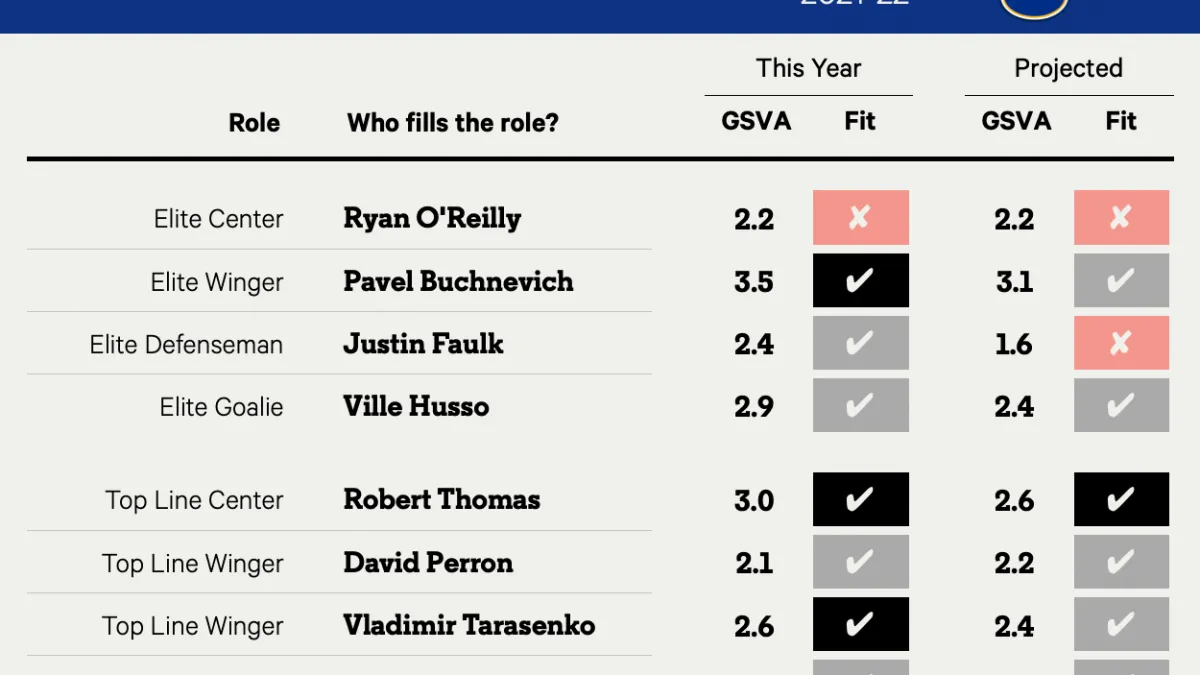
Offensive core showing early promise
Robert Thomas has continued his evolution from promising two-way center to legitimate franchise cornerstone through the opening quarter. Averaging just over a point per game, Thomas sits on pace for another 80-plus point campaign, though his underlying possession numbers have dipped slightly from last season’s torrid finish. The challenge has been maintaining production while facing opponents’ top checking lines nightly—a responsibility he’s embraced with the quiet confidence that’s defined his maturation.
Jordan Kyrou remains the offensive engine, his 10 goals in 22 games putting him on track for his first 40-goal season. The concerning inconsistency that plagued previous seasons appears to be smoothing out, thanks largely to the stability Dylan Holloway provides on his opposite wing. No longer forced to create offense in isolation, Kyrou’s explosive skating and shot have found synergy with Holloway’s power-forward approach and Brayden Schenn’s veteran playmaking. As one scout noted recently, “Kyrou looks like a player who finally understands how his speed fits into a five-man system rather than just trying to outskate everyone.”
Pavel Buchnevich’s $8 million cap hit drew scrutiny when his production plateaued last season, but the Russian winger has responded with renewed purpose. His 16 points through 22 games don’t jump off the page, but his defensive commitment and ability to elevate rookie linemate Jimmy Snuggerud have justified Montgomery’s faith in keeping the top line intact. Snuggerud, the highly anticipated 2022 first-round pick, hasn’t overwhelmed but his eight points and responsible two-way play suggest the Blues were wise to bring him along slowly rather than forcing top-line minutes he wasn’t ready for.
The wildcard has been Jake Neighbours, who Montgomery has shuffled between the first line safety net and second line catalyst role. His 15 points reflect a player who has learned to produce without the puck on his stick, complementing his natural scoring touch with the board work and defensive awareness that earned him Montgomery’s trust during last season’s playoff push.
Mid-season forward depth transformation
The story of the Blues’ early success lies in their transformed bottom six, a group that has gone from liability to legitimate weapon. Pius Suter has been the revelation Armstrong envisioned when he signed the former Canuck to a team-friendly $4.5 million AAV deal. His 12 points and 52% faceoff percentage have solidified the third line while providing insurance for a middle six that suddenly looks remarkably deep. Suter’s cerebral two-way game has allowed Montgomery to deploy his third line in any situation, freeing up the top six for more offensive zone starts.
Dylan Holloway’s emergence continues to validate one of hockey’s most aggressive offer sheet gambits. The former Oiler has translated his 63-point breakout into early season dominance, his combination of size (6’1”, 203 lbs), speed, and skill creating headaches for opposing defenders. Holloway’s 165 hits last season suggested a player willing to engage physically, but his ability to convert that aggression into puck possession has been the real development. His chemistry with Kyrou and Schenn has given the Blues a legitimate second scoring line, something they sorely lacked during their retool years.
Nick Bjugstad’s comeback story has provided the feel-good narrative for a team still searching for its identity. The 6’6” center’s offseason back surgery limited him to just 12:19 of ice time per game in Utah last season, but Montgomery has gradually increased his role as his conditioning has improved. His four goals and defensive reliability have made him an invaluable fourth-line center and penalty kill specialist, living up to the two-year deal Armstrong offered based on his 45-point season in Arizona two years ago.
The depth chart flexibility extends to Mathieu Joseph and Alexey Toropchenko, both of whom have accepted reduced roles without complaint. Their willingness to rotate in and out of the lineup based on matchups exemplifies the team-first culture Montgomery has cultivated. As Joseph told reporters after a recent win, “Everyone has a role, and when your number’s called, you just go out and execute. No one cares about ice time when you’re winning.”
Defensive corps blending youth and experience
Cam Fowler and Colton Parayko have formed one of the league’s most effective top pairs, their 63.27% goal share in 34 games together last season showing no signs of regression. Fowler’s acquisition from Anaheim has proven the perfect complement to Parayko’s defensive dominance, the veteran’s ability to join the rush creating the offensive support Parayko never consistently received from previous partners. Parayko’s 16 goals in 64 games last season represented a career high, and his four goals through 22 games suggest that offensive awakening was no fluke.
Philip Broberg’s development has been perhaps the most encouraging defensive storyline. The Oilers castoff has seized top-four minutes with the confidence of a player who understands this is his last chance to prove first-round pedigree. His eight points and plus-7 rating reflect a player who has combined his natural skating ability with the positional discipline that eluded him in Edmonton. Broberg’s 20:30 average time on ice ranks third among Blues defensemen, a workload he’s earned through consistent two-way play rather than necessity.
The most intriguing dynamic involves Logan Mailloux and the diminishing role of Justin Faulk. Mailloux, acquired at the cost of popular winger Zack Bolduc, has shown flashes of the high-end talent that made him a first-round pick, but defensive lapses have kept his ice time sheltered. His three goals in limited action demonstrate the offensive upside, yet Montgomery’s trust remains measured. This has created a veteran-rookie subplot where Faulk’s 33-year-old legs and occasional turnovers have fans clamoring for Mailloux to take his spot. Faulk’s two points and minus-4 rating through 22 games have justified those concerns, though his 1,700 games of experience still provide value in penalty kill situations.
The penalty kill remains the Blues’ Achilles heel, ranking 27th in the league at 74.2% despite Montgomery’s emphasis on defensive structure. Mike Weber’s work as PK coach has shown incremental improvement, but the underlying issues—poor lane discipline and inconsistent goaltending on the kill—persist. As Steven Ellis noted in his recent analysis, “The Blues have the personnel to be better shorthanded; the question is whether the system can evolve quickly enough to salvage what could be a special season.”
Goaltending tandem providing stability
Jordan Binnington’s renaissance has continued into the new season, his .915 save percentage and 2.58 GAA representing his best start since the championship year. The 31-year-old’s performance at the 4 Nations Face-Off, where he outdueled Connor Hellebuyck in the gold medal game, seems to have carried over into the regular season. Binnington’s quality start percentage of .618 ranks among the league’s top 10, and his ability to steal games—like his 38-save shutout against Colorado in game 15—has masked some of the Blues’ defensive inconsistencies.
Joel Hofer has proven the ideal backup, his 6’5” frame and technical proficiency providing stability when called upon. With a 2.65 GAA and .909 save percentage in limited action, Hofer has earned Montgomery’s trust to start back-to-back games and handle heavy workloads when Binnington needs rest. His $3.4 million AAV extension through 2027 looks increasingly team-friendly as the cap continues to rise.
The concern lies in workload management. Binnington has started 17 of 22 games, a pace that would give him 63 starts over a full season—precisely what the Blues want to avoid given his injury history. Montgomery’s reluctance to use Hofer more frequently may cost the team later if Binnington wears down. As the coach admitted after a recent overtime win, “When Binner’s playing like this, you want him in there. But we’ve got to be smart. January and February are coming, and we need him fresh.”
Roster management and future outlook
Doug Armstrong’s aggressive retooling strategy has positioned the Blues as a model for how to rebuild on the fly without suffering through a traditional tank. The offer sheet gambit for Holloway and Broberg, the Fowler trade, and the Suter signing have all paid dividends while maintaining enough cap flexibility for future moves. With just under $2 million in current space and several expiring contracts after this season, Armstrong has options at the trade deadline.
The prospect pipeline offers intriguing possibilities should the Blues need reinforcements. Justin Carbonneau has dominated junior hockey since being sent back after an impressive training camp, and whispers suggest he could be an emergency call-up if injuries strike the forward group. Dalibor Dvorsky continues his apprenticeship in Springfield, his 21 goals and 45 points in 61 AHL games last season suggesting NHL readiness isn’t far off. Otto Stenberg remains further down the depth chart, but his development bears monitoring.
The internal competition has created healthy pressure throughout the organization. As Montgomery noted in a recent press conference, “When you have kids pushing from below and veterans fighting to keep their spots, everyone elevates their game. That’s how you build a culture.” That culture will be tested as the schedule intensifies and the playoff picture comes into sharper focus.
Conclusion
The St. Louis Blues quarter season roster report 2025-26 reveals a team that has successfully navigated the delicate balance between contending now and building for the future. With 60 games remaining, the foundation appears solid enough to weather the inevitable regression from their league-leading PDO, but the margin for error remains slim in the Central Division. The Blues’ ability to maintain their early success likely hinges on whether Mailloux can wrestle a larger role from Faulk, whether the penalty kill can climb from the league’s basement, and whether Montgomery can resist overworking Binnington. For a franchise that looked directionless just 18 months ago, these are champagne problems—evidence that Armstrong’s accelerated retool may have produced a contender sooner than anyone dared hope. The next 20 games will determine whether this start represents sustainable progression or another false dawn in the post-Berube era.
Frequently Asked Questions

Par Mike Jonderson
Mike Jonderson is a passionate hockey analyst and expert in advanced NHL statistics. A former college player and mathematics graduate, he combines his understanding of the game with technical expertise to develop innovative predictive models and contribute to the evolution of modern hockey analytics.