






The Blues’ defensive zone coverage has deteriorated significantly during this losing streak. Breakdowns in communication between defensive pairs have led to odd-man rushes and high-danger scoring chances that opposing teams have exploited with ruthless efficiency. The mixing and matching of defensive pairings has created uncertainty about assignments and responsibilities, leaving players out of position at crucial moments.
Philip Broberg, who was expected to provide stability after arriving via trade, has been shuffled between multiple partners. Tyler Tucker has found himself paired with Justin Faulk, Colton Parayko, and Logan Mailloux at various points, creating a lack of chemistry that’s evident in the team’s defensive zone play. This constant rotation has prevented players from developing the instinctive understanding necessary to defend effectively at the NHL level.
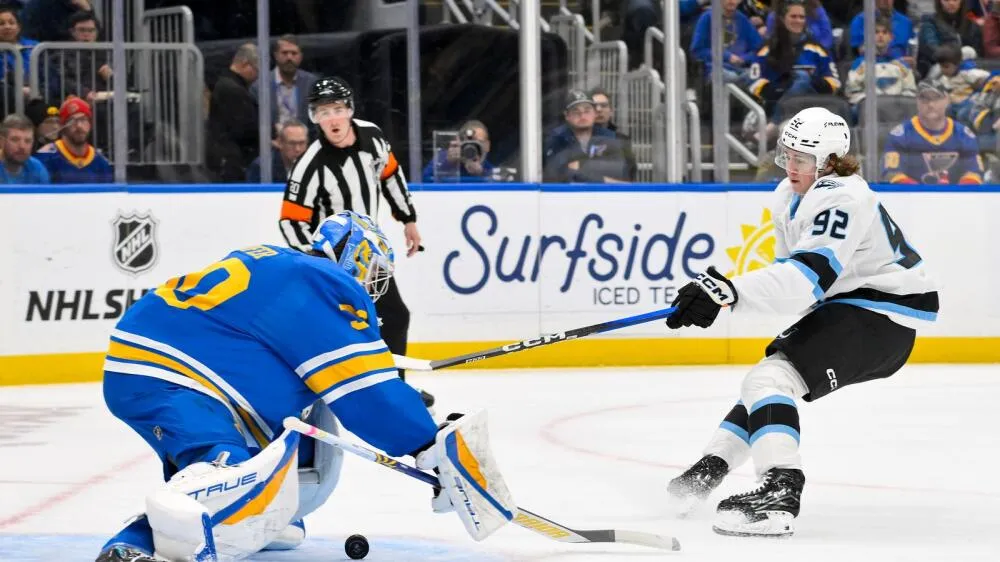
How the St. Louis Blues three-game losing streak exposed defensive flaws and Binnington struggles in critical situations
The Blues’ defensive zone coverage has deteriorated significantly during this losing streak. Breakdowns in communication between defensive pairs have led to odd-man rushes and high-danger scoring chances that opposing teams have exploited with ruthless efficiency. The mixing and matching of defensive pairings has created uncertainty about assignments and responsibilities, leaving players out of position at crucial moments.
Philip Broberg, who was expected to provide stability after arriving via trade, has been shuffled between multiple partners. Tyler Tucker has found himself paired with Justin Faulk, Colton Parayko, and Logan Mailloux at various points, creating a lack of chemistry that’s evident in the team’s defensive zone play. This constant rotation has prevented players from developing the instinctive understanding necessary to defend effectively at the NHL level.
The numbers tell a damning story. During the three-game slide, the Blues have been outscored by significant margins, allowing opponents to generate quality chances with alarming frequency. Teams have found success attacking the Blues’ defensive zone with speed, exploiting gaps in coverage and capitalizing on hesitant decision-making. The defense has struggled to clear the crease, allowing opposing forwards to establish net-front presence without consequence.
Defensive breakdowns have been particularly evident during transition play. The Blues have struggled to manage the neutral zone, allowing opposing teams to enter the offensive zone with speed and control. Once established in the defensive zone, St. Louis defenders have been slow to recover positions, creating seams that skilled opponents have eagerly exploited. The lack of physicality in clearing the crease has compounded these issues, giving goaltenders little support when they need it most.
The troubling decline of Jordan Binnington amid St. Louis Blues three-game losing streak and defensive flaws
Jordan Binnington’s performance during this stretch has been a major concern for Blues management and fans alike. The veteran goaltender, who has been the backbone of this franchise since his memorable 2019 Stanley Cup run, has posted subpar numbers that suggest he’s fighting the puck. His .885 save percentage through the early portion of the season ranks among the worst for starting goaltenders in the NHL, and his 2.75 goals-against average indicates he hasn’t provided the timely saves necessary to keep his team competitive.
The eye test confirms what the statistics suggest. Binnington has struggled with rebound control, allowing second and third opportunities that have resulted in goals. His positioning has been inconsistent, particularly on cross-ice passes where he’s been caught leaning or out of position. On several occasions during the losing streak, Binnington has surrendered soft goals that have deflated his team’s momentum and put them in early holes from which they couldn’t recover.
What’s particularly concerning is the timing of these struggles. Binnington allowed early goals that forced his team into comeback mode, a situation that amplifies every defensive mistake and creates additional pressure. According to reports from The Athletic, head coach Jim Montgomery has expressed confidence in Binnington’s abilities and mental toughness, but the results haven’t matched those expectations. The goaltender was pulled during a game against Vancouver after surrendering goals at critical moments.
The backup situation with Joel Hofer hasn’t provided much relief either. Hofer has also struggled with early goals, including allowing scores on opponents’ first few shots in multiple games. His .643 save percentage since a strong performance against Calgary represents a dramatic fall from grace. This lack of reliable goaltending depth has forced Montgomery to potentially lean more heavily on Binnington, despite his own inconsistencies. The absence of a trustworthy third goaltender option—after Colten Ellis was claimed on waivers—leaves the Blues with limited alternatives when confidence begins to waver between the pipes.
Special teams failures compound St. Louis Blues three-game losing streak, defensive flaws, and Binnington struggles
The power play’s inability to generate dangerous chances has been particularly frustrating. As documented by Bleeding Blue, the Blues converted just one of eight power play opportunities during the three-game losing streak. Their season-long power play percentage of 18.8 percent ranks 24th in the NHL, and they’ve managed only 22 power play goals through their first stretch of games.
The root of the power play struggles lies in predictable execution and a lack of shooting mentality. Players are trying to make one too many passes, attempting to create the perfect scoring chance rather than generating chaos and traffic around the opposing net. Pavel Buchnevich acknowledged this tendency, stating after a recent loss: “We’ve got to shoot more. I feel like we sometimes we try to pass (the puck) into the net. We have to shoot more pucks, and get more chaos around the net.”
Coach Jim Montgomery identified another critical issue with the power play: convergence at the net. “We’re not converging at the net. That’s what I’m seeing,” Montgomery explained. “Our eyes aren’t on the goaltender. They’re on the next pass. So if you’re converging at the net, good things are going to happen because you can outnumber people at the net, usually. And right now we’re getting the puck and we’re coming away from the net.”
The penalty kill has been equally problematic during this stretch. The Blues allowed four goals on seven penalty kill opportunities during the three-game losing streak, an unacceptably high rate that has cost them victories. Even more troubling, they surrendered a shorthanded goal to Vancouver, further highlighting the lack of defensive structure and awareness. When opposing teams feel comfortable attacking while down a man, it speaks to fundamental breakdowns in the Blues’ defensive system.
These special teams failures have a cascading effect on the team’s overall performance. Failed power plays deflate momentum and waste opportunities to build leads. Penalty kill breakdowns force the team into deficit situations that require perfect execution to overcome. Combined with the defensive struggles at even strength and inconsistent goaltending, the special teams woes have created a situation where the Blues need near-perfect play in multiple areas simultaneously just to remain competitive.
Offensive production disappears during St. Louis Blues three-game losing streak alongside defensive flaws and Binnington struggles
The Blues’ offensive struggles during this losing streak extend beyond special teams. Their top players have failed to generate consistent production, leaving the team without the firepower necessary to overcome defensive lapses. Robert Thomas, Jordan Kyrou, Dylan Holloway, and Pavel Buchnevich have each scored just one goal through the season’s opening games, a collective drought that has starved the team of offensive momentum.
The lack of scoring from star players creates a domino effect throughout the lineup. When your top-six forwards aren’t producing, depth players feel additional pressure to contribute beyond their capabilities. This often leads to forced plays, poor shot selection, and turnovers that fuel opposition counterattacks. The Blues have found themselves unable to establish sustained offensive zone pressure, settling for perimeter shots rather than driving to high-danger areas.
First period performance has been particularly anemic. The Blues have managed just three goals on 45 shots through the first period of their seven games this season. They’ve scored the opening goal in only two games, forcing them to play from behind in most contests. As Buchnevich noted: “It’s not easy chasing the game all the time. We have to start on time and try to score first goal.”
Montgomery has been equally direct about his team’s slow starts, stating: “We’ve played seven games and five (first periods) have been not good enough.” This pattern of falling behind early combines disastrously with the defensive and goaltending issues, creating holes that prove impossible to overcome. Even when the Blues have mounted comeback attempts, the energy expended chasing deficits leaves them vulnerable to additional defensive breakdowns late in games.
The line combinations have been shuffled repeatedly in search of chemistry, but this tinkering has prevented players from developing the familiarity necessary for consistent production. Offensive zone entries have lacked creativity, with predictable patterns allowing opponents to key on the Blues’ tendencies. Without a legitimate scoring threat from multiple lines, opposing defenses can focus their attention on neutralizing St. Louis’ top players, further suppressing offensive output.
Finding solutions: what must change for the St. Louis Blues to overcome three-game losing streak, defensive flaws, and Binnington struggles
The path forward requires immediate and decisive action from the coaching staff and players. Defensively, the Blues must commit to a stable set of pairings that allows players to develop chemistry and understanding. The constant shuffling has created confusion that manifests in breakdowns. Identifying the most effective combinations and sticking with them through adversity will be essential for rebuilding defensive confidence.
Binnington needs to rediscover his game, and that may require a temporary reduction in workload. However, with Hofer also struggling, Montgomery faces a difficult decision. The coaching staff must work with Binnington on his positioning and rebound control, addressing the technical issues that have led to soft goals. Mental reset may be equally important—Binnington has always played with confidence bordering on arrogance, and recapturing that swagger could prove as valuable as any technical adjustment.
The team’s approach to defensive zone coverage must be simplified. When structures become too complex, players begin thinking rather than reacting. Establishing clear responsibilities for each position, emphasizing gap control in the neutral zone, and demanding physicality in front of the net will help stem the tide of goals against. The Blues succeeded last season with straightforward, aggressive defensive play, and returning to those principles makes sense.
Special teams require immediate attention and potentially personnel changes. The power play needs shooters who are willing to fire pucks on net from dangerous areas, creating rebounds and chaos rather than searching for the perfect passing play. The penalty kill must be more aggressive, pressuring puck carriers and denying clean zone entries. These adjustments don’t require elaborate new systems—they demand commitment to fundamental principles.
Offensively, the Blues must prioritize getting to the net and generating second-chance opportunities. The skill is present on this roster, but skill alone doesn’t produce wins. Star players must embrace a more direct approach, attacking defenders one-on-one and creating space for linemates. Establishing a forecheck that creates turnovers and extended offensive zone time will generate the volume of chances necessary to support inconsistent goaltending.
The psychological component cannot be ignored. Montgomery’s message about improving intensity and playing with desperation must resonate throughout the locker room. Veteran leaders need to set the tone with their play and hold teammates accountable. The Blues have shown resilience in comebacks during recent losses, but channeling that determination from the opening faceoff rather than after falling behind will be critical.
The road ahead presents opportunity alongside challenge. With several games away from home approaching, the Blues have a chance to reset away from the pressures of Enterprise Center, where they’ve struggled mightily this season with a 1-3-1 record. However, geographical changes alone won’t solve fundamental issues with execution and commitment. This team must decide what identity it wants to establish—will they be the resilient, defensively sound group that dominated at home last season, or will they continue down a path of inconsistency that threatens their playoff aspirations?
The three-game losing streak has revealed uncomfortable truths about the Blues’ current construction and performance. Defensive flaws, Binnington’s struggles, special teams failures, and offensive droughts have combined to create a crisis of confidence. The talent exists within this roster to correct course, but talent without execution is merely potential wasted. How the Blues respond to this adversity will define their season and determine whether they can recapture the form that made them one of the league’s most dangerous teams just months ago. The margin for error has evaporated, and every game now carries heightened significance as the Blues fight to salvage their season before the hole becomes too deep to escape.

Par Mike Jonderson
Mike Jonderson is a passionate hockey analyst and expert in advanced NHL statistics. A former college player and mathematics graduate, he combines his understanding of the game with technical expertise to develop innovative predictive models and contribute to the evolution of modern hockey analytics.