






The Toronto Maple Leafs entered the 2025-26 season with high expectations, boasting one of the most talented offensive rosters in the NHL. Yet through the early portion of the campaign, one glaring weakness has emerged that threatens to derail their championship aspirations: a power play that has gone from elite to ineffective. Currently ranked 30th in the league with a dismal 12.1% conversion rate, Toronto’s special teams struggles represent a dramatic fall from grace for a unit that finished 8th last season with a 24.8% success rate.
The contrast between the Leafs’ dominant five-on-five play and their anemic power play performance has created a puzzling disconnect. While Toronto generates offense with ease at even strength, their man-advantage units have sputtered, managing just four goals through their first 13 games. This alarming drop-off has forced head coach Craig Berube to tinker with personnel, shuffle line combinations, and search for answers to a problem that shouldn’t exist for a team with this much offensive firepower.
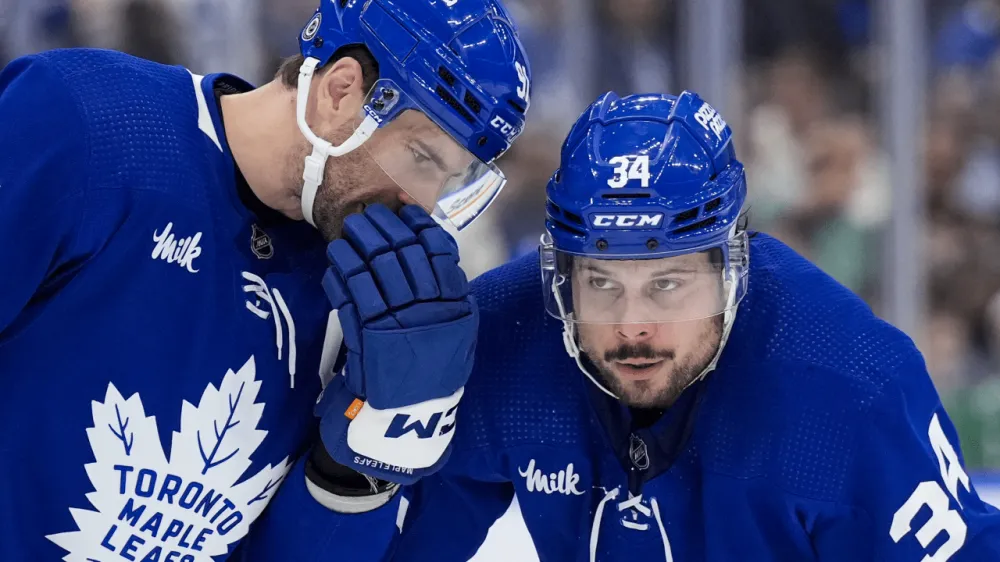
The statistical reality of Toronto Maple Leafs 2025-26 power play struggles
The numbers paint a troubling picture for Toronto’s special teams. Beyond the league-worst conversion percentage, the Leafs rank 24th in shot attempts during 5-on-4 situations according to MoneyPuck data, indicating that the problem extends far beyond shooting percentage variance. The team simply isn’t generating enough dangerous opportunities when they have the extra attacker.
Last season, Toronto converted on nearly one-quarter of their power play chances, a mark that placed them comfortably among the NHL’s elite. That unit featured Mitch Marner as the primary facilitator, who accumulated 33 power play points and was directly involved in 61% of the team’s man-advantage goals. His departure to free agency left a massive void that the organization hoped their remaining stars could collectively fill.
Through the season’s opening weeks, only five Leafs players have registered power play points. Oliver Ekman-Larsson, John Tavares, William Nylander, and Matthew Knies each have two points, while Auston Matthews has managed just one. For a team that features multiple elite offensive weapons, this production is simply unacceptable. The shooting percentages for key players have plummeted compared to their career norms, suggesting a combination of bad luck and systemic issues.
The eye test confirms what the statistics reveal. Toronto struggles to establish clean zone entries, execute crisp passes through defensive structures, and create the high-danger chances that characterized their power play success in previous seasons. Pucks are hitting sticks instead of finding tape, and the unit appears to be searching for the perfect play rather than generating volume and chaos around the opposing net.
Personnel changes and the Oliver Ekman-Larsson experiment
Faced with mounting frustration, Berube made a significant change to his top power play unit by replacing Morgan Rielly with Oliver Ekman-Larsson as the quarterback. The decision represents more than just a simple swap—it signals a philosophical shift in how Toronto wants to operate with the man advantage.
Rielly has long served as the primary point man on Toronto’s power play, a role that leveraged his puck-moving abilities and offensive instincts from the blue line. However, his production and effectiveness have waned in recent seasons, and the coaching staff determined that a fresh look might provide the spark needed to reignite the unit. Rielly now mans the point on the second power play group, where he’ll have opportunities to prove he deserves another shot with the top talent.
Ekman-Larsson brings a different skill set to the role. John Tavares publicly endorsed the change, citing the veteran defenseman’s puck-handling abilities and hockey sense as qualities that could benefit Toronto’s transition game. The hope is that Ekman-Larsson’s ability to process the ice and make quick decisions will help the unit move the puck more efficiently and generate better scoring opportunities.
The experiment debuted against the Utah Mammoth, giving the organization its first opportunity to evaluate whether this configuration could unlock better results. While one game provides insufficient data to draw conclusions, the willingness to make such a significant change demonstrates that management recognizes the urgency of fixing this critical weakness. Similar power play struggles have plagued other NHL teams this season, suggesting league-wide adjustments may be impacting special teams success rates.
Beyond the defensive rotation, Berube has also experimented with forward combinations. Easton Cowan and Max Domi both received auditions on the first unit in an attempt to add different elements and create mismatches. However, the coaching staff ultimately determined that concentrating their top offensive talent on one unit provided the best chance for success, even if early results haven’t validated that approach.
The Mitch Marner factor in Toronto Maple Leafs 2025-26 power play struggles
It’s impossible to discuss Toronto’s power play woes without addressing the elephant in the room: the absence of Mitch Marner. While attributing all of the unit’s struggles to one player’s departure oversimplifies a complex issue, his impact on last season’s success cannot be ignored.
Marner’s elite vision, passing ability, and feel for the game made him one of the NHL’s premier power play facilitators. Operating from the half-wall or bumper position, he possessed an uncanny ability to find seams in defensive structures and deliver pucks to teammates in scoring positions. His quick hands and processing speed allowed Toronto’s power play to operate at a tempo that defenses struggled to match.
Beyond the raw statistics—those 33 power play points and involvement in 61% of goals—Marner provided something more subtle but equally valuable. He created time and space for his teammates through deception and manipulation of penalty killers. Defenders had to respect his shot, his passing options, and his ability to carry the puck into dangerous areas, which opened opportunities throughout the offensive zone.
Video coach Steve Peters acknowledged Marner’s impact when discussing the team’s struggles, noting that the departed winger was able to make those quick plays at the net and delivered the puck from the top of the zone at an elite level. The question now facing Toronto is whether they can replicate that production through a committee approach or if the loss of such a dynamic playmaker represents an insurmountable challenge.
Matthew Knies has assumed a larger role on the top unit in Marner’s absence, but he brings a different skill set to the position. While Knies excels at net-front presence and finishing, he doesn’t possess Marner’s playmaking wizardry. This has forced Toronto to adjust how they generate offense with the extra attacker, a transition that has proven more difficult than anticipated.
Execution breakdowns and systemic issues
The personnel changes tell only part of the story behind Toronto’s power play collapse. According to Peters’ film breakdown, execution problems have plagued the unit from the start of the season. Players are attempting to thread passes through multiple sticks rather than making simpler plays that prioritize possession and puck movement.
They’re trying to make plays through sticks, and they’re not connecting on those, Peters explained on Daily Faceoff Live. You’re looking for plays trying to get through three sticks, looking for that perfect play. They’ve got to get more shots on net than they’re getting right now.
This observation highlights a fundamental issue: Toronto’s power play has become too predictable and too perfect. Rather than creating chaos through volume and overwhelming opponents with multiple threats, the unit is searching for the ideal passing sequence that threads every needle and produces a tap-in goal. When those precision plays don’t materialize—and against NHL penalty killers, they rarely do—the Leafs end up with nothing to show for their opportunities.
The transition game has also suffered significantly. Zone entries have become labored affairs, with opponents collapsing quickly and forcing Toronto to retreat and regroup. Once set up, the puck movement lacks the crispness and urgency that characterized more successful iterations of this power play. Defensemen can read the plays developing, close passing lanes, and force the Leafs into low-percentage attempts or turnovers at the blue line.
Shot volume statistics underscore these systemic problems. Ranking 24th in shot attempts during 5-on-4 situations indicates that Toronto isn’t even generating the quantity necessary to overcome a poor shooting percentage. While Peters noted that shooting percentages for Matthews, Tavares, and Knies have all declined and should regress toward career norms, you can’t score if you don’t shoot. Teams across the league, including those experiencing similar special teams difficulties, have found success by prioritizing volume and net-front traffic over elaborate passing plays.
Health concerns and roster disruptions
While execution and personnel adjustments dominate the discussion around Toronto’s power play struggles, injuries have also played a contributing role. William Nylander missed three games during the early season stretch, while Morgan Rielly sat out one contest. These absences disrupted the unit’s rhythm and prevented the coaching staff from establishing consistent line combinations.
Nylander’s elite shooting ability makes him one of Toronto’s most dangerous power play weapons. His capacity to score from distance forces penalty killers to respect him as a threat, which opens opportunities for his teammates. Without him in the lineup, the power play loses one of its primary finishing options and a player whose mere presence warps defensive coverage.
Rielly’s absence, though briefer, removed the primary quarterback just as the unit was attempting to find its identity. While he ultimately lost his spot on the top unit to Ekman-Larsson, his missed game prevented any semblance of continuity during a crucial period when the power play desperately needed repetitions to build chemistry.
Peters acknowledged these challenges when noting that you’re missing the core of your top unit during key stretches. However, he also emphasized that health concerns don’t fully excuse the level of dysfunction on display. This team is just too good on the power play to let that happen, Peters stated, suggesting that the talent level should allow Toronto to produce better results even when slightly undermanned.
As the team gets healthier and players return to full strength, the hope is that increased practice time and game repetitions will allow the units to develop the timing and chemistry necessary for success. However, health alone won’t solve all of Toronto’s power play problems—fundamental improvements in approach, execution, and mentality will be required to turn this weakness into a strength.
The path forward and reasons for optimism
Despite the alarming statistics and concerning trends, there are reasons to believe Toronto’s power play will improve as the season progresses. The talent level remains elite, and variance plays a significant role in small sample sizes. With proper adjustments and continued work, this unit should eventually produce results more consistent with the roster’s capabilities.
Peters expressed confidence in the eventual turnaround, noting that the players are just too good for the current struggles to continue indefinitely. Shooting percentages will normalize, chemistry will develop, and the execution issues that have plagued the unit should diminish through repetition and refinement. The question isn’t whether Toronto’s power play will improve, but rather how much and how quickly.
The Ekman-Larsson change represents a positive step forward, demonstrating that Berube and his staff are willing to make difficult decisions in pursuit of better results. If the veteran defenseman can provide better puck movement and transition play, it could unlock the offensive potential that currently sits dormant. Even if he ultimately isn’t the long-term answer, the willingness to experiment and adjust provides multiple paths toward improvement.
Toronto must also simplify its approach on the man advantage. Rather than searching for the perfect play, the unit needs to embrace a shoot-first mentality that prioritizes getting pucks to the net and creating second-chance opportunities. Net-front presence, deflections, and scrambles might not be as aesthetically pleasing as tic-tac-toe passing sequences, but they produce goals against NHL penalty killers.
The upcoming weeks will prove crucial for Toronto’s power play development. As health improves and the season progresses, the unit will have opportunities to build momentum and establish an identity. Success on special teams could be the difference between a first-round playoff exit and a deep run, making this arguably the most important area of focus for Berube’s coaching staff. Whether the adjustments prove sufficient to overcome Mitch Marner’s departure remains the central question facing this talented but flawed roster.
The Toronto Maple Leafs possess too much offensive firepower to remain this ineffective with the man advantage. As the personnel adjustments take hold and the execution improves through repetition, expect better results in the coming months. The real test will be whether they can elevate their power play to championship-caliber levels—or if this weakness will ultimately prove their undoing when the games matter most. For detailed analysis of similar issues across the league, Daily Faceoff provides comprehensive coverage of special teams trends and potential solutions.

Par Mike Jonderson
Mike Jonderson is a passionate hockey analyst and expert in advanced NHL statistics. A former college player and mathematics graduate, he combines his understanding of the game with technical expertise to develop innovative predictive models and contribute to the evolution of modern hockey analytics.