









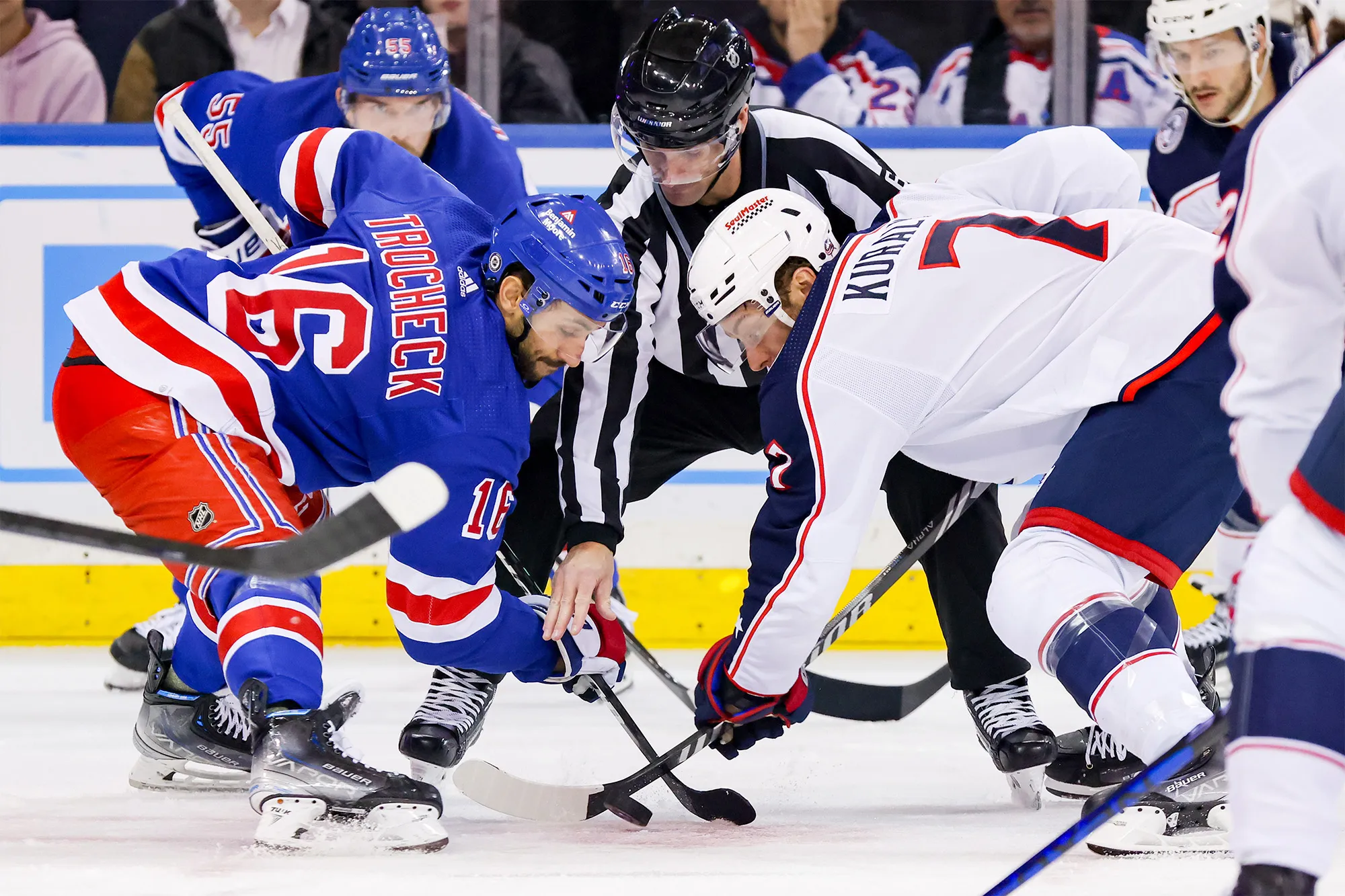
Vincent Trocheck, at 32 years old, finished the 2025-26 season with 53 points in 67 games and led qualified skaters in faceoff percentage at 56.9 percent.
Trocheck’s Statistical Profile
Trocheck skated 20:33 per game on average across those 67 appearances while posting a minus-16 rating. His 16 goals and 37 assists produced 53 points, numbers that placed him in the middle of the forward pack yet masked his specialized contributions on draws and the penalty kill. Rangers management scratched him before the trade deadline in part to manage roster protections, a decision that kept his name at the top of internal trade boards for most of the year.
Those raw totals contrast with his advanced metrics on the dot, where he converted 56.9 percent of faceoffs among players with heavy volume. The same player who won Olympic gold for Team USA in 2022 also anchored special-teams units that limited opponents to low conversion rates on the power play. Scouts note that his 1,099 faceoff wins this season ranked among the highest single-year totals in recent Rangers history.
The gap between his point production and his underlying impact explains why contending clubs view him as a plug-and-play upgrade rather than a long-term cornerstone. At 32 he still logs top-six minutes without the durability concerns that sideline younger players late in seasons. That profile creates a narrow but valuable market window before his contract structure forces harder decisions.
Interest from Multiple Clubs
The Leafs already placed an early call during the season, according to reports on The Chris Johnston Show. Minnesota had shown concrete deadline interest centered on prospects and a first-round pick, only to see the Rangers hold firm on price. Montreal now surfaces as another candidate because its center depth remains thin behind established names, a shortfall exposed during the recent Eastern Conference Final run.
Johnston observed that good teams across the league see Trocheck as a player who can immediately slot into a lineup and handle multiple roles. The Wild, Leafs and Canadiens represent the most discussed names, yet Johnston added that additional clubs outside the traditional deadline buyer pool could enter once unrestricted movement begins. That expansion of the buyer list stems directly from Trocheck’s ability to perform faceoff, penalty-kill and middle-six duties without requiring a top-line salary commitment.
Rangers general manager Chris Drury declined to move Trocheck at the deadline because offers fell short of New York’s valuation. The bet inside the organization was that more teams would surface during the summer when playoff pressure eases and roster planning accelerates. That calculation now appears validated by Seravalli’s initial offseason trade board, which ranked Trocheck among the top available centers.
Rangers’ Offseason Calculus
Holding Trocheck past the deadline preserved cap flexibility while testing whether his market would grow. The Rangers absorbed a minus-16 rating and modest point total because the alternative—a forced sale at a discount—would have yielded fewer assets than a summer auction can generate. Drury’s patience now positions the club to receive calls from both rebuilding and contending sides, a dynamic that increases leverage.
Any deal will require a fair price, Johnston emphasized, because Trocheck’s resume includes Olympic success, consistent faceoff leadership and proven playoff contributions. Teams that acquire him must weigh immediate production against the reality that he turns 33 during the 2026-27 campaign. That tension explains why the Rangers expect multiple conversations rather than a single quick transaction.
The widening pool of interested parties also reflects Trocheck’s positional value at a moment when several clubs seek experienced centers who can stabilize bottom-six or middle-six groups without blocking younger talent long-term. Montreal’s recent playoff shortcomings illustrate the type of gap Trocheck could address, while Toronto’s need to regain competitiveness mirrors the win-now profile Johnston described.
The first trade call for Trocheck will arrive within two weeks of the 2026 NHL Draft on June 26.
Frequently Asked Questions
Sources

Par Mike Jonderson
Mike Jonderson is a passionate hockey analyst and expert in advanced NHL statistics. A former college player and mathematics graduate, he combines his understanding of the game with technical expertise to develop innovative predictive models and contribute to the evolution of modern hockey analytics.