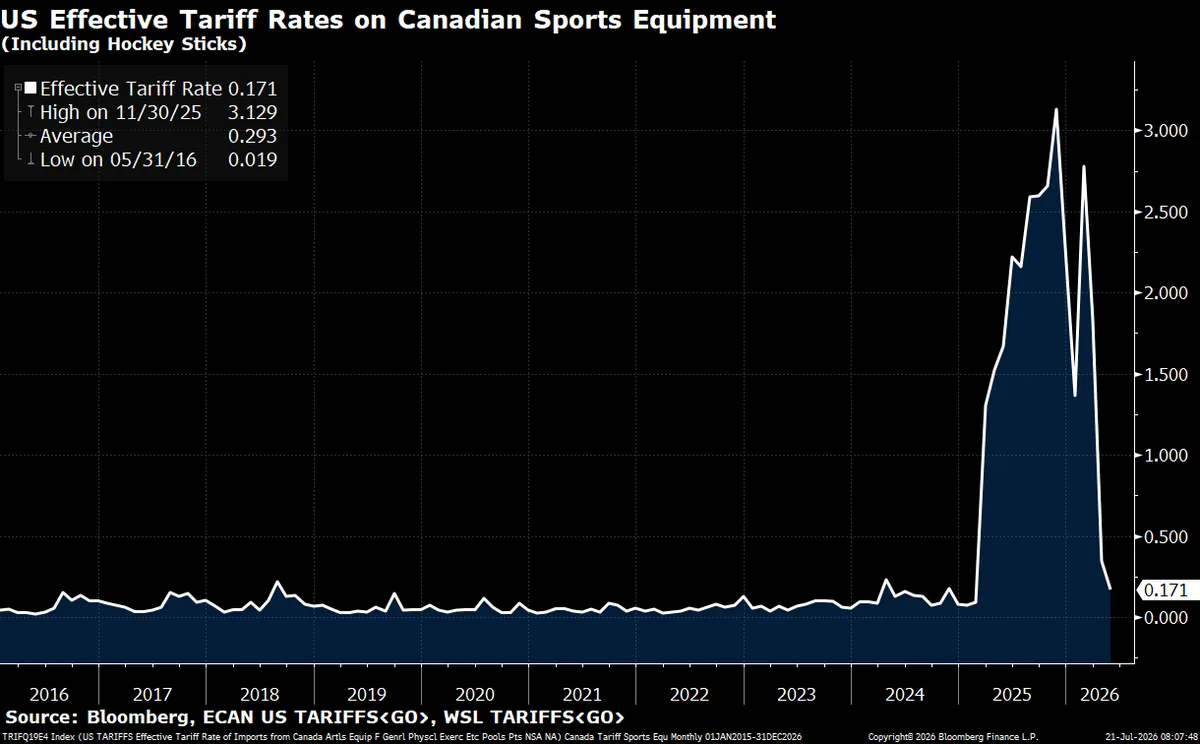
Roustan Hockey’s Brantford, Ont., factory produces about 400,000 traditional wood sticks each year, half of which are sold in the U.S. under the new 50 percent tariff.
Tariff Decision and Immediate Timeline
The tariff announcement followed five months after Jack Hughes scored the Olympic gold-medal goal against Canada. The 50 percent duty applies to hockey sticks plus wine and cement and takes effect in less than 30 days.
U.S. Trade Representative Jamieson Greer stated that President Trump took decisive action to hold Canada accountable for its retaliation and discrimination. The measure responds directly to provincial bans on U.S. liquor, Canada’s supply-managed dairy system and quotas on certain U.S. vehicles.
Canadian Prime Minister Mark Carney countered that provinces and territories stood together to support the economy and defend workers. Ontario Premier Doug Ford warned that Canada should respond tariff for tariff, dollar for dollar.
The White House decision not to renew the USMCA added further pressure on bilateral trade. No U.S. factory produces hockey sticks, leaving American retailers with no domestic substitute.
Roustan could not be reached for comment on the production impact. The 400,000-stick annual output represents a modest share of total tariffed goods yet directly affects youth and amateur players.
Cost Transmission to American Consumers
Canadian producers ship half their 400,000 sticks to the U.S. market each year. Importers will pass the full 50 percent duty to retailers, who in turn raise prices for families already facing rising equipment costs.
Three of the NHL’s top-10 goal scorers were U.S.-born in the same season the Carolina Hurricanes captured the Stanley Cup. Both U.S. men’s and women’s Olympic teams also won gold, expanding participation momentum.
Without a Made-in-USA option, every dollar of the tariff increases the price of the only available product. Kentucky Bourbon faced similar reciprocal removal from Ontario and Quebec shelves, illustrating how consumers ultimately absorb the added expense.
The absence of domestic manufacturing means the tariff functions as a direct tax on U.S. hockey households rather than a protective measure for local industry. Rising stick prices compound an already expensive sport, deterring new entrants at youth levels.
Long-Term Effects on U.S. Hockey Growth
U.S. hockey popularity reached record levels with Olympic golds, three American top-10 NHL scorers and a Stanley Cup winner. The tariff threatens to stall that trajectory by increasing equipment barriers.
Canadian manufacturers retain their domestic market and export flexibility to non-tariff countries. U.S. families lack equivalent choices, concentrating the price increase on the consumer side of the border.
The combination of higher costs and continued reliance on Canadian supply creates a structural disadvantage for American participation rates. Historical patterns in other tariffed consumer goods show sustained price elevation after duties are imposed.
Retail data from prior equipment price increases confirm that each incremental rise correlates with measurable drops in new player registrations. The 50 percent duty amplifies an existing upward price trend that has already strained budgets.
Hockey families in the United States will bear the brunt of the tariff costs, potentially slowing the sport’s growth in a year when U.S. teams achieved Olympic success and the Hurricanes won the Stanley Cup.
Frequently Asked Questions
Sources

Par Mike Jonderson
Mike Jonderson is a passionate hockey analyst and expert in advanced NHL statistics. A former college player and mathematics graduate, he combines his understanding of the game with technical expertise to develop innovative predictive models and contribute to the evolution of modern hockey analytics.