







The Utah Mammoth’s homestand took another disappointing turn Friday night at Delta Center as they fell 3-2 in overtime to the New York Islanders. Despite controlling significant portions of the game and holding leads at critical moments, the Mammoth couldn’t close out a determined Islanders squad riding a winning streak. The loss marked Utah’s fourth defeat in their last five games, continuing a troubling slide that has seen them drop six of eight contests overall.
Matthew Schaefer, the No. 1 overall pick in the 2025 NHL Draft, delivered the dagger with his first career overtime goal just 2:06 into the extra frame. The 18-year-old defenseman became the youngest player in NHL history to score an overtime goal, breaking Sidney Crosby’s record. While the Mammoth can take some positives from their performance, including finally breaking their power play drought, the manner of this defeat reveals several concerning patterns that need addressing.
Three takeaways from Utah Mammoth 3-2 OT loss to New York Islanders: power play finally converts but can’t seal the deal
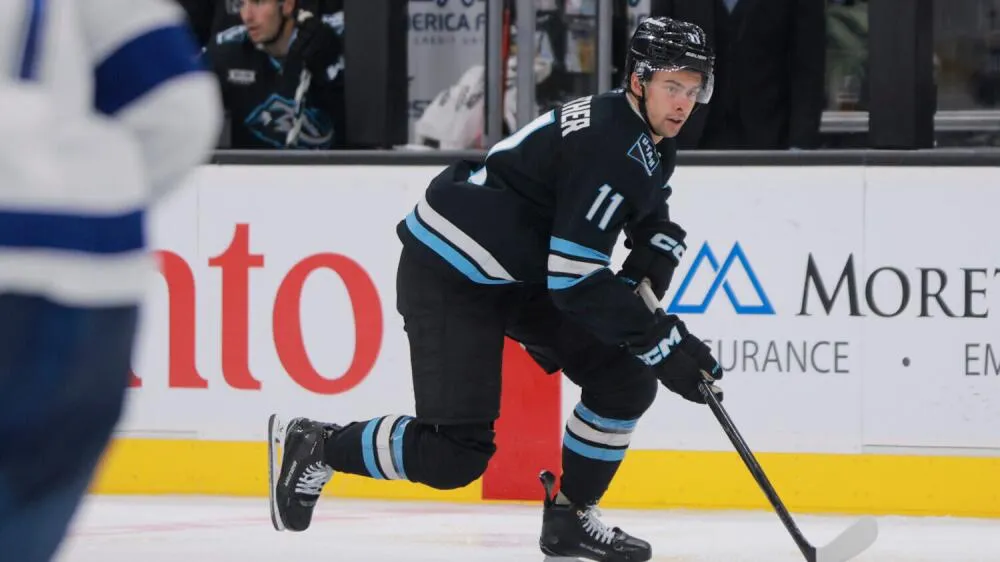
The drought is over, but the celebration was short-lived. After going 0-for-15 on the power play and failing to score with the man advantage for 19 days since October 26 against the Winnipeg Jets, Dylan Guenther finally broke through against the Islanders. His thunderous one-timer from the left face-off circle on a 5-on-3 opportunity gave Utah a 2-1 lead late in the first period and provided a much-needed jolt to a struggling special teams unit.
However, one goal out of six opportunities doesn’t signal a turnaround. The Mammoth entered the game ranked 27th in the NHL with 83 shots on goal during 5-on-4 situations, proving they can generate quality opportunities. The issue isn’t shot volume or zone entries—it’s execution and finishing. Guenther demonstrated his lethal shot from his office on the left side, but consistency remains elusive. When you’re getting prime scoring chances but failing to capitalize, it becomes a mental hurdle as much as a technical one.
Until the Mammoth can convert at a rate that reflects their talent level and shot generation, they’ll continue leaving points on the table. In tight games like Friday’s contest, special teams often make the difference between two points and one. Utah squandered that opportunity, and it cost them dearly.
Three takeaways from Utah Mammoth 3-2 OT loss to New York Islanders: controversial kicked puck goal highlights NHL rule inconsistency
The sequence at 13:44 of the third period perfectly encapsulates the frustration of Utah’s season. Jonathan Drouin appeared to kick the puck toward the net, where it deflected off Nate Schmidt’s stick and crossed the goal line. The officials initially waved off the goal, citing a distinct kicking motion. Utah’s bench exhaled. Then came the review.
After video review, the goal was allowed to stand, tying the game 2-2 and completely shifting the momentum. According to NHL Rule 49.2, “A kicked puck that deflects off the stick of any player (excluding the goalkeeper’s stick) shall be ruled a good goal.” Technically, the officials made the correct call based on the rulebook. But that doesn’t mean it makes sense.
“It’s an instinctual thing, right? In hindsight, do I wish I would have pulled my stick back so they would have called it back? Yeah, but that’s going to be really hard for me to do,” Schmidt explained. “You’re trying to get it out then I almost step on Vejmelka in the process.” His reaction highlights the impossible position defenders find themselves in when opposing players kick pucks in the crease area.
The NHL’s kicking rule contains a puzzling inconsistency. If a kicked puck deflects off a defender’s body, it’s waved off. But if it hits a stick? Good goal. The Islanders capitalized on this quirk, but the rule itself begs for clarification. Why should the specific body part that makes contact determine whether a kicked puck counts? The spirit of the rule is to prevent players from kicking pucks into the net, yet it rewards exactly that behavior if a stick happens to be in the vicinity.
This isn’t to suggest the officials made an incorrect call—they applied the rule as written. But it raises broader questions about consistency and common sense in NHL officiating. Should players now be encouraged to kick at loose pucks in the crease, hoping for a favorable deflection off a defender’s stick? The rule creates perverse incentives and leaves fans, players, and coaches confused about what constitutes a legitimate goal.
For Utah, the goal proved devastating. They had weathered the Islanders’ push and were minutes away from securing two points. Instead, they found themselves in overtime thanks to a rule that few understand and fewer still would defend as logical.
Three takeaways from Utah Mammoth 3-2 OT loss to New York Islanders: puck possession proves critical in overtime defeat
Three-on-three overtime hockey rewards speed, skill, and most importantly, possession. With vast stretches of open ice and minimal defensive coverage, the team that controls the puck typically controls the outcome. On Friday night, Utah never had a chance to test that theory because they never possessed the puck in overtime.
The Mammoth lost every faceoff in the extra period and couldn’t generate a single turnover to reclaim possession. Without the puck, all they could do was defend and hope their coverage held. It didn’t. Schaefer’s game-winning goal resulted from a breakdown in defensive assignments when JJ Peterka peeled off in the wrong direction, forcing Lawson Crouse to step up on the puck carrier and leaving Schaefer wide open for a one-timer from the right circle.
“Yeah, I mean, just coverage, right? You know, we knew that Barzal and Horvat would be coming over the boards at some point,” Crouse explained. “So, yeah, when you don’t have the puck, it’s all about coverage, communication, and making sure you’re not getting tested.” The Mammoth failed on all three counts during the decisive sequence.
Mathew Barzal, extending his point streak to six games, found Schaefer with a perfect pass that left Karel Vejmelka with no chance. The 18-year-old rookie rifled a one-timer short-side, securing his place in NHL history and extending the Islanders’ winning streak to four games. For Utah, it was another painful reminder that in three-on-three hockey, possession is everything.
The loss also highlighted Utah’s struggles in close games. They’ve now lost four of five and six of eight, with several of those defeats coming in situations where they held leads or dominated stretches of play. Learning to close out games—whether in regulation or overtime—remains a work in progress for this franchise. The difference between a playoff team and a lottery team often comes down to winning these tight contests, and right now, Utah is on the wrong side of that equation.
Friday night’s overtime loss to the New York Islanders exposed familiar demons for the Utah Mammoth. Their power play remains maddeningly inconsistent despite breaking their lengthy drought. Controversial officiating decisions continue to go against them, whether deserved or not. And their inability to control possession and execute in critical moments—particularly in overtime—keeps costing them valuable points in the standings.
At 10-7-1 through their first 18 games, Utah sits in a respectable position, but the recent slide threatens to derail what had been a promising start to the season. They’ll need to clean up their special teams execution, learn to finish games they’re winning, and avoid putting themselves in positions where controversial calls can determine outcomes. The talent is there, but translating that talent into consistent results remains the challenge as they prepare to face the Anaheim Ducks on Monday night.
Frequently Asked Questions

Par Mike Jonderson
Mike Jonderson is a passionate hockey analyst and expert in advanced NHL statistics. A former college player and mathematics graduate, he combines his understanding of the game with technical expertise to develop innovative predictive models and contribute to the evolution of modern hockey analytics.