






The Utah Mammoth’s struggles continued on Sunday night in Ottawa, where a controversial goaltender interference call proved to be the turning point in a frustrating 4-2 defeat to the Senators. What appeared to be Jack McBain’s equalizing goal early in the third period was overturned after review, effectively crushing any momentum Utah had built. The loss marked the Mammoth’s third consecutive defeat and their fifth setback in the last six games, capping off a dismal four-game road trip that saw them manage just one victory.
The defeat exposed several troubling trends that have plagued the Mammoth during this recent slide. From goaltending woes to offensive inconsistency and questionable officiating, Utah finds itself in a precarious position despite sitting in a playoff spot. With a homestand ahead, the team needs to rediscover the form that carried them through a seven-game winning streak just weeks ago.
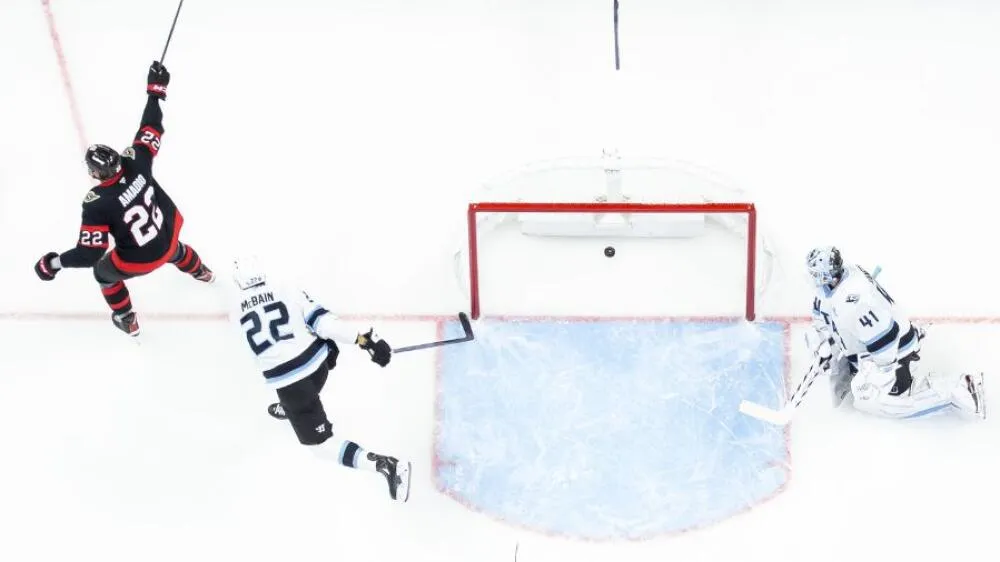
The controversial goaltender interference call that changed everything in the Utah Mammoth 4-2 loss to Ottawa Senators takeaways
The defining moment of Utah’s 4-2 loss to Ottawa Senators came just 22 seconds into the third period when Jack McBain appeared to tie the game at 3-3. After falling backward into the crease and sitting directly in front of Senators goaltender Leevi Meriläinen, McBain swiped at a loose puck that deflected off the netminder and crossed the goal line. The officials initially signaled a good goal, sending the Utah bench into celebration.
However, Ottawa head coach Travis Green immediately challenged the call for goaltender interference. After several minutes of review, the referees determined that McBain had impaired Meriläinen’s ability to defend his goal and overturned the decision. The call sparked immediate controversy, with many observers questioning whether the contact truly met the threshold for interference outlined in the NHL rulebook.
According to NHL rules, goals should be disallowed only if an attacking player impairs the goalkeeper’s ability to move freely within the crease or initiates intentional contact. In this case, McBain tripped over the backside of the goal and made only incidental contact with the goaltender. Video replay showed that Meriläinen had approximately three seconds to recover and even pushed off his left skate under his own power to hug the right post before the puck crossed the line.
Nick Schmaltz addressed the controversial call after the game, stating, “It was unfortunate that Bainer went out there and got one for us and they called it back. That’s just the way it goes sometimes.” While the veteran forward maintained his composure publicly, the momentum shift was undeniable. Just three minutes after the disallowed goal, Ottawa scored what would prove to be the game-winner, effectively ending Utah’s comeback hopes.
The overturned goal also cost Utah a potential power play opportunity, as failed coaches’ challenges typically result in a bench minor penalty for the challenging team. Instead, Ottawa retained possession and capitalized on their momentum. While the call alone didn’t cost Utah the game, it significantly impacted the outcome and highlighted how razor-thin margins can determine victories and defeats in the NHL.
Head coach Andre Tourigny chose not to dwell on the controversial decision, focusing instead on his team’s overall performance. However, for a team searching for answers during a difficult stretch, the interference call represented yet another obstacle in what has become an increasingly frustrating period for the Mammoth organization.
Goaltending concerns emerge as critical factor in Utah Mammoth 4-2 loss to Ottawa Senators takeaways
Perhaps the most alarming trend during Utah’s recent slide has been the precipitous decline in goaltending performance. Vitek Vanecek allowed four goals on just 25 shots against Ottawa, posting an .840 save percentage that simply won’t win games at the NHL level. The performance continued a disturbing pattern that has seen the Mammoth’s netminding tandem struggle mightily after providing solid play during the team’s seven-game winning streak.
The statistical comparison between Utah’s winning streak and their recent struggles tells a stark story. During the seven-game run, Karel Vejmelka and Vanecek combined to face 185 shots while allowing just 17 goals, posting a combined .908 save percentage. While not elite numbers, that level of goaltending gave Utah a chance to win every night and allowed the offense to play with confidence.
Over the last six games, however, the goaltending has collapsed. The tandem has faced 135 shots and stopped only 109, resulting in a combined .807 save percentage that ranks among the worst in the league during that span. When your goaltenders are allowing nearly two of every 10 shots to find the back of the net, winning hockey games becomes nearly impossible regardless of how well the team plays in front of them.
What makes the goaltending struggles particularly frustrating is that Utah’s team defense has remained relatively solid. The Mammoth have outshot their opponents in five of the last six games and have allowed the sixth-fewest shots in the league this season. The structure and defensive systems remain intact, but the lack of timely saves has turned manageable situations into goals against.
Against Ottawa, Vanecek was beaten on several shots that NHL goaltenders are expected to stop. Similar to their previous defeat in Montreal, the inability to make a crucial save at a pivotal moment allowed the opposition to seize control. Nick Cousins’ game-winning goal came on a play where better positioning and quicker lateral movement could have resulted in a save, keeping Utah within striking distance.
The goaltending crisis puts additional pressure on general manager Bill Armstrong to either find a solution through trade or hope that Vejmelka and Vanecek can rediscover their form. With Utah currently sitting in a playoff position but trending in the wrong direction, the importance of stabilizing the crease cannot be overstated. The defense can only do so much, and the team needs to know they have a reliable last line of defense behind them.
Offensive struggles compound problems in Utah Mammoth 4-2 loss to Ottawa Senators takeaways
While goaltending has been the most glaring issue, Utah’s offensive production has also dried up during this difficult stretch. The Mammoth have been held to three or fewer goals in seven consecutive games, with their last major offensive explosion coming in a 6-2 victory over Minnesota on October 25. For a team that features significant offensive talent throughout its lineup, the inability to generate consistent scoring represents a major concern.
Two of Utah’s highest-paid and most talented offensive players, Logan Cooley and JJ Peterka, have gone five consecutive games without scoring a goal. Both young players were instrumental during the winning streak but have largely disappeared offensively when the team needs them most. The lack of secondary scoring has placed enormous pressure on the top line to carry the entire offensive load.
Against Ottawa, only captain Clayton Keller and Nick Schmaltz managed to find the back of the net for Utah. Keller opened the scoring with his goal, while Schmaltz netted his ninth of the season to take sole possession of the team lead in goals. Schmaltz remains tied for fourth-most goals in the NHL and ranks seventh in total points through the first month of the season, putting together a career year in the final season of his contract.
After the game, Schmaltz reflected on the team’s offensive struggles, saying, “It doesn’t really mean anything when we don’t win. We need that drive, that energy. We can come back no matter how many we’re down: one, two, doesn’t matter. We gotta want it. We gotta want the puck. We gotta want to be able to make those plays when it counts.” His comments highlighted a concerning lack of urgency that has crept into Utah’s game during this slide.
Head coach Andre Tourigny noted that Schmaltz and Keller succeeded by “attacking the net with speed” alongside Dylan Guenther on a line that combined for 13 shots against Ottawa. The trio generated quality chances and tested Senators goaltender Leevi Meriläinen throughout the night, but the young netminder turned in his best performance of the season with 29 saves and a .935 save percentage.
The continued inability to score 6-on-5 goals late in games has also become a troubling pattern. Utah pulled Vanecek for an extra attacker late against Ottawa but failed to capitalize, extending a frustrating trend that has cost them crucial points in the standings. The power play has also gone cold at the worst possible time, failing to generate consistent pressure or convert key opportunities that could swing momentum during games.
Mental fortitude and intensity questions arise from Utah Mammoth 4-2 loss to Ottawa Senators takeaways
Beyond the technical and statistical breakdowns, the most concerning aspect of Utah’s recent struggles may be the apparent lack of pushback and intensity when facing adversity. After dominating opponents during a seven-game winning streak, the Mammoth have appeared shell-shocked by the sudden reversal of fortune, lacking the fire and competitiveness necessary to fight through difficult moments.
Schmaltz’s postgame comments about needing more “drive” and “energy” suggested that some players may not be fully invested in battling through the tough times. In a results-oriented league where every point matters, the inability to elevate intensity when trailing or facing adversity can be the difference between making the playoffs and watching from home. Utah needs more players willing to drop gloves, break sticks in frustration, or visibly demonstrate their desire to win.
One bright spot came when television cameras caught Clayton Keller throwing his stick against the wall in frustration as the team made their way to the locker room after the loss. While not ideal behavior in most contexts, that type of visible emotion is exactly what Utah needs right now. The captain’s frustration showed that at least some players recognize the unacceptable nature of the team’s recent play and refuse to accept mediocrity.
Tourigny acknowledged his team’s effort while pointing to execution issues, stating, “I think we generated good offense against a really stingy team. Unfortunately, we could not shut the door. I think we had a little bit too many turnovers. We were doing a lot of good stuff, but it will be good to get back home.” The coach’s measured response suggests he believes the underlying fundamentals remain sound, with the team simply needing to clean up details and regain confidence.
The reality is that when teams go through difficult stretches, frustration builds and negative momentum can become self-fulfilling. Players start gripping their sticks too tight, hesitating on plays they would normally make instinctively, and second-guessing decisions. Breaking that cycle requires mental toughness and leadership throughout the lineup, not just from the coaching staff and captain.
As Schmaltz noted, adversity brings frustration, but championship-caliber teams find ways to channel that frustration into productive energy. They demand more from themselves and their teammates. They refuse to accept losing as an option. Utah showed they possess that mentality during their winning streak, but they must rediscover it quickly as the standings continue to tighten in the Western Conference.
Looking ahead: Utah Mammoth must capitalize on upcoming homestand
Despite losing five of their last six games, the sky is not falling for the Utah Mammoth just yet. Through 16 games, Utah sits at 9-7 with 18 points, currently occupying the second wild card spot in the Western Conference playoff race. That record places them roughly where most analysts expected them to be at this stage of the season, though the recent trajectory has been concerning.
The timing of their return home could not be better. Utah will host six of their next eight games, beginning with the Buffalo Sabres on Wednesday night at the Delta Center. Home ice has been relatively kind to the Mammoth this season, and the familiar surroundings and supportive crowd could provide the boost needed to snap this losing streak and regain confidence.
The homestand represents a crucial opportunity to right the ship before falling too far behind in the playoff race. The Western Conference remains tightly bunched, with several teams separated by just a few points. A successful stretch at home could vault Utah back into a secure playoff position, while continued struggles could see them slip dangerously close to the bottom of the standings.
Key to any turnaround will be improvement in all three zones. The goaltending must stabilize, with either Vejmelka or Vanecek stepping up to provide the consistent play the team received during the winning streak. Defensively, the team needs to limit odd-man rushes and high-danger chances that have resulted from costly turnovers. Offensively, secondary scoring must emerge beyond just Schmaltz and Keller.
The Mammoth’s coaching staff will also need to find the right line combinations to maximize offensive potential while maintaining defensive responsibility. Reuniting productive duos and experimenting with different looks could spark players like Cooley and Peterka, who have gone cold in recent weeks. Special teams adjustments may also be necessary to improve a power play that has failed to generate momentum.
Utah’s identity during the winning streak was built on speed, aggressive forechecking, and capitalizing on opponents’ mistakes. Rediscovering that identity while adding the desperation and intensity that Schmaltz called for will be essential. The talent is clearly present on the roster, but talent alone doesn’t win games without proper execution and competitive fire.
The 4-2 loss in Ottawa crystallized many of the issues plaguing the Utah Mammoth during their recent struggles. From controversial officiating decisions to goaltending woes and offensive inconsistency, the team faces multiple challenges that must be addressed quickly. However, with a favorable schedule ahead and a roster that proved capable of dominating opponents just weeks ago, there remains reason for optimism.
The Mammoth’s response to adversity over the next two weeks will define their season and reveal the true character of this team. Championship-caliber squads find ways to weather storms and emerge stronger, while pretenders fold under pressure and fade from playoff contention. Utah has the talent and coaching to be the former, but they must prove it on the ice starting with their homestand. The time for excuses has passed—now is when leaders must step forward and the team must rediscover the competitive edge that fueled their remarkable winning streak.

Par Mike Jonderson
Mike Jonderson is a passionate hockey analyst and expert in advanced NHL statistics. A former college player and mathematics graduate, he combines his understanding of the game with technical expertise to develop innovative predictive models and contribute to the evolution of modern hockey analytics.