





The Washington Capitals entered the 2025-26 season riding the momentum of a historic campaign that saw them finish atop the Eastern Conference with 111 points and witness Alex Ovechkin break Wayne Gretzky’s all-time goals record. With Jack Adams Award winner Spencer Carbery returning for his third season behind the bench and the core largely intact, expectations were sky-high in the nation’s capital. However, as the season has unfolded through mid-November, the Capitals have found themselves navigating a much more turbulent path than anticipated, posting an 8-8-1 record that has them sitting eighth in the Metropolitan Division with 17 points.
The early season struggles have presented a stark contrast to the magic that permeated through Capital One Arena during the previous campaign. While the team’s underlying analytics suggest they’re playing better hockey than their record indicates, converting that process into results has proven elusive. From devastating injuries to key players to inconsistent offensive production and special teams woes, the 2025-26 season has become a test of resilience for a franchise that hoped to build on last year’s success rather than fight for playoff positioning.
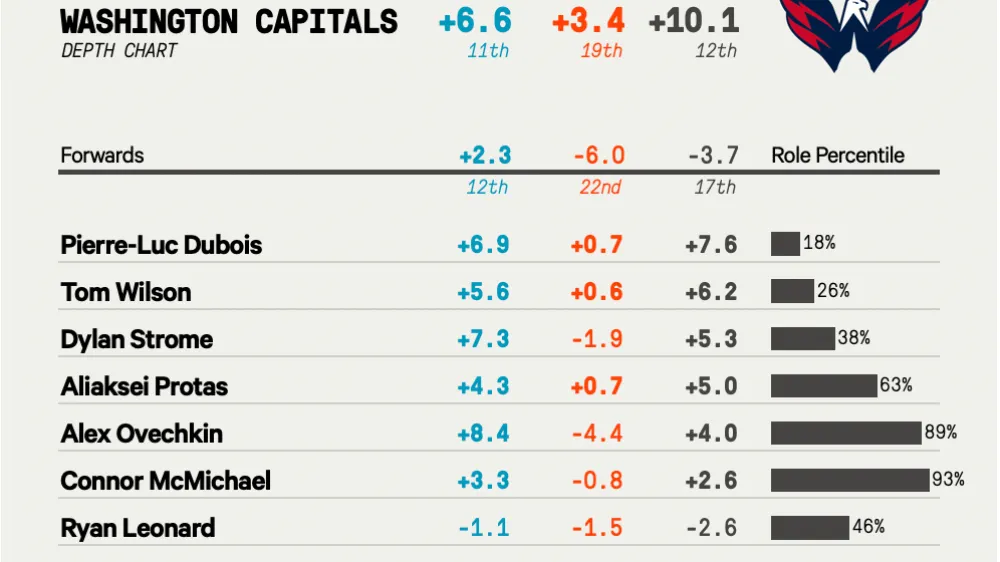
How the Washington Capitals 2025-26 season review shows a mixed offensive performance
The Capitals’ offensive production through the first quarter of the season has been a tale of two stories. On one hand, Tom Wilson has emerged as the team’s most dynamic force, leading all skaters with 17 points (9 goals, 8 assists) in 17 games while maintaining his physical edge with 46 hits and a team-high 43 penalty minutes. His 24.3% shooting percentage suggests some regression is likely coming, but Wilson’s ability to play in all situations has made him indispensable to Carbery’s lineup.
Dylan Strome has continued his excellent form from the previous season, recording 15 points (5 goals, 10 assists) in just 15 games while maintaining elite numbers at the faceoff dot with a 60.6% winning percentage. His chemistry with linemates has remained strong, though the absence of consistent wingers due to injuries has occasionally disrupted the second line’s rhythm. Strome’s ability to drive play at 5-on-5, evidenced by his 3.8 goals-for per 60 minutes at even strength, has kept the Capitals competitive even when other lines struggle.
The defensive duo of John Carlson and Jakob Chychrun has provided solid offensive contributions from the blue line, combining for 26 points through 17 games. Carlson’s 14 points (4 goals, 10 assists) have come while logging a team-high 23:22 per game, though his even strength deployment at age 36 continues to be carefully managed. Chychrun’s offensive instincts have generated 12 points (4 goals, 8 assists) with a healthy plus-7 rating, making him a valuable weapon on the power play where he’s recorded one goal and seven assists.
However, the disappointments have been notable. Alex Ovechkin, at 40 years old, has managed just 4 goals and 12 points through 17 games—a far cry from the 44-goal campaign he posted last season. While his 9.8% shooting percentage is likely to climb given his career track record, the reality is that Father Time appears to be catching up to the legendary winger. Aliaksei Protas, who broke out with 66 points last season including a remarkable plus-40 rating, has seen his production dip to 10 points (5 goals, 5 assists) with a more modest plus-6.
Connor McMichael’s regression has been particularly concerning for Washington’s depth scoring. After posting 57 points last season, the 25-year-old center has managed just 4 points (1 goal, 3 assists) in 17 games with a minus-2 rating. His 3.2% shooting percentage is unsustainably low, but his underlying metrics suggest he’s not generating the same quality of chances he did during his breakout campaign. The Washington Capitals October 2025 scoring struggles extended beyond just McMichael, as multiple players failed to find the back of the net with the consistency that defined last season’s success.
Ryan Leonard, the highly-touted prospect from Boston College, has shown flashes of his scoring ability with 8 points (3 goals, 5 assists) while averaging nearly 13 minutes per game on the second line. His two game-winning goals have provided crucial contributions, though his overall impact has been more developmental than transformative. The integration of Washington Capitals newcomers performance like Leonard has required patience from both coaching staff and fans, as the learning curve at the NHL level remains steep.
The devastating impact of injuries on the Washington Capitals 2025-26 season review
No single factor has derailed the Capitals’ season more dramatically than the injury to Pierre-Luc Dubois. The 27-year-old center, who posted a career-high 66 points last season including 46 assists, suffered an abdominal and adductor injury that required surgery on October 31st. The initial prognosis of 3-4 months essentially ended his regular season before it truly began, robbing Washington of a crucial two-way center who was expected to anchor the second line.
Dubois appeared in just six games before the injury, failing to register a point while posting a 42.3% faceoff winning percentage. While those early numbers were concerning, they represented such a small sample size that no conclusions could be drawn about his form. The surgery revealed the severity of the core muscle issue, suggesting he had been playing through discomfort even during training camp. According to NHL.com’s season preview, Dubois was penciled in as the second-line center between Connor McMichael and Tom Wilson, a role that has now been filled by committee.
The loss of Dubois created a cascading effect throughout the lineup. Spencer Carbery was forced to shuffle his forward groups repeatedly, trying different combinations to find chemistry and production. Dylan Strome was moved between the first and second lines depending on matchups, while younger players like Hendrix Lapierre and Ethen Frank received opportunities they might not have otherwise gotten. Lapierre has contributed 2 assists in 16 games while winning just 39.7% of his faceoffs, highlighting the learning curve for the 23-year-old.
Beyond Dubois, the Capitals have dealt with various minor injuries and illnesses that have prevented them from icing a consistent lineup. Sonny Milano, who was fighting to re-establish his NHL career after missing most of the previous season with an upper-body injury, has appeared in just 8 games with 1 goal. His limited availability has prevented the third line from developing any sustained chemistry, forcing Carbery to constantly adjust his bottom-six forward deployment.
The injury situation has been particularly frustrating given the depth the Capitals believed they had entering the season. The additions of players like Justin Sourdif, acquired from Florida in the offseason, were meant to provide insurance and competition for roster spots. Instead, these depth pieces have been forced into regular duty earlier than anticipated, sometimes in roles that don’t suit their skillsets. Sourdif has recorded 2 goals in 17 games while averaging just over 11 minutes per game, showing glimpses of his potential without yet making a decisive impact.
Goaltending excellence amid defensive inconsistencies in the Washington Capitals 2025-26 season review
One of the few bright spots in Washington’s season has been the performance of Logan Thompson between the pipes. The 28-year-old netminder, who won 31 games last season, has posted a stellar .923 save percentage and 1.85 goals-against average through 12 appearances. His 7-5 record doesn’t fully reflect his quality of play, as he’s consistently given his team a chance to win even when the defensive structure in front of him has broken down.
Thompson’s ability to make timely saves has kept the Capitals in games they had no business competing in. His positioning and rebound control have been exemplary, and he’s shown the mental fortitude to bounce back from occasional tough nights. The decision to name Thompson the primary starter heading into the season has been vindicated by his performance, as he’s proven capable of handling the workload and pressure that comes with being the number-one goalie for a contending team.
Charlie Lindgren, meanwhile, has struggled in his backup role with an .878 save percentage and 3.59 goals-against average across 5 appearances. His 1-3-1 record includes one shutout, suggesting that when Lindgren is sharp, he can still deliver quality starts. However, his inconsistency has made it difficult for Carbery to trust him in back-to-back situations or against elite offensive teams. The 32-year-old appears to be best utilized in spot starts rather than as a true 1A option alongside Thompson.
The team’s defensive structure has shown concerning vulnerabilities despite the strong goaltending from Thompson. Washington is allowing 2.37 goals per game as a team, which ranks respectably in the NHL, but their defensive zone coverage has featured too many breakdowns leading to high-danger chances against. The .908 team save percentage masks some issues with defensive awareness and gap control, particularly from the bottom-pairing defensemen.
Matt Roy, signed in the offseason to bolster the right side of the defense, has struggled to make the impact Washington envisioned. With zero goals and 2 assists through 17 games, Roy’s offensive contributions have been minimal, though his plus-7 rating suggests he’s been relatively solid in his own end. His 20:09 average ice time indicates Carbery trusts him in key situations, but Roy hasn’t provided the two-way excellence that made him attractive as a free agent.
Rasmus Sandin has been more productive in limited action, recording 6 points (2 goals, 4 assists) with a plus-5 rating in just 12 games. His skating ability and puck-moving skills have made him valuable on the second pairing, though his defensive reads remain inconsistent. Martin Fehérváry has provided steady if unspectacular play with 6 points and solid defensive metrics, though his minus-2.3% Corsi-for relative suggests the team gets outshot when he’s on the ice.
Special teams struggles defining the Washington Capitals 2025-26 season review
The power play, which was supposed to be a weapon for Washington given their offensive talent, has sputtered to a 14.8% conversion rate through 17 games. With just 8 goals on 54 opportunities, the Capitals have converted at a rate that ranks in the bottom third of the NHL. This represents a significant decline from last season when their power play clicked at over 20%, fueled by Ovechkin’s office on the left circle and quality movement from Strome and Dubois.
The loss of Dubois has particularly hampered the power play’s effectiveness. His ability to distribute the puck from the half-wall and create shooting lanes was a crucial element of Washington’s man-advantage scheme. Without him, the Capitals have looked more predictable, often defaulting to Ovechkin one-timers without sufficient puck movement to create those opportunities. Defenders have been able to key on Ovechkin more aggressively, knowing that the secondary options aren’t as dangerous.
John Carlson’s power play quarterbacking has generated 5 points on the man advantage, showing he can still facilitate from the point, but his decision-making has occasionally been questionable. Too often, the Capitals’ power play entries lack clean zone gains, forcing them to regroup and reset, which allows penalty-killing units to establish their structure. The shooting mentality on the power play has also been problematic, with perimeter shots rather than quality chances being generated with concerning frequency.
The penalty kill has been more effective, operating at 73.2% efficiency with 15 shorthanded goals allowed on 57 opportunities against. While this isn’t elite territory, it’s respectable enough to keep the team competitive in tight games. Nic Dowd has been a key contributor to the penalty kill, along with Brandon Duhaime, whose physicality and tenacity have helped disrupt opponents’ power play entries. The unit has been particularly effective at clearing pucks out of the defensive zone, limiting extended pressure.
However, the Capitals have been undisciplined at times, taking unnecessary penalties that have put them in shorthanded situations they could have avoided. Tom Wilson’s 43 penalty minutes lead the team, and while his physical play is part of his identity, some of his infractions have come at inopportune moments. The team’s overall minus-11 goal differential on special teams has been a significant factor in their middling record, as winning teams typically dominate the special teams battle.
Spencer Carbery’s coaching challenges in the Washington Capitals 2025-26 season review
Spencer Carbery’s second season has presented challenges vastly different from his Jack Adams Award-winning debut campaign. The coach has had to manage expectations while dealing with injuries, inconsistent production, and a roster that hasn’t performed to its capabilities. To his credit, Carbery has remained measured in his public comments, focusing on process over results and emphasizing the analytical improvements the team has made even when the win column hasn’t reflected those gains.
According to recent reports, the Capitals are playing better analytically this season than their record suggests. Their expected goals metrics and shot quality numbers indicate they’ve been on the wrong end of some variance, both in terms of finishing chances and goaltending performances from opponents. Carbery has stressed this point with his players, trying to maintain their confidence and commitment to the system even as losses mount.
The lineup juggling necessitated by injuries has tested Carbery’s ability to maximize his available personnel. He’s experimented with different line combinations, trying to find chemistry and spark offensive production. The decision to elevate Ryan Leonard to the second line alongside Dubois (before the injury) and later with other centers showed a willingness to give young players opportunities in meaningful situations. Carbery’s player development background has been evident in how he’s managed Leonard’s minutes and situations, gradually increasing his responsibilities.
Carbery’s timeout usage and in-game adjustments have come under some scrutiny from media and fans. In several losses, the Capitals have struggled to respond after surrendering momentum-shifting goals, and questions have been raised about whether more aggressive tactical changes might have altered outcomes. The coach’s preference for staying the course and trusting his players hasn’t always been rewarded, though it’s consistent with his philosophy of building long-term habits rather than panicking in the moment.
The relationship between Carbery and his veteran players, particularly Ovechkin, remains strong despite the team’s struggles. Ovechkin continues to buy into the defensive structure and system play that Carbery emphasizes, even as his offensive numbers decline. The coach has been careful with Ovechkin’s ice time management, recognizing that at 40 years old, the captain needs to be deployed strategically rather than playing heavy minutes every night. This balancing act between competing now and preserving Ovechkin for a playoff push will be crucial to the season’s trajectory.
Looking ahead: Can the Washington Capitals salvage their 2025-26 season?
With 65 games remaining in the regular season, the Capitals still have ample time to right the ship and reclaim a playoff position. Their current 8-8-1 record through 17 games projects to approximately 77-78 points over a full 82-game season, which would likely leave them on the outside of the playoff picture. However, the Metropolitan Division’s competitive nature means that a modest winning streak could vault them back into contention quickly.
The return of Pierre-Luc Dubois, though not expected until late in the season or potentially the playoffs, could provide a massive boost if the Capitals can remain within striking distance. His presence would stabilize the center ice position and allow Carbery to deploy his forward lines as originally envisioned. In the meantime, Washington needs players like Connor McMichael and Aliaksei Protas to rediscover the form that made them so productive last season. Both players are likely due for positive regression given their unsustainably low shooting percentages.
The upcoming schedule will be crucial in determining whether this season represents a temporary stumble or a more concerning decline. The Capitals need to bank points against divisional opponents and take advantage of home games at Capital One Arena, where they’ve posted a 4-4-0 record thus far. Improving that home record to something closer to their 51-22-9 overall record from last season would go a long way toward stabilizing their playoff positioning.
Ovechkin’s pursuit of personal milestones, while no longer chasing the all-time goals record, could still provide motivation and storylines for the team. Every goal he scores cements his legacy and provides moments for the roster to rally around their captain. The emotional lift from Ovechkin’s achievements last season was palpable, and while lightning rarely strikes twice, his leadership and competitive fire remain assets that can’t be quantified on a stat sheet.
The Capitals’ championship window hasn’t closed, but it’s certainly not as wide open as it appeared during last season’s magical run. Health, consistency, and some positive variance in shooting percentages could transform this season from disappointment to success. However, the margin for error has shrunk considerably, and every game from here forward takes on increased importance. The coming weeks will reveal whether Washington’s early season struggles were merely growing pains or symptoms of a deeper issue that threatens their Stanley Cup aspirations.
For a franchise that exceeded all expectations just months ago, the 2025-26 season has delivered a harsh reminder that sustained success in the NHL requires everything to break right. The Capitals still possess the talent, goaltending, and coaching to compete with anyone in the league on a given night. Whether they can string together enough of those nights to make a legitimate playoff run remains the defining question of their season. With Carbery at the helm and veterans like Ovechkin, Carlson, and Wilson providing leadership, there’s reason to believe this team can overcome its early adversity and return to contending form. The alternative—missing the playoffs after a 111-point season—would represent one of the most stunning collapses in recent NHL history, a fate the organization is determined to avoid.
Frequently Asked Questions

Par Mike Jonderson
Mike Jonderson is a passionate hockey analyst and expert in advanced NHL statistics. A former college player and mathematics graduate, he combines his understanding of the game with technical expertise to develop innovative predictive models and contribute to the evolution of modern hockey analytics.